
Decide what you want to feel before choosing how long to stay. A ghost story can leave a small, stubborn question; a continuing mystery lets fear change relationships; a psychological film can make one person’s ordinary world impossible to trust. These six choices offer different kinds of attention as well as different commitments.
Want a strange encounter that stays with you?
A ghost story told across the room
Yamishibai: Japanese Ghost Stories
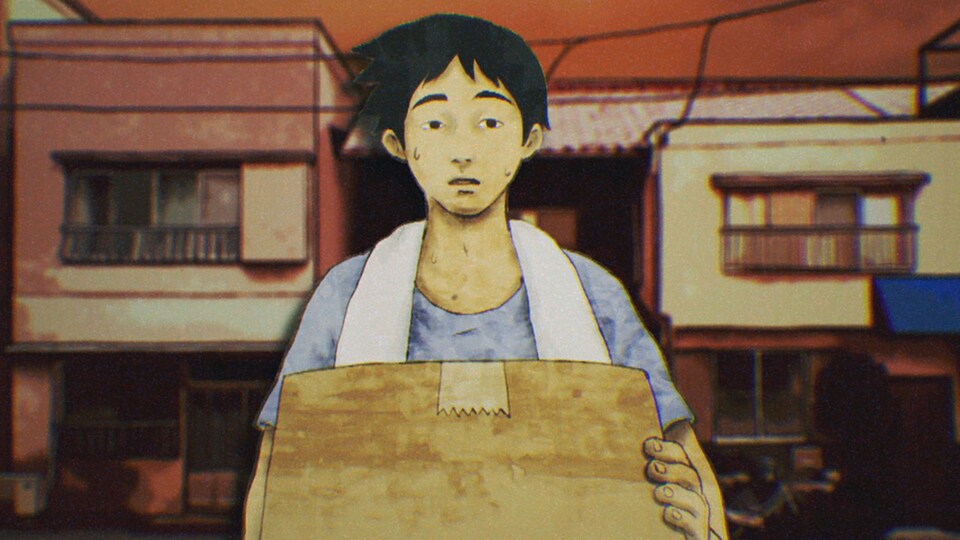
A move to a new apartment begins the first story. Original 2013 season, episode 1. (C)「闇芝居」製作委員会2013 A student moves into an apartment and finds a talisman on the ceiling. A woman across the way seems to watch him. The opening has given him an object and a person, but no reassuring way to connect them.
Why try it: the original season’s digital paper theatre makes the storyteller’s selection of a few details central. A move, an unsettling farewell or a family custom can carry a complete incident. Choose it when you want the feeling of being told something strange rather than learning a large fictional world.
What sets it apart: brevity leaves less room for character history or a complete explanation of the folklore. That can be the sting of an urban legend, or a frustration if you want answers. Begin with the 2013 season’s episode 1; thirteen nominal five-minute tales let you try a few without committing to later seasons.
Vanity, ambition and the grotesque
Junji Ito Collection
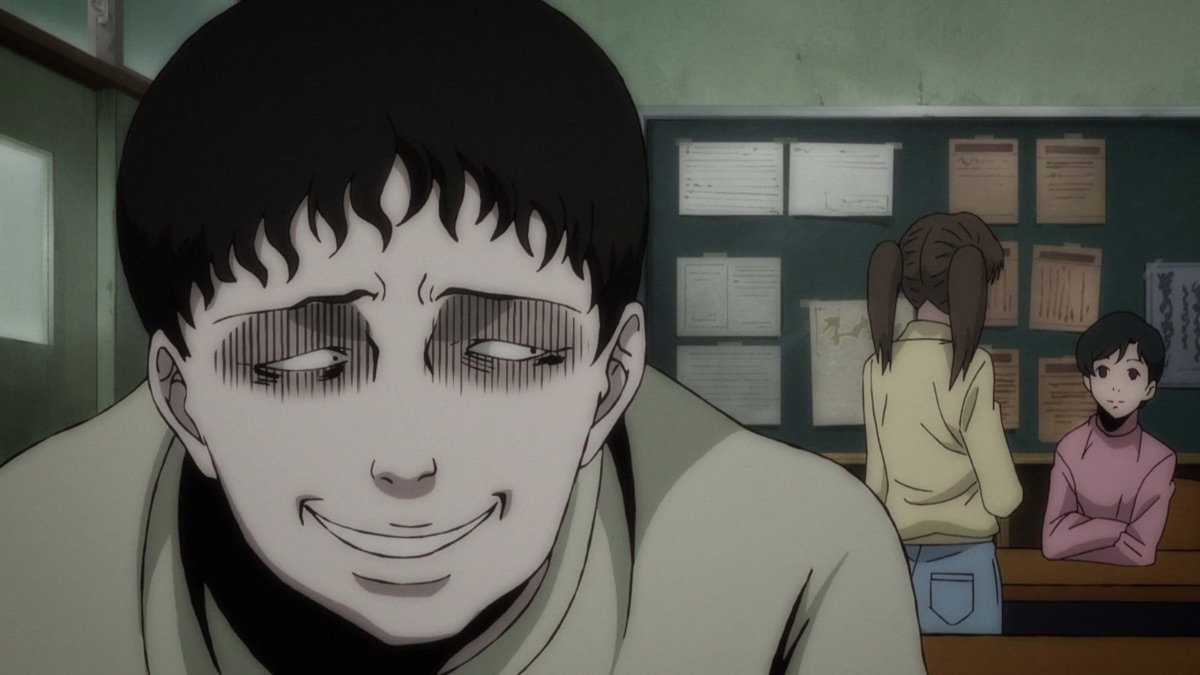
Souichi's self-importance begins in an ordinary classroom. Junji Ito Collection, episode 1. © (C)伊藤潤二/朝日新聞出版・伊藤潤二『コレクション』製作委員会 Souichi, a resentful schoolboy, imagines curses as a way to put other people in their place. A university film group’s ambition leads it to hire a model one student already finds disturbing. Ordinary desires give these short nightmares people to work on.
Why try it: the 2018 anthology keeps changing the source of unease. A character’s absurd self-importance can sit beside bodily revulsion or an ominous encounter; there is room for grotesque humour as well as straightforward fear. Try it if switching premises is part of the evening’s fun.
What sets it apart: an animated selection is a particular adaptation, not a substitute for every quality of Ito’s manga or a promise that every story lands alike. Start at TV episode 1 and sample the mixture; the twelve-episode main run is separate from Tomie extras, Junji Ito Maniac and Uzumaki.
Read our feature: Junji Ito Collection: a nightmare gets the part
Want to follow people as their world changes?
Beauty with a troubling history
Mononoke (2007 television series)
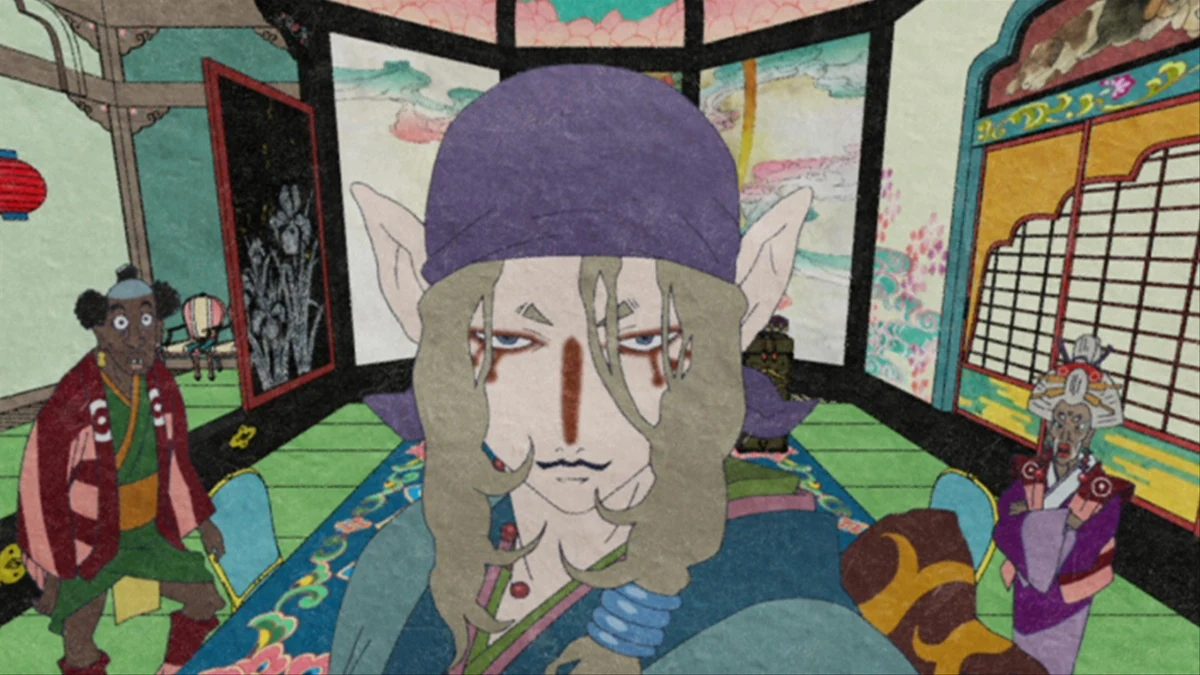
The Medicine Seller's investigation enters a room dense with colour and pattern. Mononoke, 2007 TV series. © 2007 mononoke committee A pregnant traveller needs an inn room. On a different journey, a ship loses its prescribed course. The Medicine Seller enters both kinds of trouble with a sword that requires the human circumstances and feelings behind the haunting before it can be drawn.
Why try it: the richly patterned 2007 series gives you an investigator to follow and different groups of people to understand. Its five cases combine the satisfaction of an enquiry with images that make the room or voyage worth examining. Choose it for curiosity and stylised unease as much as overt shocks.
What sets it apart: ornate colour does not mean gentle subject matter, and the stories ask for attention to testimony and emotion. Begin with the two-part Zashiki-warashi case, then continue through twelve episodes. The earlier Ayakashi Bakeneko and later Mononoke films are separate stories.
Read Mononoke (2007 television series) introductionA school puzzle with violent interruptions
Another (2012 television series)
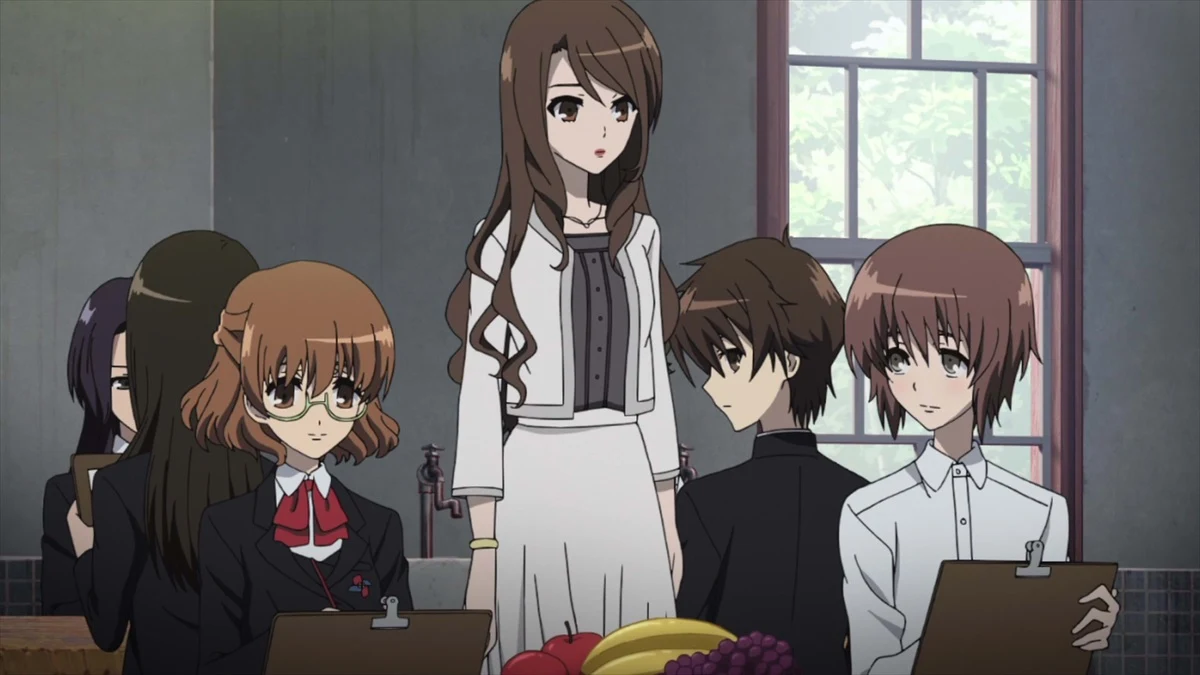
An ordinary school setting holds the class's unexplained unease. Another, 2012 television series. (C)2012 綾辻行人・角川書店/「Another」製作委員会 Kouichi meets Mei in hospital before joining her class a month late. His new classmates can be friendly without mentioning her. Curiosity about one quiet pupil puts ordinary school relationships under a pressure he does not yet understand.
Why try it: the 2012 series offers an ongoing question about a frightened class, then makes ordinary actions and objects feel dangerous. Choose it if you want to keep following a mystery while anticipating the next abrupt turn into accident horror.
What sets it apart: its increasingly emphatic violence can be the attraction or the point where atmosphere turns into excess. It is a poor fit for a night of gentle ghostliness or for somebody seeking only a restrained puzzle. Start with episode 1 of the twelve-part TV run; leave the separate episode 0 prequel until afterwards.
Read Another (2012 television series) introductionA whole village under pressure
Shiki

The opening introduces Sotoba's residents before the deaths can be explained. Shiki, episode 1. ©小野不由美・藤崎竜/集英社・屍鬼製作委員会 A doctor looks for a cause as unexplained deaths accumulate. A priest who writes novels, teenagers who want the city and a conspicuous new household see different parts of the same isolated village. Sotoba is already full of conflicting desires before its crisis has a name.
Why try it: the 2010 series makes an ensemble’s friendships and obligations part of its horror. A village can gradually become a community whose people you recognise, so fear affects more than an investigator’s next clue. Choose it when you want the evening’s mystery to open into a longer human conflict.
What sets it apart: learning households asks for patience, and the later story becomes graphically violent. Begin with the 22 broadcast episodes. The full catalogue package adds two unaired 2011 stories; together they are 24 episodes at an approximate 23-minute estimate, rather than a single-night casual sample.
Read Shiki introduction
Want an intense film about being watched?
The terror of somebody else claiming your life
Perfect Blue
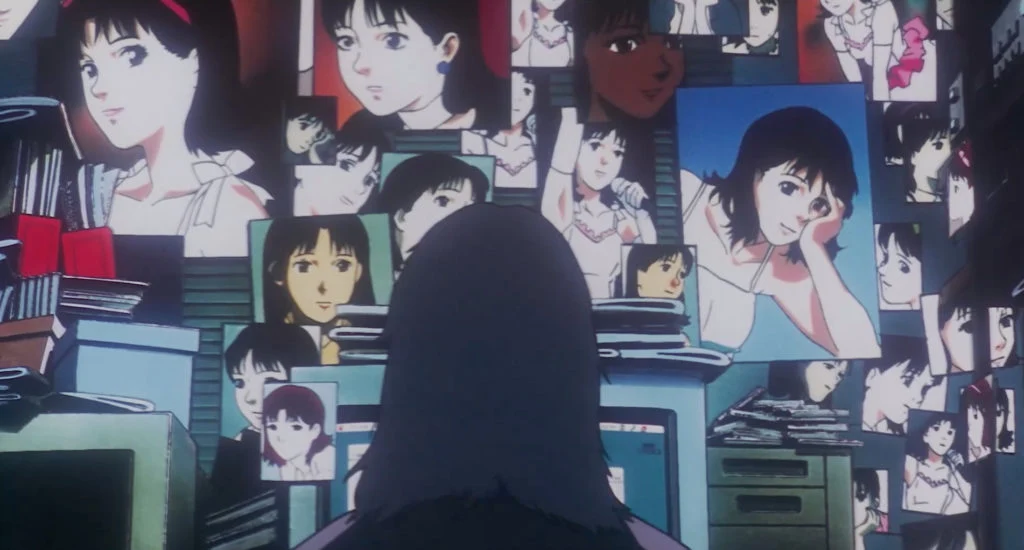
Mima's public image fills the wall around a figure whose face is turned away. Perfect Blue, original animated film. © 1997 MADHOUSE Mima leaves a pop-idol career for acting. An obsessive admirer and a website apparently recording her private life make the distinction between the person and the image other people want increasingly threatening. Her work and her sense of herself become difficult to keep apart.
Why try it: Satoshi Kon’s 1997 film concentrates the night around one person’s unstable experience. The threat is intimate: a performance, a screen or an apparent everyday moment can complicate what we think we know. Choose it for psychological pursuit and questions of identity rather than supernatural lore.
What sets it apart: the film includes sexualised violence, assault, nudity and bloody murder. Its intensity is not a family-Halloween default. Allow roughly 82 minutes for the BBFC-listed edition of the original film; some editions add extras. It is a complete one-film choice, so a continuing TV mystery is not required.
Read Perfect Blue introduction
How much should you start tonight?
If you want to finish an encounter before deciding whether to continue, try a few original-season Yamishibai stories or an episode of Junji Ito Collection. The difference is not simply five minutes against a television slot: one concentrates a small urban-legend situation, while the other can change characters and premises within an episode.
For a longer story, Mononoke’s opening two-part case offers a natural first stopping point. Another asks you to follow one classroom mystery across its run. Shiki gives its larger cast time to make Sotoba feel inhabited. Perfect Blue supplies the complete film when you want a story with an ending tonight. Those are different invitations, not rungs on a scale of how serious a viewer you are.
What if you like the idea but not its treatment?
An anthology gives you more than one chance to discover that difference. In a Junji Ito Collection discussion, Acceptable_Band5199 values the range from creepy to frightening. A separate adaptation discussion asks what animation contributes when a manga’s detailed image changes. Both are useful questions for a sample: are you enjoying these characters and premises, and is this version’s way of presenting them doing enough for you? You do not need to turn a choice for tonight into a verdict on all of Ito’s work.
For a continuous mystery, leaving a question open can be the attraction. Another combines that curiosity with much more emphatic physical shocks; Mononoke repeatedly brings its enquiries to a case boundary. Perfect Blue concentrates uncertainty around Mima’s experience. Choose whether you want new beginnings, a sequence of cases or one sustained pursuit, as well as how much violence you want to watch.
Would you prefer Halloween without a horror night?
A seasonal mood can mean costumes, monsters, autumn or playful fantasy rather than fear. One Reddit Halloween discussion pairs frightening suggestions with gentle witch stories and a film chosen for its decorations; that range is a useful reminder to choose the experience you actually want.
For a spirit-world alternative already covered here, Spirited Away follows Chihiro into a bathhouse where work, hunger and a wish to rescue her parents shape the adventure. Its wonder comes with frightening transformations, so the word fantasy is not an age recommendation.
Sources
Episode pages, film sources and audience discussions contain later events. The selections above reveal opening situations, not case solutions, named deaths or endings.
- Bandai Channel: original Yamishibai and first episode, TV Tokyo’s original story summaries: digital paper-theatre identity and opening situations.
- Junji Ito Collection: first and second episodes: Souichi and the model/film-circle situations; main story index: exact 2018 run.
- Mononoke licensed 2007 record, Fuji opening and licensed sea-case setup: sword, cases and human situations.
- P.A.WORKS: Another and licensed opening: exact TV production and relationships; Australian Classification: violence guidance.
- Shiki official introduction, characters and release information: village, ensemble and episode package.
- GKIDS: Perfect Blue, BBFC: identity, premise, running time, craft sources and adult content.
- Reddit’s Halloween-vibes discussion, particularly the seasonal-film response: different reader wishes, not a representative popularity poll.
- Studio Ghibli: Spirited Away: the separate fantasy film.