
A paper talisman is stuck to a new apartment’s ceiling. Across the way, a woman appears to be watching. In Yamishibai: Japanese Ghost Stories episode one, those are two pieces of evidence, but they do not yet explain one another. Is the paper warning of a danger, causing it, or simply part of an apartment Ito does not understand? The gap between clue and explanation is where the story can hold attention.
That is one useful way to approach the original 2013 season: ask what each tale lets its audience know, and when. TV Tokyo calls the series “digital paper theatre” and describes its subject as urban-legend-like stories. The phrase points to more than a short running time. A teller presents an incident to an audience; the incident can be shaped around a few chosen details, and the audience has to decide what those details mean.
What does the storyteller place between us and the story?
Kamishibai presents picture cards in sequence with a teller. Its basic arrangement makes telling visible: a person offers images and words to listeners gathered for a story. Yamishibai carries that relationship into a television anime, as its original-season title art makes plain.
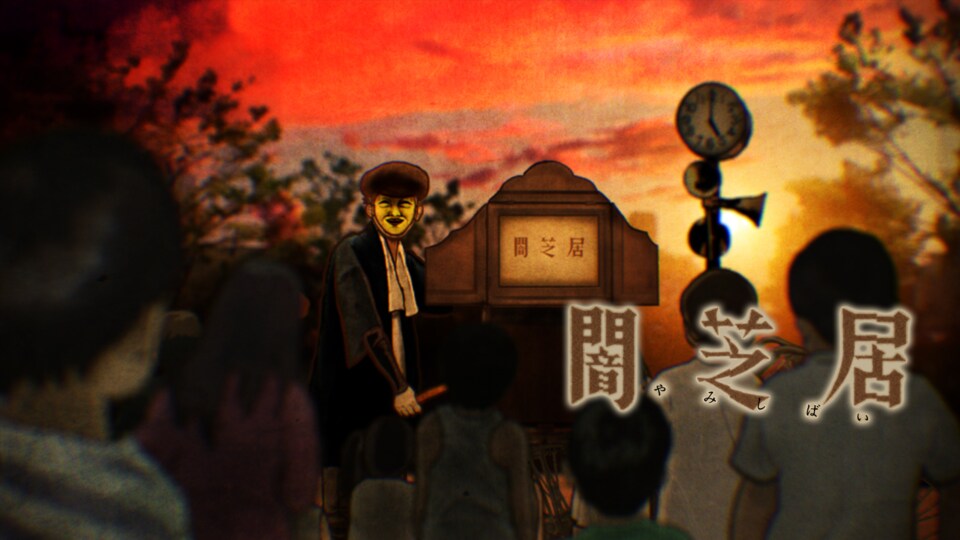
The frame gives a viewer a double position. We are listening to an account, but we are also invited to inspect the signs the account has selected. That can make the audience an interpreter rather than a passenger waiting for a large world to be explained. The frame alone does not make a story frightening; what matters is how the incident parcels out what can be seen, inferred or still misunderstood.
When do two clues refuse to fit together?
Ito, the university student in “Ofuda Onna”, has found a talisman and a watcher without knowing what either wants from him. These details create different kinds of uncertainty. The talisman looks placed for a reason; the woman looks like she may know that reason. Yet neither clue, at first, tells Ito or the audience what the other means.
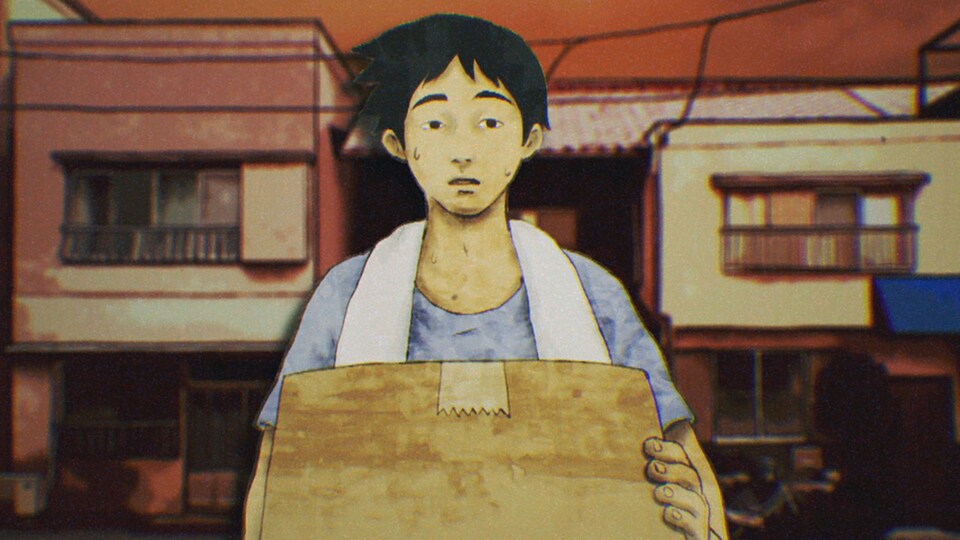
A move is a practical beginning: carry the boxes, enter the room, start living there. The talisman turns that routine into a question about who occupied or watched the place before Ito arrived. The neighbour’s gaze offers a possible source of knowledge, but it does not make her intentions clear. One clue seems to point towards an answer while making the other harder to read.
This is a compact story engine. It does not need to establish a long backstory before a viewer can weigh the evidence. The home, the object and the person opposite are enough to make a small set of relationships matter. The point is not simply that the apartment becomes strange; it is that each new fact could revise the meaning of the last.
What happens when a familiar gesture is hard to read?
Episode two, “Zanbai”, changes the kind of uncertainty. Its protagonist, Inoue, is injured on a business trip in a rural village and kept overnight in hospital. Other patients watch him and whisper. When he is discharged, they appear on the hospital roof making a gesture that resembles a celebration. The gesture stays suspended between a welcome and something less reassuring.
The audience can recognise the social form before it knows the social meaning. A farewell can look kind; the same raised arms can feel alarming after the watchers’ earlier behaviour. This is a different use of limited information from episode one’s linked clues. The tension comes from having a familiar signal whose context is incomplete. The viewer is not only asking what is present, but whether an ordinary interpretation can still be trusted.
Can an explanation make a family more unsettling?
Episode three, “Family Rule”, offers a useful counterexample to the idea that horror must keep every cause hidden. Toshiharu returns to the countryside with his parents. His father insists that he sleep alone that night. Later, Toshiharu hears laughter, opens a sliding door and sees relatives laughing together. The laughter is a family ritual intended to keep spiritual beings away.
Here the account does provide a reason for the strange behaviour. But knowing the ritual’s purpose does not make the scene ordinary: a child’s private instruction, a household’s collective act and the supernatural threat named by the custom now share one frame. The explanation changes the question from “what are they doing?” to “what danger makes this make sense, and what happens when the rule is interrupted?” The tale has supplied context without dissolving unease.
What can this short form leave unresolved?
The original season is a set of thirteen short stories, rather than one investigation that must explain every mystery. That makes it easy to enter through one incident and then meet a different arrangement of clues in the next. The trade-off is that a concentrated premise can carry more weight than its characters’ histories or a larger supernatural system. Some viewers will find that focus inviting; others may want more development, firmer answers, or an explanation of the folklore behind the haunting. A ghost story can stage an encounter without explaining its supernatural rules.
In a discussion about whether the series explains Japanese ghost stories, engalleons, who explicitly watched season one, draws attention to what its brevity and paper form leave out. kaonashishonen likes the look but finds some tales generic. Their reservations identify two different expectations: an encounter that lingers, and an account that explains. Recognising the theatrical form does not require finding every story equally satisfying.
The paper-theatre frame makes a promise of an encounter, not an encyclopaedia. The talisman asks you to wonder what a new home contains; the farewell makes a friendly gesture difficult to read; the family ritual puts a child outside knowledge the adults share. Each tale gives its audience a different kind of uncertainty to carry away.
Sources
- TV Tokyo: original-season stories and episode summaries, for the original-season situations in “Ofuda Onna”, “Zanbai” and “Family Rule”. The page goes beyond these setups.
- TV Tokyo: series framing and staff/cast, for the official “digital paper theatre” framing and original-season credits, including general director Tomoya Takashima, scriptwriter Hiromu Kumamoto and animation studio ILCA.
- TV Tokyo: 2018 series release, for the broadcaster’s description of the series as a digital presentation of kamishibai and urban-legend horror. This is a later series overview, used only for the broadcaster’s framing, not as evidence for the original season’s individual stories.
- Asian Art Museum: Telling Tales with Kamishibai, for the conventional picture-card theatre and storyteller context.
- Bandai Channel: original-series title, for the original 2013 identity, title art and production notice.
- Bandai Channel: episode one, for its episode-one still and original-season identity.
- dAnime Store: original season grouping, for the original season’s thirteen-episode catalogue grouping and separation from later seasons.
- r/anime comment by engalleons, explicitly scoped to season one, for one viewer distinction between short ghost stories and explanations of ghosts.
- r/anime comment by kaonashishonen, for a separate view that likes the kamishibai look but finds some stories generic.