
Whose village is Sotoba?
To Megumi Shimizu, it is somewhere to escape. She wants the fashions and possibilities of the city, and notices both the city boy newly arrived at school and the grand Western-style mansion on the hill. Natsuno Yuuki, that new arrival, has his own plan to leave for university. Their shared impatience does not make them a couple: Megumi is drawn to him, while he wants distance from the place and its attentions.
To Toshio Ozaki, Sotoba is a responsibility. He is the doctor in a mountain village of roughly 1,300 people, isolated enough to have a single road to the outside. When unexplained deaths accumulate, he has to work out what is happening to neighbours he cannot simply treat as anonymous cases.
Shiki joins these lives rather than choosing one as the only important story. The 2010 anime, directed by Tetsuro Amino at Daume, brings Fuyumi Ono’s fiction to the screen through Ryu Fujisaki’s manga adaptation. Its horror grows inside a place that already has gossip, friendships, duties and people who cannot stand one another.
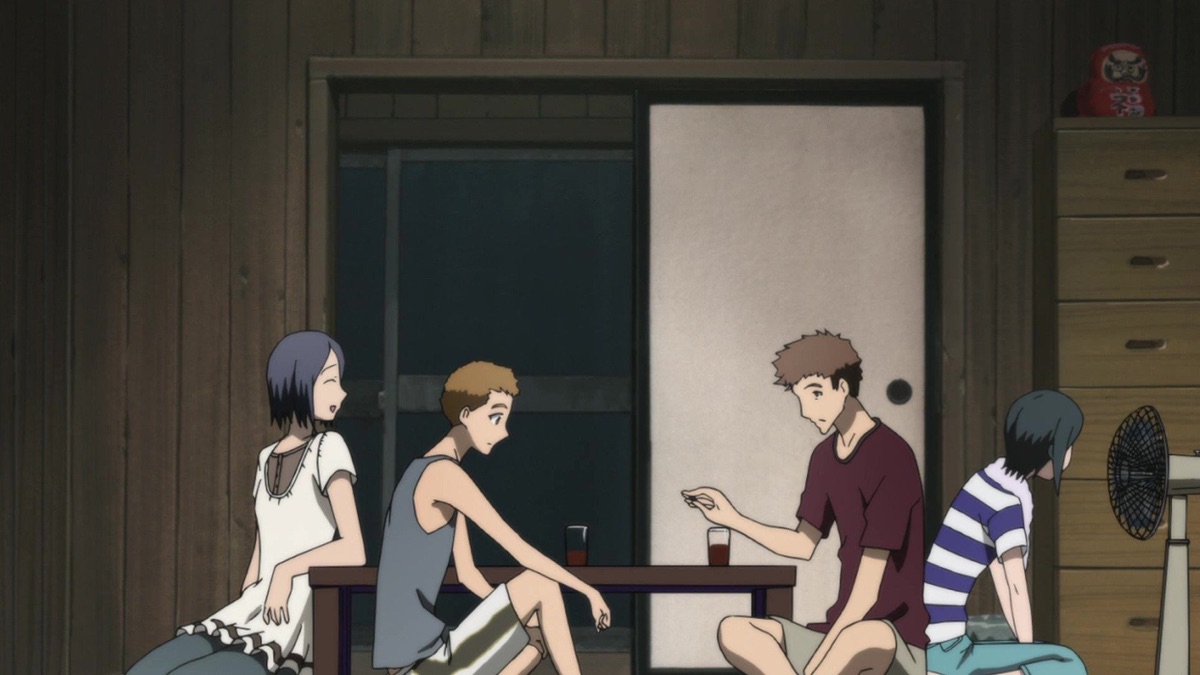
How does a familiar place become difficult to understand?
Sotoba still buries its dead. Its clinic and temple belong to the same network of households that notices a conspicuous arrival at the mansion. The opening puts that network under strain: bodies are discovered, more people die, and the possibility of an epidemic becomes a question the doctor has to investigate.
Megumi’s curiosity supplies another route into the same place. The official first-episode account follows her attention towards the mansion. She sees it through the life she wants, not through a doctor’s search for a cause. That difference is part of the story’s design: people can look at the same development and notice different promises or dangers.
The new Kirishiki household is therefore more than a suspicious shape on the skyline. Its arrival enters a village whose residents already have reasons to watch one another. The mystery gathers force as their routines stop producing reassuring explanations.
Who gives the investigation its personal stakes?
Toshio’s childhood friend Seishin Muroi helps run the temple and writes novels. Their professions bring them close to the same losses from different directions. The doctor needs a way to keep people alive; the priest’s work places him among the stories and practices through which people understand death.
Seishin also has a reader in the new household: Sunako Kirishiki, its daughter. An interest in his fiction creates a connection that the village’s gossip cannot fully describe. Someone who looks like an outsider can know something personal about a local man through the work he has made.
Among the young people, Toru Muto is an affable older pupil whose kindness reaches Natsuno despite his reluctance to settle in. Their friendship matters because wanting to leave a place does not prevent finding someone there worth caring about. The series has room for that contradiction, alongside Megumi’s more restless longing.

What is the attraction of so many viewpoints?
A large cast asks you to learn names and households. Here that effort has a purpose: a possible illness looks different to the doctor, a frightening rumour travels through families, and a teenager may recognise a connection an adult does not share. Nobody has to see the whole picture for their part of it to matter.
The official cast interview describes the movement between Natsuno, Toshio and Seishin as different ways into an ensemble drama. It is a useful expectation for a first watch. The series builds pressure through people continuing to live beside one another, not solely through the speed at which a single investigator solves a clue.
If you enjoy a setting becoming a community of recognisable lives, that accumulation is the invitation. If you want an immediate procession of isolated scares, the attention paid to households may ask for more patience. The deaths make the enquiry urgent; the relationships explain why an answer alone will not make everything simple.
How does its style sit beside the rural setting?
Fujisaki’s conspicuous hair and large-eyed faces give the cast a theatrical quality against wooden rooms and village landscapes. The designs make people easy to notice even when the community is crowded. In the cast interview, Koki Uchiyama draws attention to the mismatch between those faces and the setting’s old customs.
The music extends that sense of desire and unease. Yasuharu Takanashi composed the score; the first opening is BUCK-TICK’s “Kuchizuke.” In the band’s official comments, Atsushi Sakurai names hunger and thirst among its images, while Hisashi Imai offers the idea of an unending night. Those stated musical starting points fit a story in which wanting another life, saving a life and fearing its loss begin to pull the same community apart.
Which episodes should you start with?
Watch the 22 broadcast episodes of the 2010 television anime in order from episode 1. The complete catalogue package adds two unaired stories issued with Japanese disc volumes 8 and 9 in 2011; these can follow the broadcast story on a first watch.
Allow approximately 9 hours 12 minutes for all 24 episodes, using the established estimate of 23 minutes each. Individual extra-episode durations have not been measured. The source novel and manga are separate works, outside this total.
Sources
The character pages, disc descriptions and interview contain later developments and outcomes. This introduction stays with the opening mystery and relationships.
- Official introduction, first episode and character biographies: Sotoba, initial character wants, roles and ties.
- Official cast interview: Sunako’s reader connection, ensemble and attributed design account.
- Aniplex work page, staff and music: adaptation, production and musical conception.
- Official disc information, dAnime and Apple TV: package scope, duration basis and still provenance.