
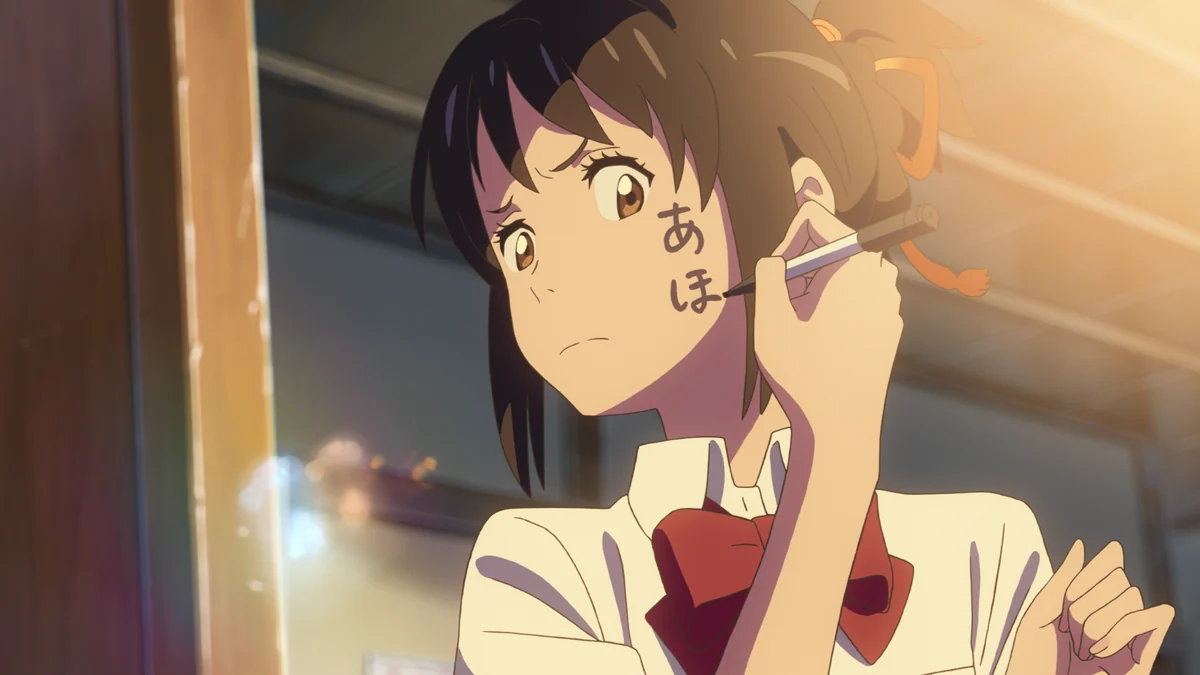
Your Name has a better romantic idea than two strangers being destined for each other: let them become responsible for each other’s ordinary days. Mitsuha and Taki start with the alarming fact of swapping bodies. They move on to something more revealing: discovering what the other person has spent, said and interfered with while they were away.
That is the film’s strongest argument for their connection. Messages and mistakes give attraction a practical foundation. Its weakness is the speed with which it asks that foundation to bear a much larger romantic weight. Across the complete 2016 film, the ordinary detail remains more persuasive than the insistence that the bond must be extraordinary.
Borrowing a life creates obligations
Mitsuha’s mountain town gives her family responsibilities and little anonymity. Taki’s Tokyo offers cafés, friends and the apparent freedom she wants, alongside school and restaurant shifts. The exchange has an immediate imbalance: his surroundings look like her escape route, while hers are a set of unfamiliar expectations he has to negotiate.
Leaving instructions changes the meaning of the premise. They have to acknowledge that the other person will return. An indulgence is no longer contained within a private dream; somebody will inherit its consequences. The romance acquires a small but credible ethical demand: take care of the life you are borrowing.
Mitsuha’s intervention in Taki’s relationship with his co-worker Okudera makes that intimacy especially awkward. She can affect his romantic prospects while knowing him chiefly through his circumstances. She learns what he wants before the pair have anything resembling a normal date of their own. The scene’s usefulness is not merely that it complicates a love story. It makes the body swap a way of knowing someone from the outside in.
This is also why the jokes about unfamiliar routines matter more than the shock of waking in a different body. The first surprise can be exhausted quickly. The consequences keep accumulating. A romance conducted through someone’s school and work life has people around it who can answer back.
Tokyo is a wish with an address
The city and countryside are more than contrasting scenery. Mitsuha does not initially want Taki; she wants access to a world he takes for granted. The film has room to move from wanting someone’s life to caring about the person living it. We can recognise the first impulse before being asked to accept the second.
Shinkai explained to Sight and Sound that the Tokyo lifestyle is idealised even where its locations are observed closely. That distinction keeps the attractive cafés from being mere decoration. They show what the city promises to someone elsewhere. Their appeal belongs to a character’s longing, not to a neutral survey of student life.
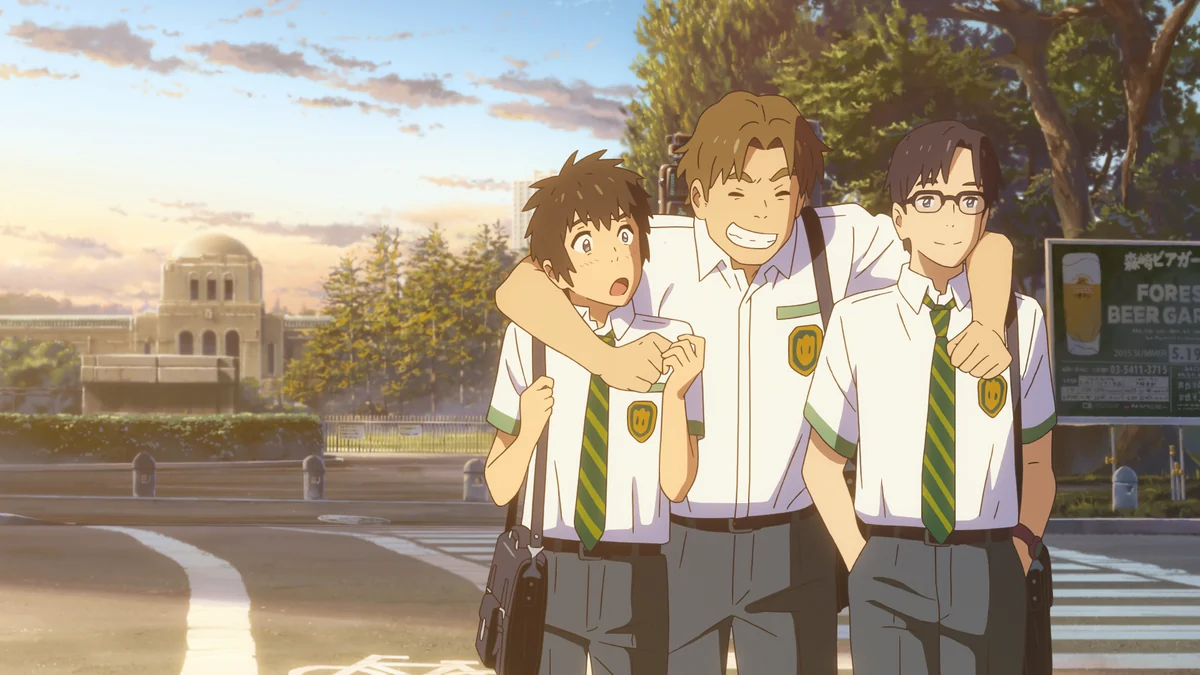
There is an asymmetry here that the romance never entirely loses. Mitsuha’s reasons for wanting another life are immediately specific. Taki’s attachment has to emerge more through the experience of the exchange. The fantasy is good at making us want a connection to continue; it is less interested in supplying a full account of how these two would manage an ordinary relationship once possibility becomes daily life.
The songs accelerate the attachment
RADWIMPS’s songs help compress repeated switches into a feeling of mounting familiarity. A succession of short incidents can feel like a shared stretch of life, even when each incident receives little time. This is an effective fit for teenagers whose access to one another is intermittent: the music supplies continuity while their days keep being interrupted.
Compression is also a shortcut. Tom Pinchuk’s Tofugu review finds the adjustment to body-swapping at times suggestive of an abbreviated series. Sam Gray at The Upcoming is more resistant to the film’s musical and emotional excess. Those reservations identify the same pressure point from different angles: momentum can tell us how intensely to feel before the relationship has earned that intensity for every viewer.
The counterargument is substantial. A romance need not establish compatibility like a practical questionnaire. Longing can be convincing precisely because it is incomplete. Your Name captures the way an absent person can become part of your expectations: someone whose response you anticipate, whose habits you recognise, whose place in your day suddenly matters. The musical rush can express that absorption rather than conceal a missing conversation.
The larger stakes test the smaller details
When the film expands beyond the comic routine, its central problem becomes harder and the emotional demands become bigger. James Berardinelli’s ReelViews review favours the clarity of the early exchanges over parts of the second half. Gray similarly finds the move towards spectacle less controlled. Their objections are worth taking seriously without treating the change of scale as a failure in itself.
The strongest case for the expansion is that it tests what the borrowed days have built. Caring about another person’s ordinary life becomes consequential. The weaker case is that a larger obstacle can substitute for deeper knowledge of the person on the other side of it. Urgency demonstrates attachment; it does not automatically demonstrate compatibility.
The film is capable of restraint within that scale. Shinkai told Sight and Sound that a later twilight scene reduces the visual contrasts he usually relies on. A quieter meeting can carry feeling that a grand landscape only announces. The most effective intimate moments leave room for uncertainty instead of insisting that splendour must equal emotion.
The supernatural mechanics demand some acceptance, too. In his interview with Pinchuk, Shinkai says he shifted emphasis away from explaining the complicated narrative structure and towards the relationship. That clarifies his priority. It does not require a viewer to find every leap convincing. Readers who want a mystery’s rules to be fully legible as it unfolds may feel the film spends emotional confidence it has not yet earned.
Access is not the same as care
The repeated breast-touching gag is a more direct limitation. Taki treats access to Mitsuha’s body as an opportunity, and the film repeatedly presents it as comedy. This sits awkwardly beside a story whose better idea is that entering another person’s life creates responsibilities.
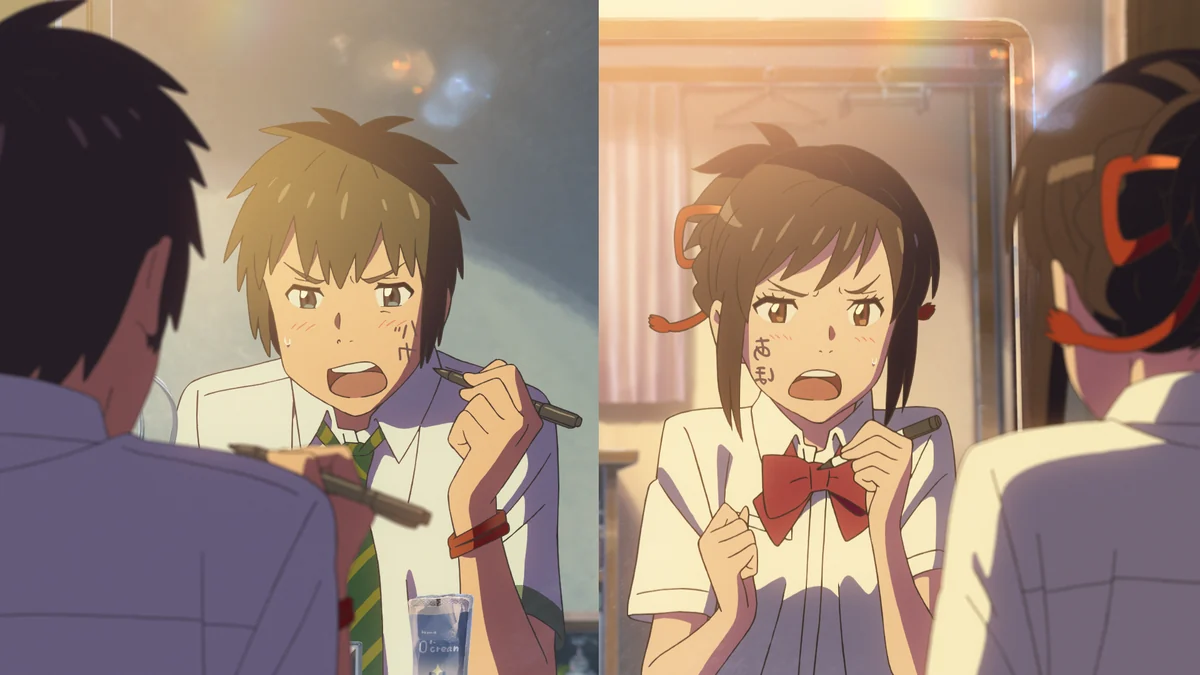
Berardinelli treats the gag as part of the early comedy’s charm. It is possible to value the same section while rejecting that judgement. Mitsuha’s body is not simply another unfamiliar feature of the surroundings, like a train route or a menu. The joke asks the audience to accept a lack of consideration that the broader romance otherwise encourages Taki to overcome.
That does not invalidate the film’s affection, but it belongs in an assessment of how the body-swap premise is used. The fantasy invites empathy more imaginatively than it explores consent or gender. Its emotional generosity is real enough to make that inconsistency conspicuous.
The everyday beginnings make the leap worthwhile
Your Name is worth choosing for the pleasure of ordinary contact acquiring extraordinary importance. Its strongest romantic material is recognisable: an irritating message, a habit discovered second-hand, a life that becomes harder to imagine without someone else’s interference.
The complete film is less certain as a recommendation for viewers who want a romance developed mainly through sustained conversation, or a mystery that explains every mechanism. It offers an exhilarating fantasy of attachment with some shortcuts attached. The borrowed days are what give that offer substance.
Sources
The official film site establishes the characters, repeating swaps and credits. The BBFC’s UK record lists 106m26s editions and details sexual body-touching jokes, language and peril. Both reveal more plot than this review.
Creator explanations come from Nick Bradshaw’s Sight and Sound interview, originally published in the December 2016 issue, and Tom Pinchuk’s Tofugu review and interview from February 2017. The latter also discusses the compressed body-swap montage.
Critical counterpoints draw on James Berardinelli at ReelViews and Sam Gray at The Upcoming. These assess later developments and contain major spoilers. The argument about responsibility through borrowed routines, and the reservation about consent, are this review’s readings of the described scenes.