
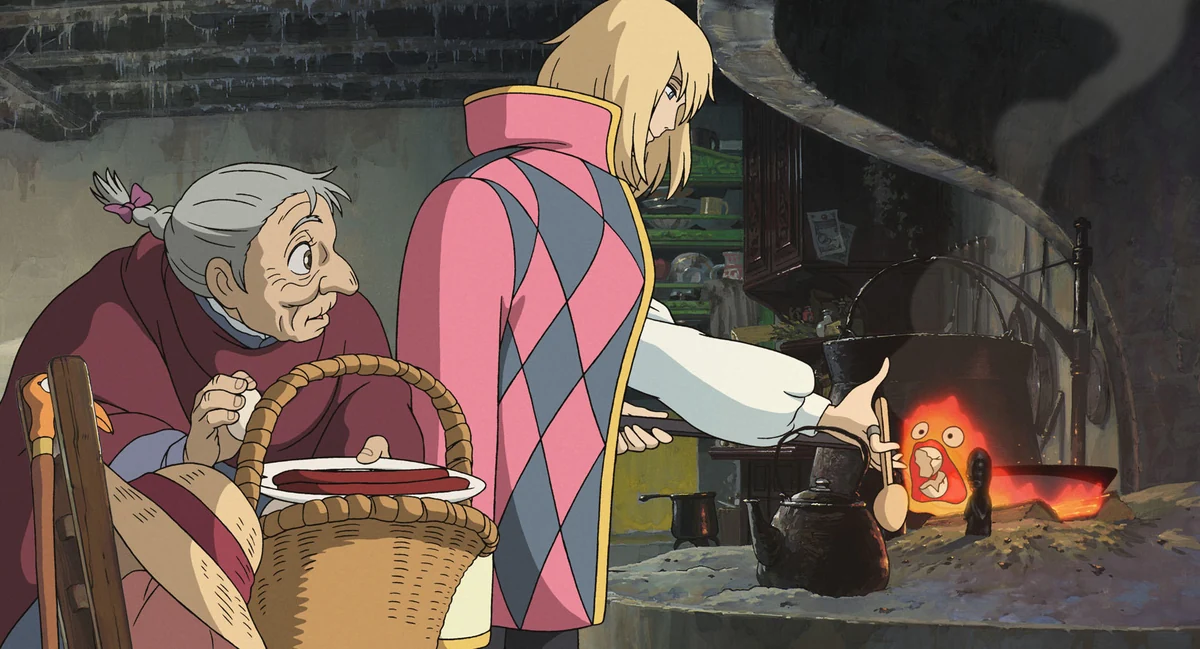
A plate of bacon and eggs is easy to admire in isolation. Put it back inside Howl’s Moving Castle and a more interesting question appears: why does a house with plenty of food need a newcomer to get breakfast organised?
In that film, My Neighbor Totoro and Spirited Away, meals are small tests of relationships. Somebody has to prepare them. Somebody decides who is welcome. Eating together can mark the beginnings of a home; helping yourself can mean you have misunderstood where you are. Looking at the work and the invitation makes these three meals more interesting than a collection of delicious-looking dishes.
Who gets breakfast started in Howl’s castle?
Sophie arrives in a home where enchantment is easier to find than an ordinary routine. Howl is a wizard, Markl his young apprentice, and Calcifer the fire demon whose cooperation makes cooking possible. Markl expects a cold meal because Calcifer normally obeys Howl. Sophie puts a pan on the reluctant fire anyway; Howl arrives and takes over the cooking, feeding eggshells to Calcifer.
Each person has a role before the household has agreed what they are to one another. Sophie initiates; Howl cooks; Calcifer supplies the heat while protesting his treatment. The hearth has a voice, so even the fuel can object. Domestic work becomes a negotiation the audience can follow inside a much stranger magical arrangement.
Natalie Chudnovsky’s MovieMaker essay reads Sophie as a stabilising presence in this untidy household. The breakfast supports that interpretation, but it is worth separating competence from servitude. Sophie can make a home more liveable without the audience having to conclude that cleaning up after a wizard is her natural purpose.
Howl’s ability to take over the pan is the useful complication. The problem is not that nobody else can cook. A capable person has allowed an unreliable routine to persist. That makes the scene funny and affectionate without turning it into proof that the household is already working well. A plentiful kitchen tells us what is available; a prepared breakfast tells us that someone has acted.
What does Satsuki’s packed lunch make possible?
In My Neighbor Totoro, the sisters’ mother is in hospital and the family is settling into a country home. Satsuki, the older child, prepares a bento, a boxed meal. Its neatness can look like a small emblem of happiness. In context it also records a child’s practical contribution to a family under strain.
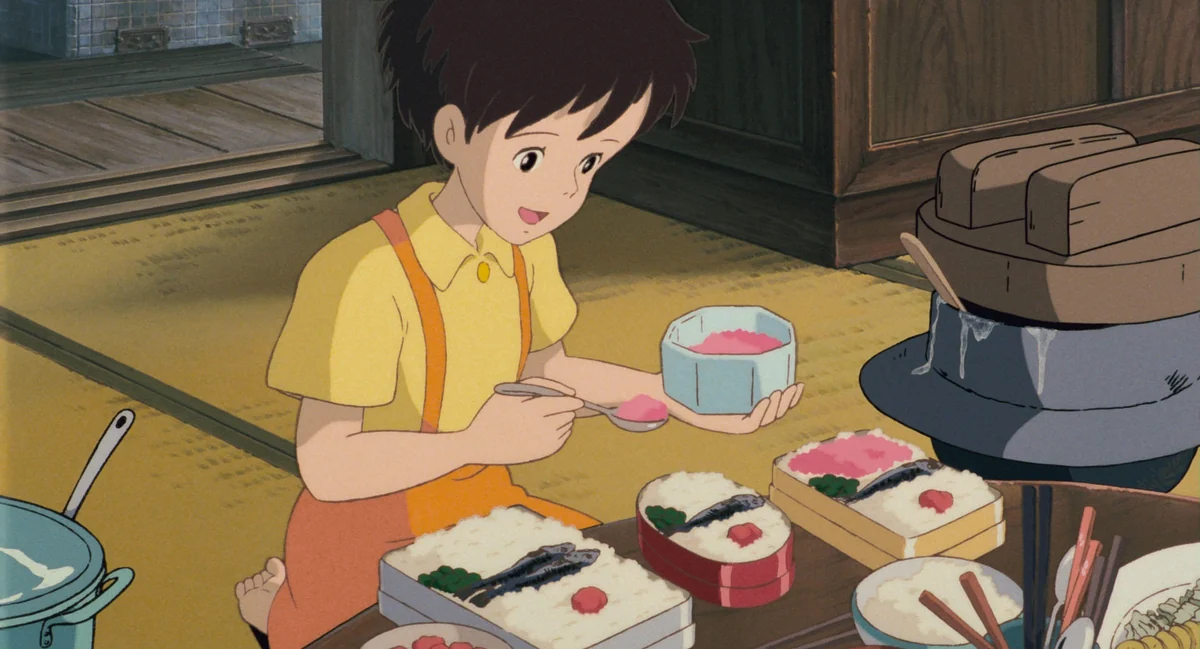
There is no temperamental magical hearth to negotiate here. The contrast with Howl’s household is useful: Satsuki’s work does not need a comic obstacle to matter. It lets an ordinary day proceed while the larger worry remains unresolved. School, hunger and looking after a younger sister do not wait for the adults’ problems to become manageable.
The Ghibli Museum’s exhibition on animated meals recreated Satsuki and Mei’s kitchen, giving the preparation space the same attention a visitor might expect for a more spectacular fantasy location. That is a good way to look at the film itself. The forest is a place of discovery; the kitchen is a place where someone makes continued daily life possible.
Admiring Satsuki’s capability need not mean idealising her burden. She is still a child, and a well-packed meal does not establish that she is unworried or needs no care herself. The image holds both things at once: pleasure in a task done well and awareness of why this particular person is doing it.
When is eating a welcome in Spirited Away?
This section reveals the early consequence of Chihiro’s parents eating at the deserted food stalls.
The parents find an abundant meal, start eating without an invitation and become pigs. Later, Haku gives Chihiro rice balls, and she cries while eating. The distinction is not simply extravagant food versus plain food. One meal is taken; the other is offered by someone who has noticed a need.
The feast has to look appealing for the temptation to make sense. Chihiro’s parents do not walk into a visibly repellent trap. They assume that an available meal can be theirs, without understanding whose place they have entered. Appetite becomes a poor guide to the rules of an unfamiliar world.
Haku’s offer changes the relationship around eating. Chihiro does not have to pretend she is managing well before receiving help. The Ghibli Museum connects her rice-ball scene with recovering courage; its account also attends to the physical act of crying with a mouthful of food. Relief is not tidy. She can need nourishment and be overwhelmed at the same time.

This is a more precise account of hospitality than saying food always makes Ghibli worlds safe. The same film offers appetite as both danger and support. To understand which kind of meal this is, we need to know who has provided it, who is entitled to it and what passes between the people involved.
Does comfort hide the work behind it?
The three meals resist a single moral about good food. Howl’s extravagant breakfast can help a household form; abundance is not inherently suspicious. Satsuki’s lunch can be lovingly made while its maker still needs care herself. Chihiro’s rice ball can be comforting without resolving the situation that made her cry.
The attractive plate captures a result. The scene restores the time, work and uncertainty that produced it. Those details prevent comfort from becoming an empty atmosphere. A home feels welcoming because people do things there: start the fire, prepare the lunch, notice that somebody has not eaten.
On a return visit to these films, watch what happens before the first bite. Who is expected to serve, and who volunteers? Can the cook refuse? Is the food shared, offered or simply claimed? These questions keep the pleasure of the meal while revealing the relationships that make each one distinct.
Sources
Film identities and official still galleries: Studio Ghibli’s Howl’s Moving Castle, My Neighbor Totoro and Spirited Away.
The museum’s Delicious! Animating Memorable Meals exhibition documents the breakfast, rice-ball scene and reconstructed kitchen. Its interpretations are identified above. Natalie Chudnovsky at MovieMaker describes the breakfast’s actions and argues for Sophie’s stabilising influence; that essay reveals later events.
El País’s essay on food in anime supplies the Satsuki lunch example and discusses the parents’ feast. Sandie Angulo Chen’s Common Sense Media review of Totoro provides the family context. Both discuss later events. The comparison of labour, permission and welcome is a reading of these selected scenes, not a claim about every Studio Ghibli film.