
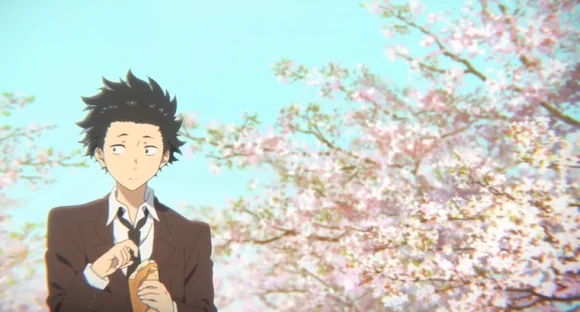
A classroom can make somebody an outsider long before its members admit what they are doing. When deaf pupil Shoko Nishimiya joins a new school, other children turn the effort of communicating with her into an excuse for cruelty. Shoya Ishida takes part. Years later, isolated himself, he seeks her out.
A Silent Voice is a strong choice if you want a drama about what happens after harm has been done: the awkwardness of contact, the desire to apologise and the difficulty of seeing another person clearly through your own guilt. Allow about two hours and ten minutes for the 2016 film, with no earlier viewing or reading required. Its delicate drawings are not a promise of a gentle evening: bullying and suicidal distress are central concerns.
What makes the reunion difficult?
The school setting matters because the damage is social. Shoko wants to join in; her classmates can make space for her or treat communication as an inconvenience. Shoya’s harassment includes targeting her hearing aids. Other children participate in the exclusion, then turn on him when the bullying comes under scrutiny. Becoming an outsider does not erase his part in making someone else one.
By high school, Shoya has lost the easy place among his peers he once enjoyed. Finding Shoko brings the past into the present, but an apology cannot dictate its reception. The person he hopes to help has a life beyond his need to feel forgiven.
That tension distinguishes the film from a simple lesson about being kinder. Responsibility is harder than recognising that you behaved badly. It involves listening to someone whose experience you have already misunderstood, and accepting that regret may not make you a reliable judge of what they need now.
Who is trying to reach whom?
Shoya is the main viewpoint character. His shame affects where he looks and how he approaches people; the film often stays close to his difficulty making contact. Shoko, meanwhile, has learned to smile through uncomfortable encounters to avoid friction. A pleasant expression is not a reliable measure of how well a conversation is going. The difference between what she shows and what others assume gives their exchanges much of their uncertainty.
Her younger sister Yuzuru is protective. She has good reason to care about who gets close to Shoko, and her presence prevents the reunion from becoming a private arrangement between two former classmates. Shoya also makes a new friend in Tomohiro Nagatsuka. Friendship gives him something to practise in the present, beyond endlessly reconsidering the past.
The old school group remains important, too. People do not all remember their own conduct in the same way. Bringing them together can reopen a conflict instead of neatly settling it. Expect a network of awkward loyalties rather than a pair of leads whose problems disappear once they finally speak.
How does the film make communication visible?
Shoko uses a notebook and sign language to communicate. Written exchanges, signing, hesitant gestures and averted eyes make communication something the characters actively work at. The question is often whether someone is willing to attend to another person, not simply whether words have been spoken.
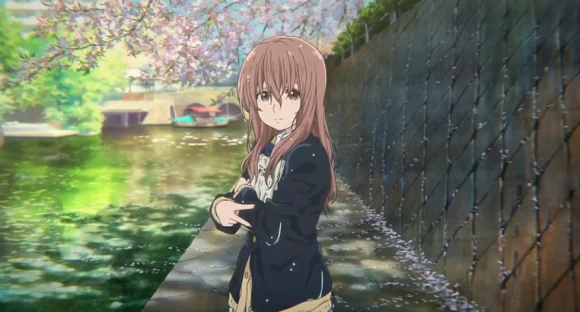
Naoko Yamada described the camera’s perspective to Anime! Anime! as following what Shoya can see and chooses to notice. In the same interview, she explained that a sign-language supervisor checked the storyboards and supplied filmed reference performances. The animators also considered each character’s personality and proficiency, so signing could function as acting as well as an accurately drawn movement.
That attention is a particular reason to try the film. A downward glance can withhold contact as effectively as an unanswered sentence. But the viewpoint also sets a limit: following Shoya’s isolation does not give equal access to Shoko’s inner life. Do not choose this expecting a comprehensive account of deaf experience. Nor should Shoko’s deafness be confused with the cruelty directed at her: the story’s relationships need repair, not a miraculous cure for the person being excluded.
Is it a romance or a comforting watch?
Affection matters, but a conventional romantic payoff is the wrong main expectation. The more persistent questions are whether these people can understand one another, face what happened and make room for a life beyond shame. Shoko is not a reward for Shoya becoming a better person, and reconciliation should not be read as an obligation placed on anybody who has been bullied.
There is humour and companionship alongside the pain. Yet the sizeable supporting group also makes this a demanding single-film story. James Berardinelli’s ReelViews review finds some classmates insufficiently developed; that is a useful reservation if you want every relationship to receive equal attention. The film’s close attention to an individual exchange can be more satisfying than its attempt to gather everyone into one narrative.
If sustained bullying, depression or suicide attempts are material you want to avoid today, choose another evening for it. These concerns are not confined to one brief sad passage. A softer-looking poster is poor guidance for this film’s intensity.
Which version should you start with?
Look for A Silent Voice / Koe no Katachi (2016), directed by Naoko Yamada, animated by Kyoto Animation and adapted from Yoshitoki Oima’s manga. Start at the beginning of that feature. The source manga is additional reading, not homework, and this introduction does not compare its treatment of the characters with the film’s.
The approximate 130-minute commitment covers the complete film. Check the audio and subtitle options on the particular edition you select; the existence of an international distributor’s page does not establish availability in your country.
Sources
The official introduction establishes the film, adaptation and reunion premise. The official character pages describe Shoya, Shoko, Yuzuru and Nagatsuka.
Andrew Osmond’s All the Anime article describes Shoko’s notebook and signing; it is published by the film’s UK distributor and discusses later emotional developments.
Runtime and content guidance follow the BBFC’s UK edition record: 129m34s for cinema and 129m40s for home release, rounded here to about 130 minutes. Its detailed advice reveals crisis scenes.
Craft and viewpoint draw on Yamada’s 2017 Anime! Anime! interview, paraphrased from Japanese, and James Berardinelli’s ReelViews review. Trevor Johnston at Time Out also discusses the school group’s complicity and the crowded narrative. These reviews discuss later events; the reservation about the supporting cast is critical assessment, not an established fact about the manga.