

In rural Itomori, family rituals and everyone knowing your business make escape seem especially attractive. In Tokyo, crowded trains, cafés and part-time work offer a very different teenage life. Your Name puts a teenager from each place into the other’s body, then makes them deal with the mess they leave behind.
Choose it for a romance that begins with practical comedy and grows into a mystery. Its particular attraction is knowing someone’s routine before properly meeting them. The complete 2016 film takes about 106 minutes and needs no preparation. It is an expansive fantasy of connection, with prominent pop songs and sudden turns, rather than a restrained account of a couple getting acquainted.
What is different about these two lives?
Mitsuha lives with her younger sister and grandmother in a small mountain town. Her family’s shrine duties make her conspicuous to classmates; her father is the mayor. Wanting to leave means wanting some freedom from being watched and judged. Tokyo represents a place where she might choose a different life instead of continually inheriting an existing one.

Taki goes to school in Tokyo and works in an Italian restaurant. The city gives him opportunities Mitsuha longs for, but it also gives him shifts, friends and expectations that an unexpected substitute cannot simply ignore. He has a crush on his co-worker Miki Okudera. Arriving in his body means entering relationships already in progress.
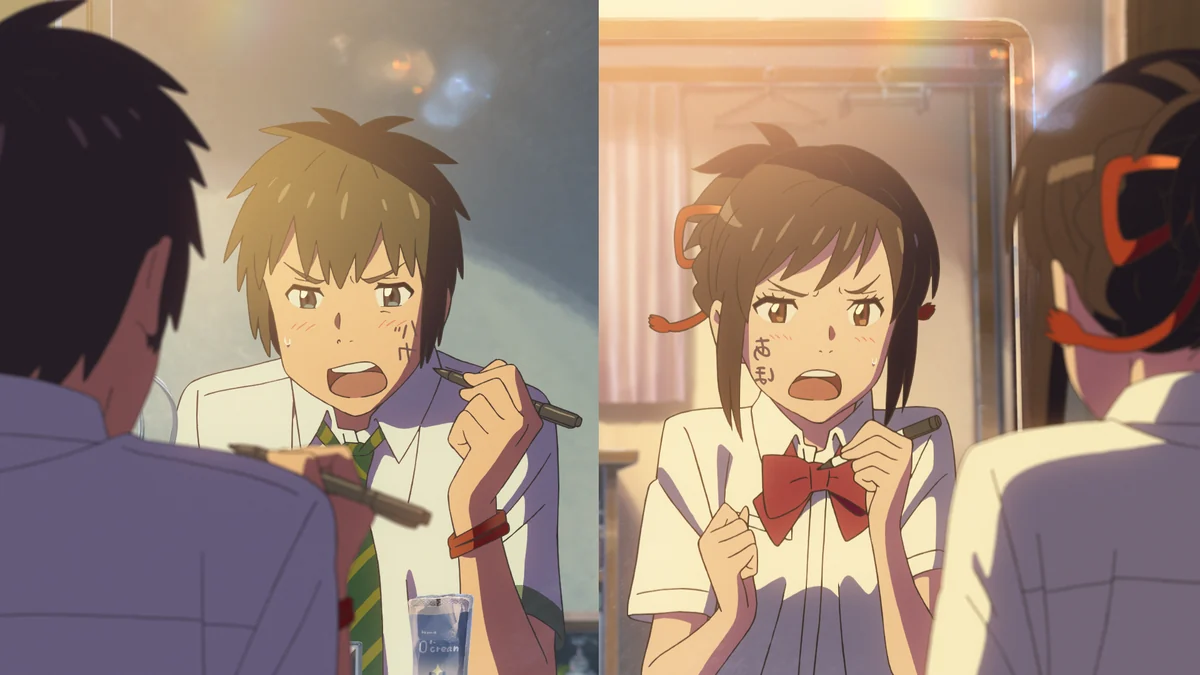
The swaps initially seem like dreams. Repetition, missing memories and other people’s reactions make that explanation harder to maintain. They begin leaving notes and rules. A day spent enjoying someone else’s freedom can produce a bill, an awkward conversation or a change in reputation waiting for its usual occupant the following morning.
Who keeps the ordinary days going?
The supporting characters give the fantasy consequences. Mitsuha’s grandmother Hitoha and younger sister Yotsuha share the shrine’s routines; her friends Tessie and Sayaka know the familiar person whose behaviour has suddenly changed. On the Tokyo side, Taki’s friends and co-workers still expect him to know how to behave. The body swap does not pause anyone else’s day.
That is what lets the premise develop beyond surprise at a mirror. Each teenager has to interpret a life from its surroundings. Who can be teased? What does work require? Which family duty is optional only in your imagination? Their mistakes make the other person more than a face or a name.
The comedy also allows affection to arrive indirectly. Mitsuha interferes with Taki’s relationship with Okudera before she can have an ordinary relationship with Taki herself. They can become unusually close while remaining strangers in some very basic ways. Whether that feels romantic or frustrating is part of deciding if the film suits you.
Why do the places and music matter so much?
The city is deliberately inviting. In Nick Bradshaw’s Sight and Sound interview, Shinkai distinguishes his carefully observed Tokyo locations from the idealised student lifestyle he puts inside them. Mitsuha’s dream of cafés and urban freedom helps explain why the exchange is exciting before it becomes emotionally complicated.
The country setting offers a different kind of attachment: family practices, familiar people and a landscape she knows even when she wants to leave it. The contrast gives the romance more to connect than two isolated personalities. Each person comes with a place, and wanting access to that place is not yet the same as caring for its inhabitant.
RADWIMPS supplies the music, including the songs. Musical passages carry the pair through repeated switches and discoveries without turning each morning into another full scene. The film likes emotional momentum. If you enjoy being swept into a romance with a question to solve, that is part of its appeal; if you prefer long conversations and a slower courtship, the acceleration may feel too convenient.
What should you know before choosing it?
The early body jokes deserve a plain warning. Taki repeatedly touches Mitsuha’s breasts while occupying her body, and the film plays this for comedy. You may find that uncomfortable even if the larger idea appeals. There is also moderate language and disaster-related peril.
The mystery changes the stakes, but explaining its mechanism would take away a substantial part of a first viewing. You need the body-swap premise, not a timeline diagram. The review explores what the romance earns and what it asks the audience to accept while keeping the central revelation and ending private.
For another romantic fantasy, Howl’s Moving Castle builds affection inside a magical household, with war outside. A Silent Voice offers a grounded attempt to reconnect after bullying; its suicide themes make it a heavier choice, not an automatically gentler alternative.
Where should you begin?
Select Your Name / Kimi no Na wa. (2016), directed by Makoto Shinkai. Its complete story fits into one evening. Other Shinkai films and the print adaptations are not prerequisites, and you do not need a shared-universe viewing order.
The 106-minute estimate is rounded from the BBFC’s listed 106m26s editions. Check the actual audio and subtitle options before choosing a stream or disc; this page does not establish current regional streaming availability.
Sources
The official Japanese film site supplies the premise, character relationships, director and music credits. Its synopsis and trailers go beyond the opening setup.
Runtime and content guidance use the BBFC’s UK record, which lists the 2016 cinema and 2017 home editions at 106m26s. The detailed advice reveals the nature of later peril.
Nick Bradshaw’s Sight and Sound interview with Shinkai informs the distinction between real locations and imagined city life. Tom Pinchuk at Tofugu and James Berardinelli at ReelViews discuss the comic routines and the film’s changing pace. All three contain later story details.