
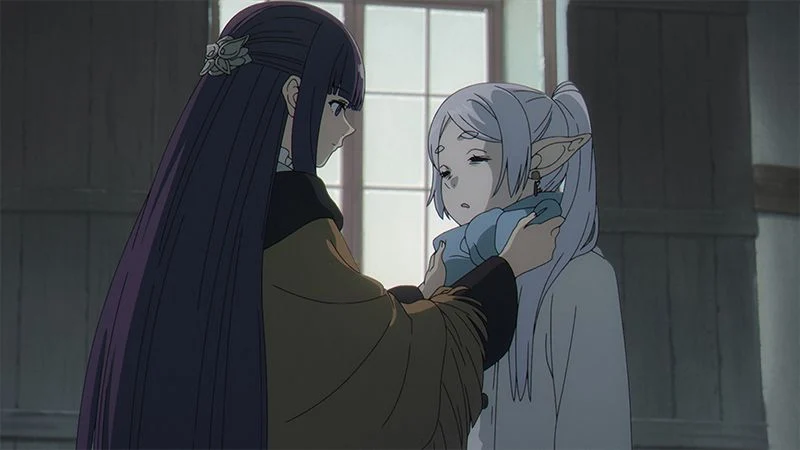
Frieren asks for two kinds of patience. On the road, it asks you to notice why a small errand matters to the person doing it. In its longer conflicts, it asks you to learn rules and wait for a tactical problem to unfold. The first is its most persuasive habit. The second gives it variety, but sometimes interrupts the closeness that makes the journey appealing.
Across the first two seasons, that makes it a strong recommendation for viewers who enjoy a recurring party’s company. It is a qualified one for anybody expecting either pure contemplation or a steady escalation of battles. The series keeps moving between those modes, and its most interesting question is whether the people remain worth following when the type of adventure changes.
Experience does not remove the need for companions
Frieren has enormous magical experience and a poor instinct for the urgency of a human life. Fern is much younger, yet her needs make time immediate. A delay cannot be treated as an insignificant fraction of a century when someone else has to spend it with you. Their teacher–pupil relationship therefore has a useful imbalance: magical authority does not settle every disagreement about how to live.
This gives the second-season opener a particularly good problem. In episode 29, the party falls into a cave containing minerals that suppress magic. Frieren and Fern cannot rely on their defining skill. Stark’s practical presence suddenly matters more than either mage’s reputation.
For Cameron C. at Anime Fire, the scene restores attention to all three companions, with Frieren’s relaxed response contrasting with Fern’s alarm. That is the useful distinction: shared danger does not make them react identically. The situation also lets a powerful lead need help without inventing a still more powerful opponent every week.
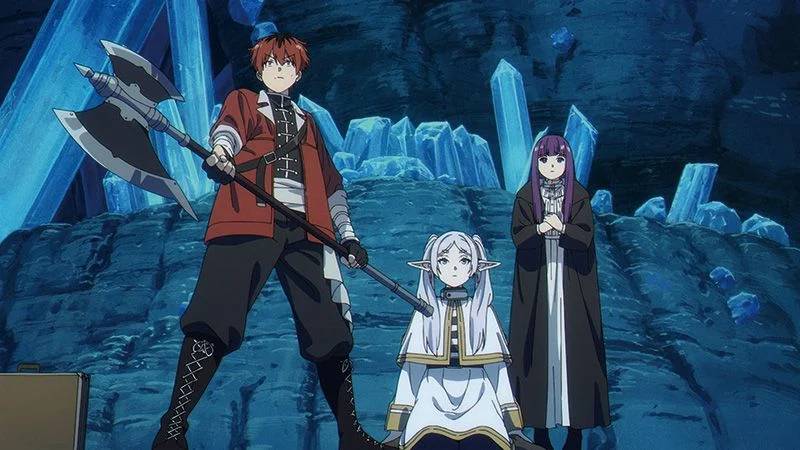
The affection is less convincing when Stark is mainly the target of the group’s jokes. Cameron C. also questions the repeated cold treatment he receives. A party can bicker affectionately, but its quieter member still needs choices and appreciation. The cave provides a better demonstration of his value than another exchange in which he is merely flustered.
The exam expands the world at a cost to intimacy
Season 1’s first-class mage exam has a clear purpose. The party needs a qualified mage to continue into the northern plateau, as the episode 18 synopsis explains. Magic acquires institutions, entrance requirements and other practitioners whose ambitions do not revolve around Frieren.
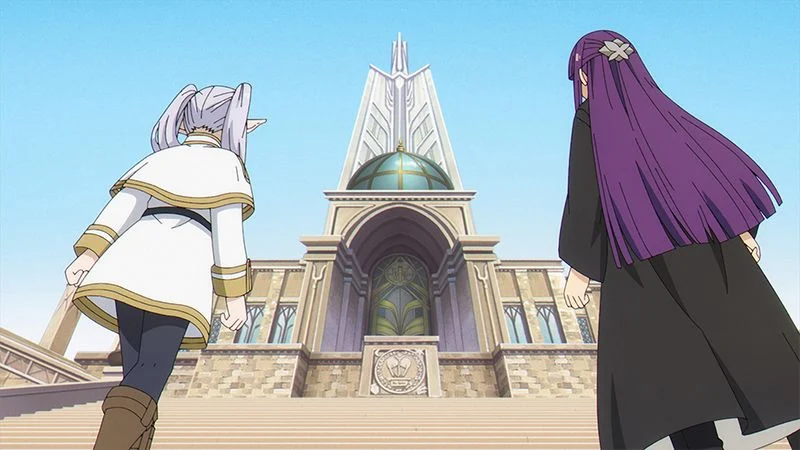
That expansion also changes the viewing proposition. A long stay among competitors replaces the movement between small communities. Learning how a spell works becomes more immediately useful than learning why one travelling companion is upset with another. The series asks you to transfer some affection to a much larger cast.
There is a good argument for the change. Charles Hartford at But Why Tho? welcomes the exam’s return to present-day concerns after repeated memories of Himmel. He points to Frieren’s new teammates, Lawine and Kanne, whose quarrelling coexists with established coordination. They have a relationship before Frieren meets them. Her world should contain people who do not exist only to remind her of an old friend.
Yet breadth is not the same as depth. Mitchell Chapman’s season-one review at InReview enjoys the expansion while finding much of the exam’s cast thinly developed. That is a fair cost to weigh against its tactical interest. If the village visits and central trio were your favourite part, the extended stop asks for a different investment rather than simply providing more of the same pleasure.
Season 2 finds several uses for a long life
The ten-episode second season is looser than the first. It offers shorter visits around a sustained conflict, rather than another long process of assembling a party and qualifying it for travel. Okami at Anime Ignite finds the individual stories less cumulative, preferring the Divine Revolte stretch and the attention it gives the previously introduced mage Genau.
That reservation should not make every small episode disposable. Consider episode 33: a dwarf’s centuries-long search for a particular drink sits beside a debt Frieren has left outstanding for eighty years. Duration can mean devotion or neglect. The same lifespan that gives the story its melancholy can also make an unpaid obligation absurdly large.
At the season’s far end, episode 38 presents a bridge a dwarf has spent more than two hundred years building. Time has become labour with a public use. 7mononoke’s Anime Rants review values the episode’s attention to both made and natural beauty. The bridge supplies a worthwhile counterweight to the idea that a long life matters chiefly because it lets someone mourn many shorter ones.
Memory works best when it changes the present
The weaker habit is the repeated use of the original party to explain a new encounter. Remembering can deepen a choice, but it can also supply its meaning too quickly. In its much more negative season-two review, Anime War Crime Tribunal singles out a sword-retrieval errand whose flashback repeats the same commission. The complaint is about insufficient difference between then and now, rather than the mere presence of a flashback.
The distinction matters. A current companion should be able to surprise Frieren, disagree with her or need something Himmel never did. When a memory gives the present an approved answer, Fern and Stark risk becoming an audience for someone else’s better-documented friendship. When the remembered experience changes how Frieren responds to their particular needs, the old journey becomes useful without consuming the new one.
The first two seasons remain worth the time. The exam supplies breadth and opposition; season 2 makes the small group necessary again. Watch for companionship changing an old traveller’s habits, and allow for a substantial tactical detour and a more episodic continuation. The story has not reached its final destination at episode 38, but it has repeatedly found something worthwhile to do on the road.
For the order, commitment and content advice, use the Frieren introduction.
Sources
The full reviews and archives contain outcomes omitted here.
- Official season 1 and season 2 archives establish the 1–38 scope. Episodes 18, 29, 33 and 38 establish the specific setups discussed.
- Cameron C., Anime Fire, 16 February 2026: season-two opening, contrasting responses in the cave and reservations about treatment of Stark.
- Charles Hartford, But Why Tho?, 12 January 2024, updated 24 March: the exam’s renewed present-day focus and Lawine/Kanne’s relationship.
- Mitchell Chapman, InReview, 2 April 2024: complete season-one judgement and the exam’s breadth/depth tradeoff.
- Okami, Anime Ignite, 1 April 2026: complete season-two judgement, preference for sustained arcs and Genau’s development.
- 7mononoke, Anime Rants, 30 March 2026: the final episode’s bridge and attention to beauty.
- Anime War Crime Tribunal, 27 March 2026: a contrary complete-season assessment, especially repetition in flashbacks. Its conclusion is more negative than this Review’s.