

How does Sophie find a home in a walking castle?
Sophie works in a hat shop in a world where witches and wizards can interfere with ordinary lives. After she meets the wizard Howl, the Witch of the Waste transforms her into an elderly woman. Leaving home to find a way to break the spell, Sophie takes refuge in Howl’s moving castle.
It is a home with a peculiar household: Howl’s young apprentice Markl and the fire demon Calcifer live there too. Sophie takes on housekeeping, becoming involved with the people she has arrived among while still carrying her own problem. Outside, war threatens this makeshift home.

Who lives in Howl’s castle?
Sophie arrives with a curse to break, but taking charge of practical work gives her a way to act immediately. Howl can perform extraordinary magic and still be vain, evasive and difficult to live with. The contrast keeps their relationship from being only a rescue by a handsome wizard: she discovers the habits behind his impressive entrance.
Calcifer powers the castle and has plenty to say about how he is treated. His needs make the household’s magic feel like something that must be looked after. Markl, Howl’s young apprentice, has grown used to this unusual arrangement; Sophie’s arrival changes the everyday routine he shares with his master. Meals and cleaning let these differences emerge without a separate introduction for every resident.
What does breakfast reveal about the household?
The castle’s magic has to coexist with the business of living in it. One early breakfast has Sophie negotiating with Calcifer to use his fire for cooking, before Howl takes over with bacon and eggs. Eggshells become a snack for the fire demon. It introduces a strange household through a recognisable task: making sure everyone gets fed.
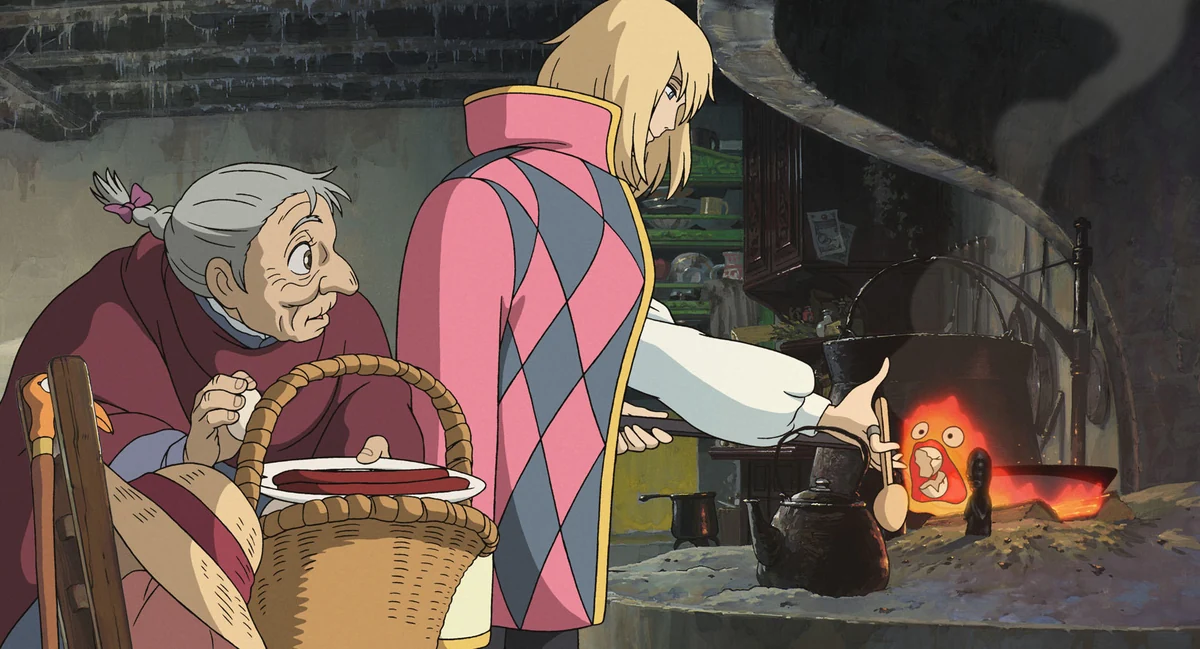
In MovieMaker’s close reading of that scene, Natalie Chudnovsky connects the meal with the home’s disorganisation and Sophie’s arrival as a stabilising presence. If you like discovering how unlikely companions live together, the castle gives you a household to get to know.
The war reaches into that domestic life. Sophie has only just found a place in the household when its inhabitants are pulled into the conflict outside. The castle offers companionship, but it cannot keep the war away.
Will its mix of romance, war and magic suit you?
Romance grows out of Sophie and Howl’s awkward shared life, while the war gives them more to contend with than a personal curse. Choose it if that mixture sounds more appealing than the sisters’ childhood discoveries in Totoro.
There is a real complication to consider: the magic is not always easy to keep straight. Common Sense Media’s review notes that the overlapping curses and disguises can be confusing. It also identifies the film’s concern with love, care and why people go to war. Choose it for those relationships and conflicts; do not expect every magical rule to be neatly explained.
Brian Eggert at Deep Focus Review also finds the plot meandering, despite admiring the setting. He objects to the castle’s visibly composited movement. The household scenes offer a more immediate reason to stay involved: who can cooperate, who avoids responsibility, and how Sophie changes their shared life.
If a rescue mission is a more immediate hook for you, Spirited Away gives its young protagonist a clear task: free her parents and get home.
Is Howl’s Moving Castle suitable for children?
The meals and odd companions can make Howl look like a gentle family fantasy, but its war imagery makes it a less comfortable choice for children frightened by explosions or threatening creatures. Common Sense Media’s US parent guide also notes an early scene in which soldiers intimidate Sophie.
For family viewing, read the detailed content guide first if those subjects are a concern.
Is it a one-evening watch?
Allow about two hours. Studio Ghibli lists the original film at approximately 119 minutes; the GKIDS disc listing rounds it to 120.
No previous Ghibli viewing is needed. Studio Ghibli credits Diana Wynne Jones for the original work, but you do not need to read the novel before watching Miyazaki’s adaptation.
Look for the 2004 animated film directed by Hayao Miyazaki.
For a shorter commitment, Totoro runs about 86 minutes. The three-film comparison compares their stories, time and intensity.
Sources
- Studio Ghibli: Howl’s Moving Castle: release, director, source-work credit, approximate runtime and official stills.
- GKIDS: Howl’s Moving Castle: distributor’s premise and 120-minute disc listing.
- Natalie Chudnovsky, MovieMaker: Breakfast at Howl’s Moving Castle: an original critical reading of the breakfast scene; contains later-story spoilers.
- Common Sense Media: parent guide: content considerations; detailed text contains spoilers.
- Brian Eggert, Deep Focus Review: independent reservations about narrative direction and the castle’s movement, alongside the domestic and war setting. Contains later revelations.