
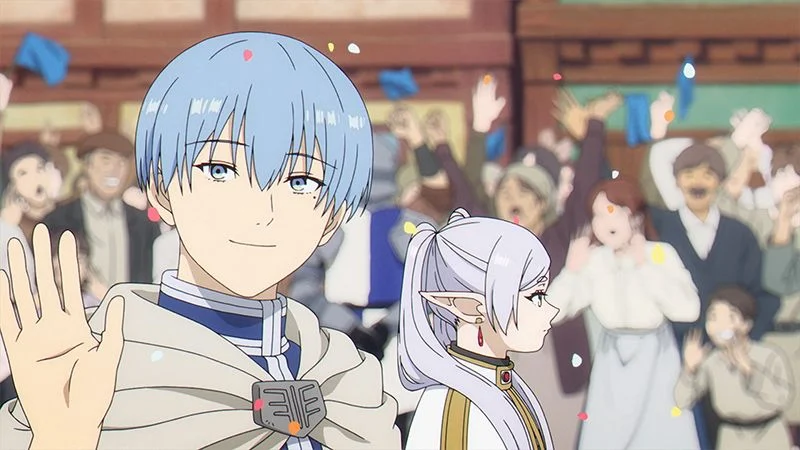
Many adventures make victory the moment when an experience becomes complete. The goal has been reached, the danger has passed and the travellers have earned their way home. Frieren begins there, then asks what success failed to teach them.
Its opening is effective because it leaves the achievement intact. The party really has defeated the Demon King. The problem is that completing a shared task does not guarantee that you understood the people who helped you do it.
Opening spoilers: this Feature discusses the reunion and its consequences, Fern’s apprenticeship and the flower errand in the first four episodes.
What does the victory leave unfinished?
Frieren returns from a ten-year expedition with companions for whom that decade was a substantial part of life. To an elf more than a thousand years old, it was brief. When she leaves again and returns fifty years later, her appearance scarcely registers the interval. Himmel has grown old.
His subsequent death exposes something the defeated enemy never could: her lack of attention. She had years beside him and still wishes she had tried harder to know him. There is no villain left to defeat who can repair that omission.
The official episode-one summary places the long absence immediately after the triumphant return. That compression matters. It makes fifty years something the story can pass through quickly while showing that a human companion cannot. Frieren’s sense of scale is comprehensible without being adequate to another person’s life.
This also changes what a flashback is for. The old expedition is not primarily withheld evidence about whether the heroes will succeed. We already know they did. A remembered exchange instead asks whether Frieren understood it then, and what it requires of her now.
Why can a flower matter more than a monument?
A statue preserves Himmel as a public hero. In episode 2, visiting one prompts Frieren to remember flowers he liked. A preference is smaller than a military achievement, but also more particular. Many people can know what a hero accomplished without knowing what he enjoyed.
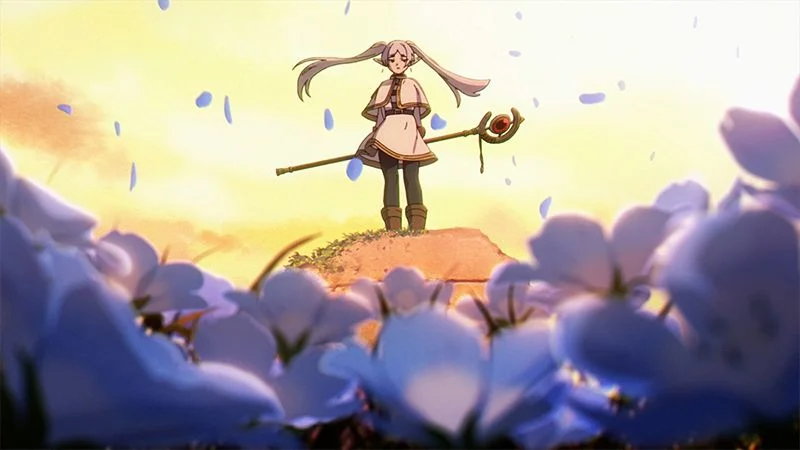
The errand changes the kind of evidence that counts as knowing someone. Frieren cannot make the famous victory more complete. She can attend to a detail she once passed over. The contrast between monument and preference makes the emotional task concrete without requiring another speech about regret.
There is a complication: Fern is now travelling with her. Time spent honouring a dead companion is time the living one also has to spend. Darius Ahmadi’s Anime Feminist essay reads the search as a change in whose time Frieren must consider. Remembering kindly is not automatically the same as behaving kindly towards the person waiting beside you.
That tension keeps the flower search from being merely a tribute. Frieren has to learn more than the right detail about Himmel. She has to recognise that a shared journey gives somebody else a claim on her attention.
What can the new relationship change?
Heiter’s request that Frieren teach Fern puts that problem into daily practice. Fern needs skills for a future in which the people caring for her will not all remain. Frieren’s experience becomes useful through a sustained responsibility to another person, rather than through the reputation of the earlier victory.
Teaching also creates an answer to regret that remembrance alone cannot provide. Frieren cannot redo a conversation with Himmel. She can make a different choice about how much attention to give Fern. The new relationship has its own needs; it is not a replacement with the same lines to say.
By episode 4, the search for Flamme’s writings gives the journey a direction. The official synopsis connects that search to Eisen and Heiter, so the past continues to help organise the route. But the person walking beside Frieren is new. The opening’s promise is that remembered experience might improve a present relationship rather than trap the traveller inside the old one.
Why keep the successful quest at all?
The victory gives these small choices their scale. Frieren has already demonstrated the sort of competence fantasy adventures usually reward. The story can now expose a different limitation without pretending that her courage or magic was worthless.
Peace also makes room for tasks that are not emergencies: a lesson, a visit, the care of a monument. Their modest size is part of their importance. Someone who can help save the world may still need to learn when to stop travelling alone, what a companion is asking for and why another fifty years cannot simply be assumed.
Beginning after victory therefore leaves two truths together. The adventure was successful. The relationship was unfinished. The first four episodes turn the distance between those truths into a reason to start walking again.
Sources
These sources discuss the opening losses. The linked essay ranges beyond this Feature’s four-episode scope.
- Official episodes 1, 2 and 4: the ten-year expedition and fifty-year return, Fern’s apprenticeship and flower memory, then the search for Flamme’s writings.
- Darius Ahmadi, Anime Feminist, 24 June 2026: the opening grief and the flower search as a question of shared time. That specific reading is attributed above. The public-monument/private-preference comparison and the distinction between completed task and incomplete relationship are this Feature’s interpretation of those examples.
- Official series introduction: the post-victory setting and Frieren’s long lifespan.