
What is Overtake! about?
A racing driver can be fast and still lack the money to compete. Haruka Asahina races for Komaki Motors, a small family-run team, in Japanese Formula 4, an entry-level category of single-seater racing. He wants a place on the podium, but the opposition includes a better-funded operation with resources that enthusiasm cannot replace.
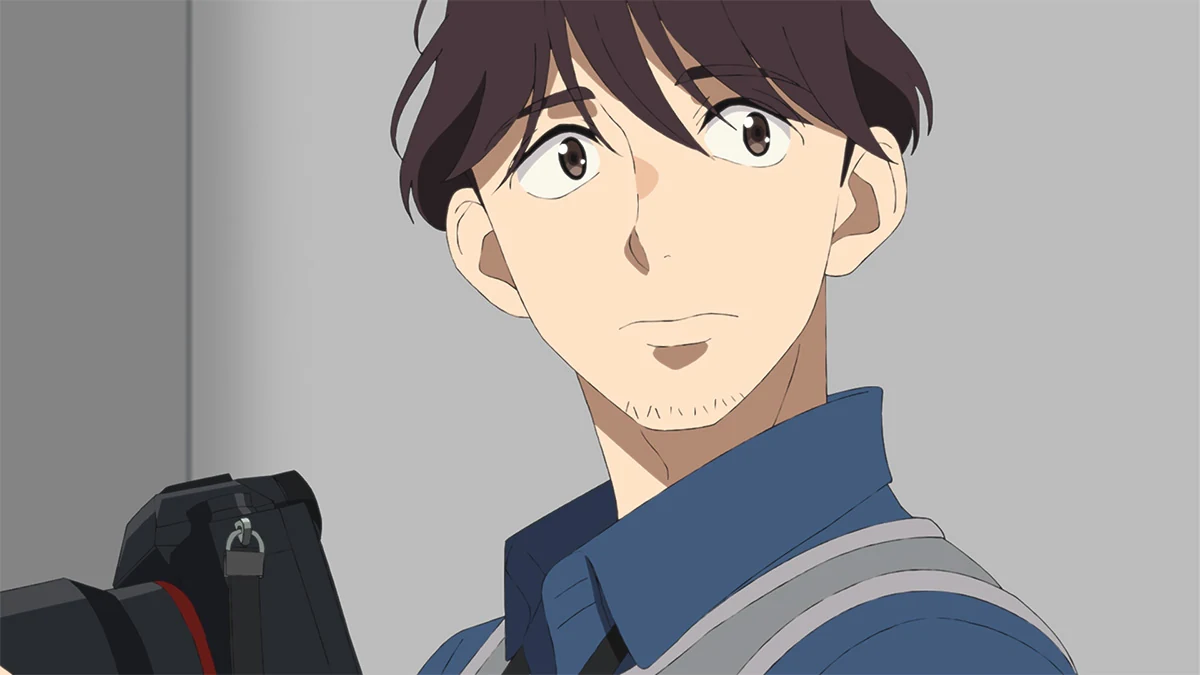
Kouya Madoka arrives at the circuit as a freelance photographer in a professional slump. Meeting Haruka gives him something to care about again, and he decides to help. Haruka is not waiting gratefully for a benefactor: his first response to Kouya’s encouragement is to reject it. That awkward meeting establishes the series’ central problem. One person badly wants to be useful; the other wants to prove he can manage without being cheered on.
The pleasure of Overtake! is that racing gives these very different people something concrete to do together. Getting a car to the grid requires money, mechanical work, publicity and trust. The person in the driver’s seat is the most visible part of a much larger effort, and a photographer standing outside the sport can gradually find a place within it.
It is an original anime from KADOKAWA and TROYCA, directed by Ei Aoki, with series composition by Ayumi Sekine. Its compact story joins a young person’s determination to move forward with an adult’s need to recover a purpose. Neither has to be reduced to an inspirational lesson for the other.
Why does a photographer become part of the team?
Kouya’s difficulty is more specific than losing interest in his job: he struggles to photograph people. Taking pictures therefore carries a personal risk that is invisible to someone asking him to do ordinary professional work. Haruka’s determination draws him towards a subject he cannot approach casually.
His new enthusiasm does not immediately make him competent. In episode 2, Kouya proposes sponsoring Komaki Motors and discovers that the costs exceed what he had imagined. The series gives his good intentions a practical test. He has to learn what the team needs, instead of assuming that wanting to help is enough.
Haruka has his own reasons to resist being treated as somebody else’s project. He lives with the Komaki family and delivers newspapers alongside school and racing. His claim to need nobody’s encouragement sits beside a life already made possible by other people’s labour. The tension is not whether he should stop taking racing seriously. It is whether accepting support has to diminish the achievement he wants to call his own.
That makes their relationship more interesting than a simple mentor-and-prodigy arrangement. Kouya brings attention and energy but is hardly a model of confidence. Haruka knows the work of racing but cannot settle Kouya’s problems by being talented. Each has to recognise needs that the other finds difficult to express.
What keeps Komaki Motors on the grid?
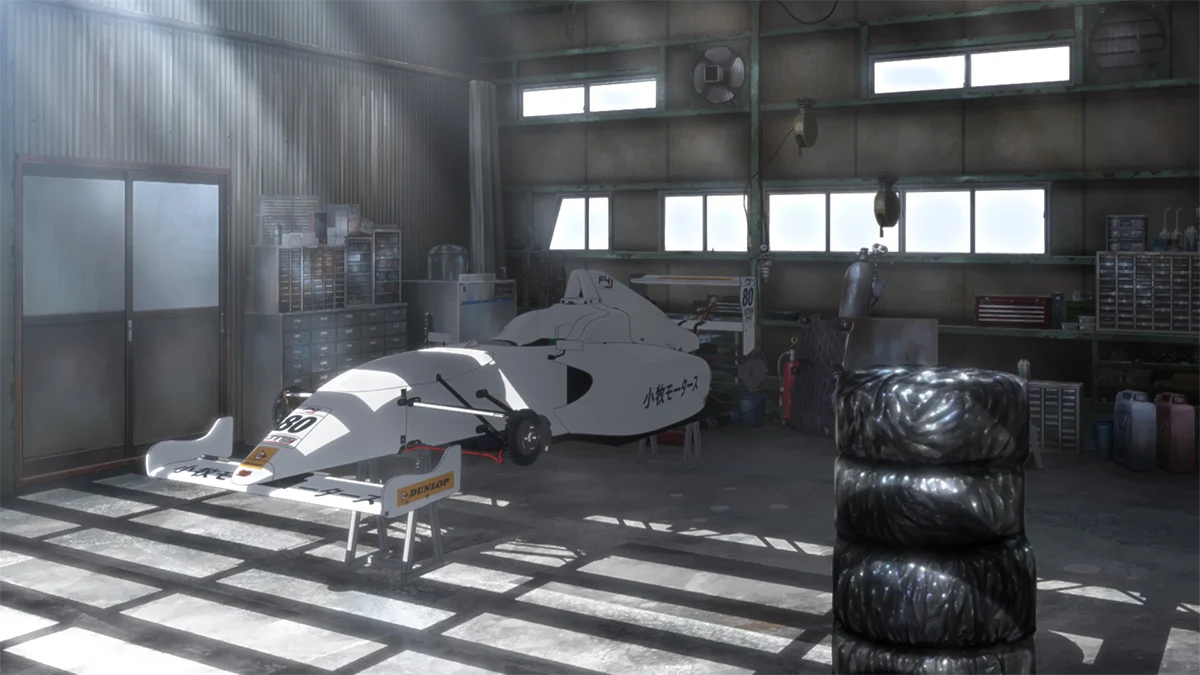
Komaki Motors makes the machinery feel like somebody’s responsibility. Kotarou Komaki, the owner’s son, is a skilled mechanic and has grown up alongside Haruka. Their long family connection matters: this is not a driver choosing an anonymous service provider. Haruka’s chance to race depends on people with whom he also shares an ordinary life.
Episode 3 turns sponsorship into a publicity job when a photograph leads to a commercial opportunity. An interview question then creates friction. The progression is revealing: getting financial help brings expectations about how the driver presents himself, not just a welcome logo on the car. A person who wants to communicate through racing still has to speak to people who might fund it.
The rival Belsorriso team gives that struggle a sporting shape. Satsuki Harunaga is its confident first driver, with the skill to support his showmanship. Toshiki Tokumaru, the second driver, has ability of his own and a more combustible attitude towards Haruka. Their place within a stronger team does not erase the pressure to prove themselves. The competition has personalities and unequal resources, rather than a single sneering obstacle placed in Haruka’s way.
How does the racing bring the people into focus?
Kouya’s ignorance gives the team a reason to explain the category and its demands. You do not have to memorise a rulebook to understand the basic stakes: a talented driver needs a competitive car, support and enough opportunity to demonstrate what he can do.
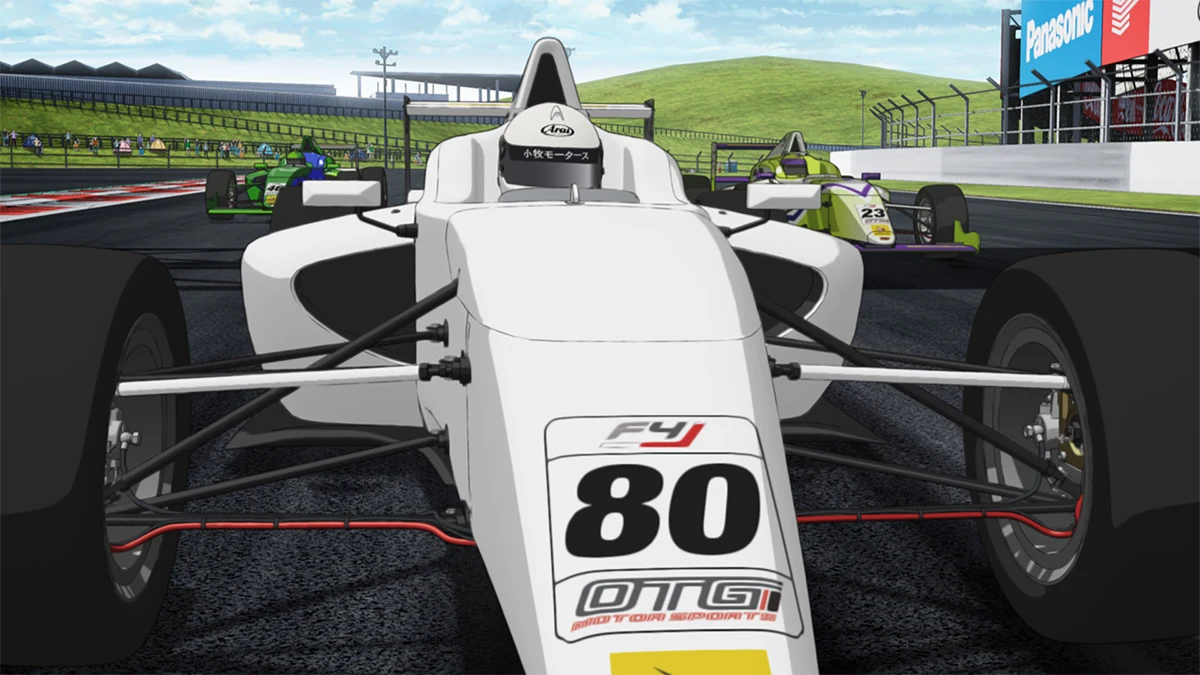
Once competition is under way, the racing is selective rather than a lap-by-lap simulation. Alexander Case’s full-series review notes the emphasis on passes and difficult corners that advance a character’s story. Guardian Enzo’s finale review also praises the CG racing and moving aerial-style views. A pass matters because a particular driver has worked to reach that opportunity. The sporting action gives the relationships and preparation a moment of visible consequence.
In a Best Car interview, Aoki identifies another concrete part of that racing texture: the team recorded sounds from real FIA-F4 cars and built the circuits and machines in 3D. The sound is worth attending to alongside the editing. The series wants the category to have a recognisable physical presence even when its main concern is the person driving.
What does the story find away from the circuit?
Kouya’s camera creates a second kind of suspense beside the race. A driver wants to reach a place worth photographing; the photographer needs to be able to meet that moment. Work that might look routine from outside becomes emotionally consequential to the person trying to do it. The partnership lets the series connect ambition with attention: being there for someone also means learning to see them on their own terms.
Haruka’s seriousness and Kouya’s eagerness give that process room for awkwardness and humour. An offer made in a burst of enthusiasm can collide with a workshop’s actual bills. A driver accustomed to concentrating on the car can find a promotional interview much less comfortable. Those early situations keep the people approachable while letting their limitations matter.
The wider cast adds other versions of the same tension. The Komaki family’s everyday commitment makes support tangible, while Belsorriso’s drivers have to negotiate expectations inside a more successful organisation. Racing brings them into competition, but it also gives them a shared understanding of how much the work demands. The rivals are interesting because they have something to lose themselves.
The series also takes injury, grief and the difficulty of returning to work seriously. That can draw it away from the circuit for substantial stretches. Its balance will not suit every reader looking primarily for racing; Iro’s premiere response at the Glorio Blog also finds that technical explanations interrupt the character drama. The explanations and personal histories are part of the shape of the story, rather than brief pauses before uninterrupted competition resumes.
Where should you begin?
Watch episodes 1–12 of the 2023 original series, a complete story with no earlier anime or manga required. Allow about 4¾ hours, using Crunchyroll’s rounded episode timings. Crunchyroll lists the series; access and subtitle options depend on territory. The first two episodes introduce both the circuit and the practical work behind Kouya’s offer of help.
There are racing crashes, injury, bereavement and some strong language. Episode 9 specifically depicts an earthquake and tsunami and includes alarm sounds, as warned on the official episode page; the sounds differ from real warning signals.
What does the official trailer show?
The trailer previews racing and emotionally charged character scenes from the original series. It gives a sense of the drama as well as the cars; skip it if you prefer to meet the cast entirely through episode 1.
Original series · Crunchyroll · 2023
Loading the player connects to YouTube. Playback does not start automatically.
Sources
Later episode pages and full-series reviews discuss race results, personal histories and the ending.
- Official episode 1, episode 2, episode 3, episode 9 warning and episode 12 endpoint.
- Official character profiles: Haruka, Kouya, Kotarou, Satsuki and Toshiki.
- Official staff and cast and Crunchyroll’s episode listing, for production, runtime estimates and language advice.
- Alexander Case, Breaking it all Down, full-series review, Guardian Enzo, Lost in Anime, finale and series review and the Glorio Blog’s premiere roundtable, for the racing, character emphasis and competing responses to the opening.