
The ordinary car journey has changed. In the near future of MF Ghost, self-driving electric vehicles dominate the roads. Petrol-powered sports cars have become the stars of MFG, a competition that turns public roads into a spectacle followed far beyond Japan.
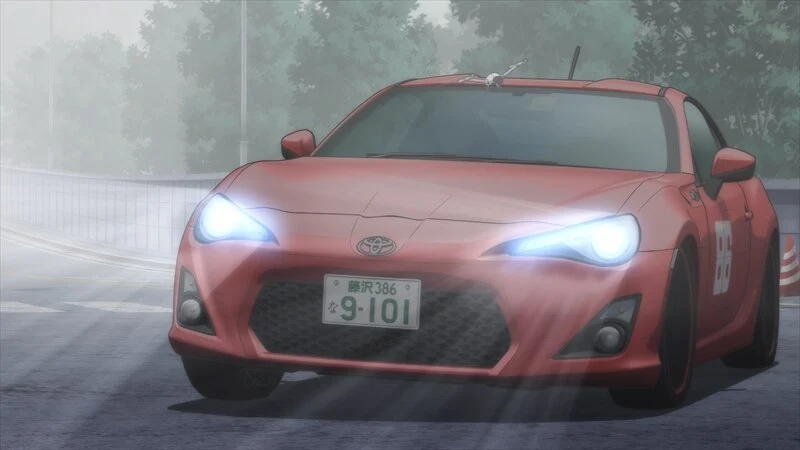
Into that world comes Kanata Rivington, a nineteen-year-old trained at a British racing school. He enters in a Toyota 86, a relatively modest machine among the competition’s more powerful cars. His driving gives the entry its promise, but racing is not his only reason for travelling to Japan. He is also looking for his missing father.
This introduction covers the 2023 first season: Kanata’s arrival, the people who help him compete and the opening road-racing challenge.
What can the driver add to the car?
Kanata arrives with training. The attraction is not watching a complete novice discover what a steering wheel does, but seeing how existing skill can matter in a new field. He has chosen a car whose badge will not frighten every rival before the race begins.
The first qualifying run gives that skill changing conditions to work against. The course includes an uphill sector, a descent and a fog-covered area around Hakone’s abandoned town. A useful technique in one part of the route is not a guarantee that the next part will be equally forgiving.
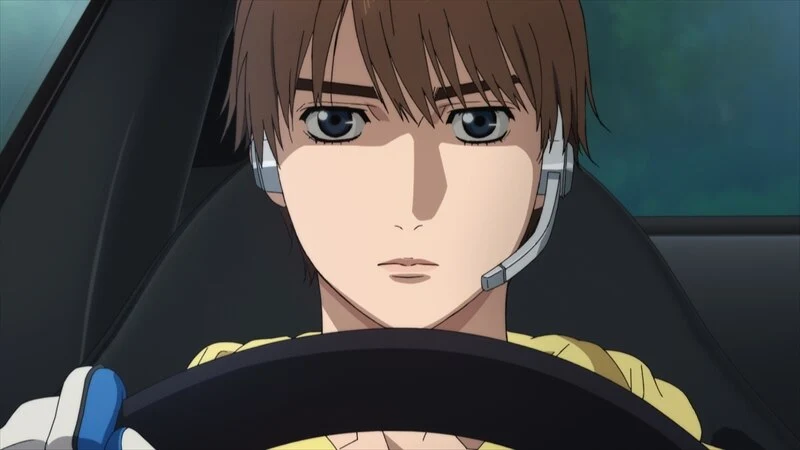
That makes the road more than a backdrop. Gradients, bends and visibility change what the driver has to judge. The red Toyota is easy to recognise, but the question is what Kanata can do with it in a particular stretch of tarmac.
The opening’s fog supplies a particularly clear visual problem. The headlights remain bright while the landscape loses definition. A familiar machine moves into a place that is becoming harder to see, giving concentration a setting rather than leaving it as something a commentator merely praises.
Who gets Kanata to the starting line?
Ogata is the mechanic helping Kanata prepare the 86. Shun Aiba, a more experienced MFG racer, becomes another useful contact. Before the competition can reveal anything about Kanata’s driving, he needs people who know how this event works.
The support continues during the qualifying run. Ogata speaks to him over the radio, following his progress from outside the car. The person at the wheel and the people watching do not occupy the same situation: one has to drive through the immediate conditions while the other tries to understand what that driving means for the result.
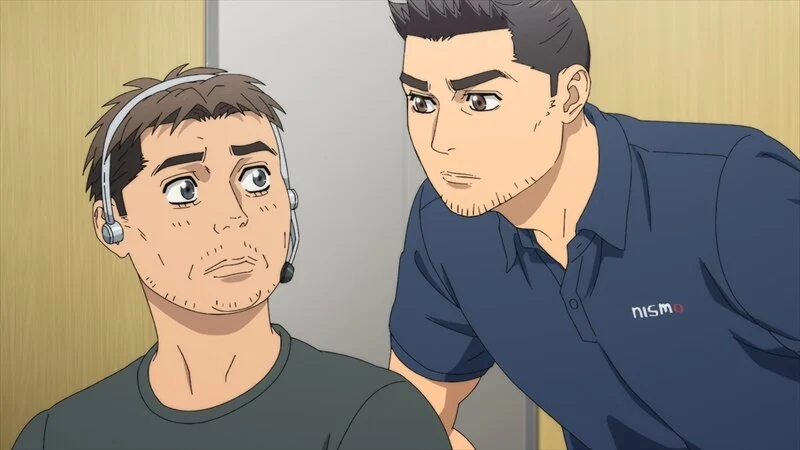
That relationship is part of the appeal of a racing story. Talent sits inside a practical arrangement of car, preparation, information and encouragement. Kanata may have the most conspicuous job, but entering an unfamiliar competition is not something his feet and hands accomplish alone.
What is waiting away from the circuit?
Kanata stays with the Saionji family, whose daughter Ren is attracted to him. She also works as one of the MFG Angels, the event’s promotional hostesses. The two roles overlap in a way Kanata initially fails to recognise.
That gives the racing story an awkward social life. The young man who looks composed behind the wheel can miss what is happening in front of him when the problem involves another person. Ren knows him in an ordinary domestic setting and has a public role inside the spectacle he is entering.

The father’s disappearance gives Kanata a reason to be in Japan that extends beyond placing well. It leaves room for a quieter search alongside the public achievement the race can measure. The series therefore spends time away from the road; it is not a continuous driving demonstration.
Its treatment of the promotional hostesses is a meaningful reservation. Kate Sánchez’s premiere review for But Why Tho? points to their sexualised presentation while also noting how much of the opening is setup rather than racing. Expect that material alongside the cars and family story, rather than a drama concerned solely with driving technique.
How does it connect to Initial D?
Shuichi Shigeno created both manga series, and MF Ghost takes place in the world that follows Initial D. Returning people and references give earlier viewers another layer of recognition. They can also reveal information about the older story’s later lives and careers.
Kanata has his own starting point, introduced through a new competition and supporting cast. You can follow that introduction without first completing Initial D. If protecting the older series’ surprises matters to you, watch it first; this is a later setting, not a spoiler-free substitute for its story.
There are production connections too. Director Tomohito Naka worked on the Initial D theatrical films, and sound director Masafumi Mima worked on its television series. Eurobeat is an explicit part of the new production’s identity: the original publicity foregrounds it, and Kanata’s actor Yuma Uchida discussed its pairing with the cars at the first-season preview event. That establishes the intended musical connection without requiring the new reader to recognise every reference.
Where should you begin?
Start with season 1, episode 1, from 2023. This introduction’s scope is its 12 episodes, about four hours and fifty minutes using a 24-minute allowance. The two official first-season Blu-ray sectors each list six episodes and 144 minutes of main content.
Later seasons continue the story and are outside this first-season introduction’s viewing total. The end of this twelve-episode scope is not presented as the conclusion of the whole adaptation. Promotional MFG-TV extras are also separate from the numbered route.
For a broader choice of racing stories, the racing-anime guide compares the different pleasures of preparation, road rivalry and larger-than-life competition.
What does the original trailer introduce?
Crunchyroll’s first-season trailer belongs to the 2023 launch. It offers a short look at the original competition and Kanata’s arrival.
Original 2023 season · Crunchyroll. Opens YouTube.
Sources
Current official introductions and episode archives can reveal later-season events.
- Original character and staff announcement, for Kanata, Ren and production connections.
- Official Turn 01 and Turn 02, for the support network and changing qualifying conditions.
- Official 2023 preview-event report, for the original launch and the production’s Eurobeat connection.
- First-season Blu-ray Sector 1 and Sector 2, for the exact twelve-episode scope and viewing allowance.
- Kate Sánchez’s premiere review, for the attributed reservation about setup and sexualised hostess scenes.