
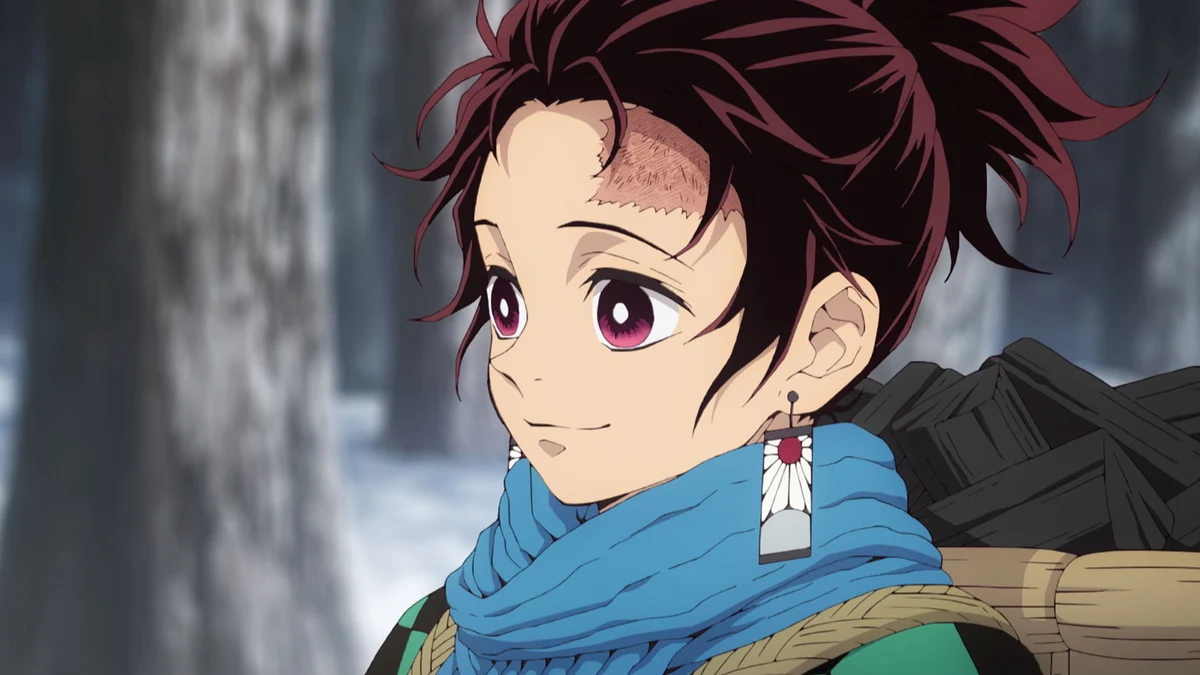
Tanjiro Kamado is a charcoal seller who lives with his family in the mountains during Japan’s Taisho era. Returning from town, he finds that a demon has attacked their home. He carries the only survivor, his sister Nezuko, down through the snow in search of help. Then she turns on him. The person he is trying to save has become dangerous before he even knows where to take her.
What remains between the siblings?
Tanjiro wants to restore Nezuko’s humanity, not simply avenge the rest of the family. Before the attack she was a gentle girl devoted to them; as a demon she can still act to protect her brother and other people. There is something for him to recognise in her beyond the fact that she survived. Protection can run in both directions.
The Demon Slayer Corps, an organisation that hunts demons, has good reason to fear what she has become. Tanjiro cannot make that fear disappear by explaining that he loves his sister. To keep travelling with her, he needs the skills to survive encounters with other demons and a way to show that her behaviour matters.
His kindness can also get him into immediate trouble. On the journey towards trainer Sakonji Urokodaki, he smells blood at a temple and runs towards it because somebody may be hurt. What he finds is a demon eating people. The same impulse that sends him to help puts him within reach of a creature much stronger than he is. This is a useful introduction to Tanjiro: concern gets him moving before he has the skill to manage what he finds.

Image credits
Demon Slayer: Kimetsu no Yaiba
(C)吾峠呼世晴/集英社・アニプレックス・ufotable
Image sourceWhat does Urokodaki make him learn?
Training on Mount Sagiri turns that impulse into hard physical work. Urokodaki sends Tanjiro down a mountain laid with traps, alongside sword practice, waterfall training and breathing exercises. Wanting to reach somebody in danger will be no use if he cannot read the ground, control his body or keep going on the way there.
After a year, Urokodaki tells him there is nothing more to teach and sets a further hurdle before the Corps’ entrance selection: split a huge boulder. The progression is stubbornly physical: Tanjiro can improve at the exercises without his mentor declaring him ready. Sword combat begins with practice and breath, long before Tanjiro can deliver a finishing stroke.

Image credits
Demon Slayer: Kimetsu no Yaiba
(C)吾峠呼世晴/集英社・アニプレックス・ufotable
Image sourceThe mentor’s red tengu mask keeps his expression hidden while Tanjiro’s face stays easy to read. Together with the boy’s checked coat and Nezuko’s bamboo muzzle, it gives the early story a set of distinctive, purposeful shapes. Nezuko’s eyes remain visible above an object that recalls why strangers fear her. The designs carry the siblings’ changed circumstances even when nobody is explaining them.

Image credits
Demon Slayer: Kimetsu no Yaiba
(C)吾峠呼世晴/集英社・アニプレックス・ufotable
Image sourceWhere should you begin?
Begin with episode one. The television route through Hashira Training has 63 episodes: 26, then 7 for the Mugen Train TV edition, 11 each for Entertainment District and Swordsmith Village, and 8 for Hashira Training. That is roughly 26 hours at a nominal 25 minutes per episode; premieres and finales vary.
The Mugen Train film is an alternative presentation of that story, not an additional required stop after its television edition. Compilation screenings and the Infinity Castle films are outside this TV count. The Infinity Castle films continue after Hashira Training.
Come for the sword-fighting fantasy if that draws you, but the early test is whether Tanjiro’s concern and exhausting apprenticeship make you care about the person wielding the blade. The violence and bereavement are substantial; the wish to recover a shared family life keeps their cost personal.
For a promotional sample, see 2019 first-season PV · Aniplex. Trailers may include scenes beyond the early setup described here.


