
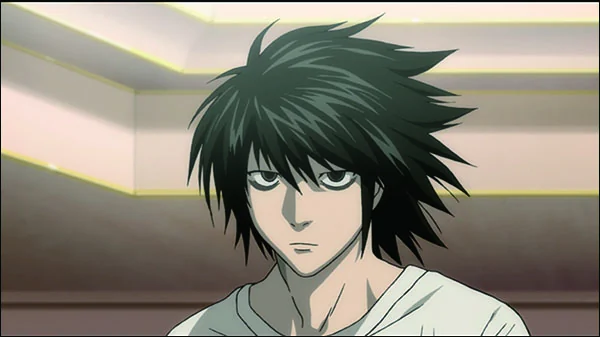
The most persuasive thing about Death Note is that it can make you want to understand Light Yagami’s next move without wanting him to succeed. His plans are ingenious. His willingness to turn people into obstacles or instruments is repellent. The tension between those responses gives the series more force than a simple invitation to admire a clever protagonist.
The complete 37-episode anime is worth following for that contest of intentions. Its weaker stretches arise when further complications receive more attention than the people carrying them out. The early duel between Light and L has a personal clarity that the larger late-series struggle does not always retain.
Information is both a weapon and a liability
Early-method spoilers: this section explains the episode 2 broadcast trap and episode 8 surveillance scheme. Later plot outcomes remain undisclosed.
L’s early television challenge is a particularly economical demonstration of the show’s appeal. Light responds angrily to a man publicly denouncing Kira. He believes the broadcast’s apparent reach; L has restricted where it can be seen. The response gives the investigator information about the killer’s location and capabilities. Nippon TV’s episode 2 account establishes the deception.
The trap works because Light has a temperament, not just a high score for intelligence. Being challenged threatens the authority he imagines he possesses. His pride creates an opportunity that an impersonal killing machine would not offer. L, in turn, chooses an experiment with a human life at stake. The contest immediately complicates any comfortable division between an immoral killer and an investigator whose methods need no examination.
This is why the name-and-face rule matters beyond being a clever restriction. It makes ordinary publicity dangerous and anonymity useful. Light needs access to information, but every attempt to obtain or exploit it can produce another pattern for L to examine.
The theatricality makes a small action matter
Episode 8 turns a packet of crisps into concealment. Under surveillance, Light needs to appear to be doing ordinary homework while acting on information the cameras must not see. The scene’s physical action is small; the consequences are not. Ryuk’s involvement is transactional too: Light uses his appetite for apples to enlist him in finding the cameras’ blind spots.
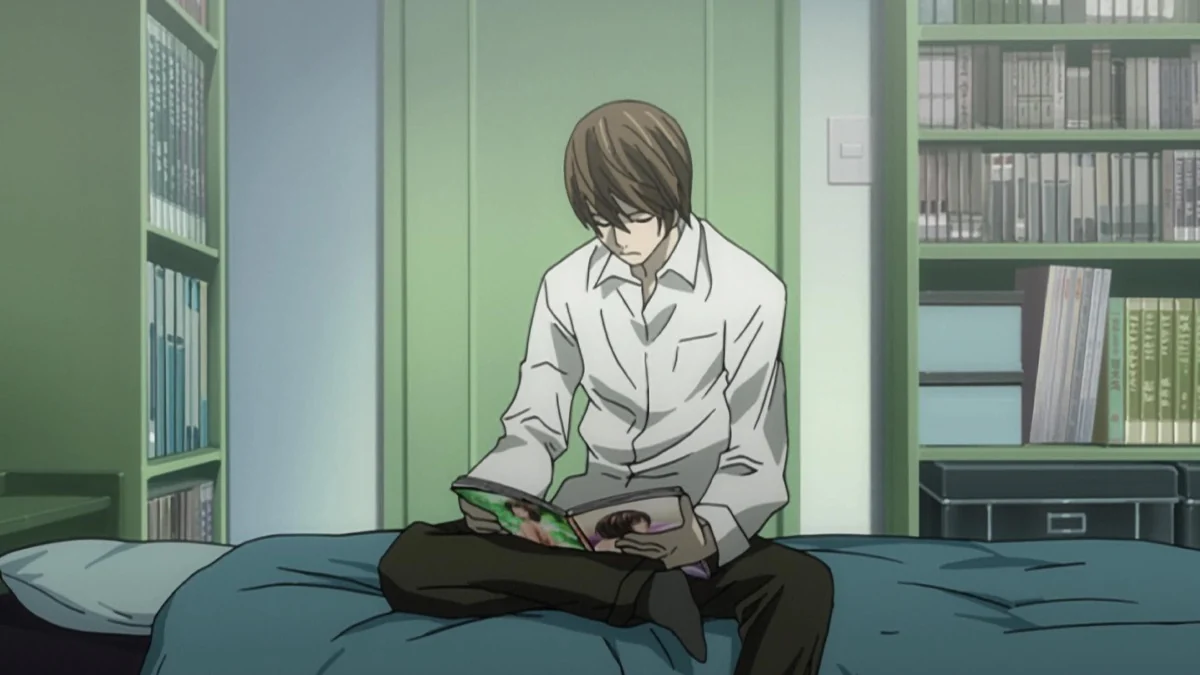
That detail gives Ryuk a useful role beyond explaining supernatural rules. He helps because something interests or benefits him, not because he has adopted Light’s idea of justice. Depending on him therefore exposes another limit to Light’s control.
Drew Hurley’s Cubed3 review singles out the dramatic energy given to eating a crisp and writing in a notebook. The exaggerated presentation makes an almost invisible struggle legible. It is not merely decoration around a deduction: it turns the effort to look unremarkable into a performance the viewer can recognise.
The cost is that private calculation can dominate conversation. The series often explains several possible readings of an action, and its excitement depends on enjoying that process. If you want more unguarded time with the characters, another ingenious contingency is not always a substitute.
Misa has initiative, but the story limits what it is for
The treatment of the supporting cast is a more substantial reservation. Chris Perkins at Animation for Adults argues that Misa is defined too heavily by her attachment to Light, while acknowledging that Light treats men as instruments too. Those are related but different problems. A protagonist can deliberately exploit people; the writing still decides how much independent life they receive.
Misa is not simply incapable. During the corporate investigation in episode 21, she pursues information through a deception of her own, outside the investigators’ immediate control. Her deception changes what the investigators know; the official later-episode archive describes the episode.
The limitation is the direction in which that ability is channelled. Her desire to be useful to Light repeatedly supplies the motive. Competence alone does not give a character a substantial life beyond the lead’s purposes. Her initiative makes a blanket dismissal unfair, but it also makes the narrower role more frustrating: the story has shown that she can do more than wait for instructions.
The later expansion adds pressure more readily than intimacy
As the struggle grows, the problem is no longer only how Light conceals a notebook from one detective. He must also deal with people who believe in Kira, interpret his intentions and act with their own interests. A later strand involving television advocacy turns his supposed authority into something other people can exploit. Nippon TV’s episodes 31–32 establish this expansion.
That is a meaningful development of the premise. A private plan becomes harder to control when it needs followers and intermediaries. It also demands more explanations and introductions, leaving less space for relationships to become as immediately distinctive as the early rivalry.
The full-series critics disagree about the bargain. Chris Maffris at Toonami Faithful finds the final stretch less meaningful than the central early contest. Scott Emsen at AnimeBlurayUK values the series’ continuing changes of rules and pace. Both responses identify a real part of the experience: renewed complexity keeps the contest moving, but cannot automatically recreate an established relationship’s appeal.
That is a reason to adjust expectations, not to stop before the end. The later episodes continue testing Light’s assumption that cleverness entitles him to direct everybody else. Cutting the story off when its most concentrated phase ends would leave that assumption less fully examined.
A compelling thriller with an uneven distribution of attention
Choose Death Note for plans that reveal character as well as solve problems. Light’s pride can betray his intelligence, L’s pursuit of proof can make his choices uncomfortable, and Ryuk’s interest is never the same thing as moral approval. That combination keeps the early investigation more alive than a competition between flawless calculating machines.
Expect less satisfaction if your priority is an evenly developed ensemble. Misa’s initiative is a useful counterexample to the idea that everyone merely follows Light’s instructions, but the series repeatedly returns other people’s ambitions to his contest. The ending completes the original television story; the practical route is simply episodes 1–37, as set out in the Death Note introduction.
Sources
The sources below reveal major deaths and the ending that this page omits.
- Nippon TV, episodes 1–19: episode 2’s broadcast trap and episode 8’s cameras, Ryuk’s apples and concealed viewing method. Episodes 20–37: Misa’s episode 21 initiative, the later media strategy and the completed television arc.
- Drew Hurley, Cubed3, 10 December 2016: the visual energy given to ordinary actions. The collection also includes specials, excluded from this Review.
- Chris Perkins, Animation for Adults, 19 December 2016: characterisation, treatment of women and reservations about accumulating complications.
- Chris Maffris, Toonami Faithful, 3 January 2017: early deduction and a less favourable assessment of the final stretch.
- Scott Emsen, AnimeBlurayUK, 16 December 2016: an alternative positive reading of changing rules and pace.
- VIZ’s series record: 37 television episodes.
- Apple TV’s episode 8 listing: source of the bedroom image, associated with “Glare”.