
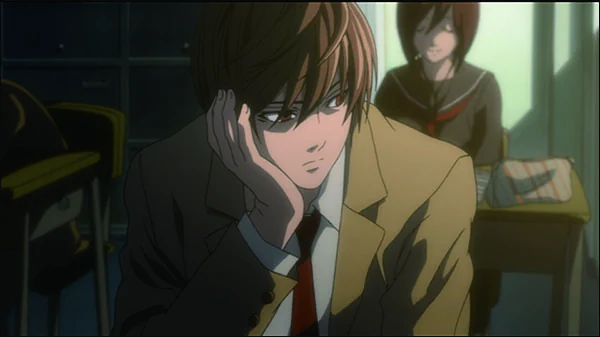
A person can kill by writing a name in a notebook, provided they also know the victim’s face. In an otherwise recognisable modern Japan, that supernatural rule creates a crime the police cannot initially explain. There is no ordinary weapon or physical connection between killer and victim.
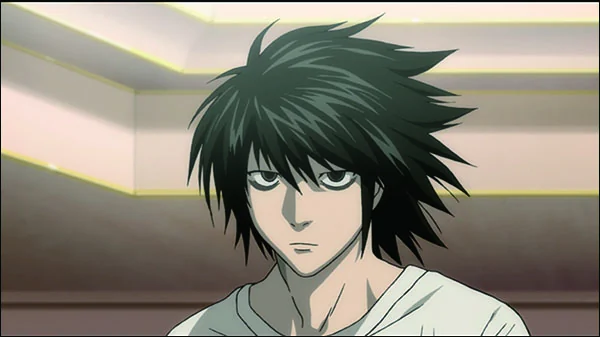
The student who finds the notebook, Light Yagami, begins killing criminals and attracts followers who call him Kira. The detective investigating him works under the alias L. Names, photographs and apparently harmless conversations become dangerous resources: each opponent needs information the other has reason to conceal.
Try Death Note if you enjoy watching a plan meet an equally ingenious obstacle. It is a talkative, theatrical thriller, often more interested in exposing an intention than staging a fight. Its cruelty and lengthy explanations are part of the bargain; it is not an affectionate ensemble adventure.
Start with episode 1 of the 2006–2007 animated television series and continue through episode 37. VIZ lists the complete run at 888 minutes, or 14 hours 48 minutes. The first two episodes give a useful sample of both the supernatural premise and the investigative contest.
What makes the notebook’s rules interesting?
The Death Note comes from the realm of shinigami, or death gods. That does not mean the human investigators begin with knowledge of how it works. Light knows the weapon; L has to infer its limits from what happens in the world.
The name-and-face requirement prevents the notebook from being a completely effortless answer to every obstacle. Publicly identifying a person may expose them. An alias may protect them. A television report can supply the killer with information while also giving the investigators a chance to test what he needs.
You do not need to learn every rule before starting. The series introduces further conditions as they become useful to a plan. Its central appeal is the gap between knowing a rule and understanding how somebody else will exploit it.
What do Light, L and Ryuk want?
Light has excellent prospects before finding the notebook. He does not need its power to escape poverty or defend himself from a monster. He decides that his own judgement should determine who deserves to live. That ambition makes his intelligence unsettling: the ability to devise a plan is not evidence that he has the right to carry it out.
L needs proof. Being suspicious of someone is not the same as knowing how the murders happen or establishing responsibility. His hidden identity is a practical defence, but he is not content to remain behind it. He devises tests designed to provoke a revealing response. His methods can put other people at risk, so opposing Kira does not make every investigative choice comfortable.
Ryuk, the death god associated with the notebook, is interested in escaping boredom. He can explain things Light does not understand, but he is not a reassuring mentor or moral authority. His curiosity makes him an uneasy companion: a human catastrophe can be an entertaining development to somebody standing outside human consequences.
Light’s father works in the police investigation. That gives the contest a domestic pressure as well as an intellectual one. Keeping up the appearance of an ordinary promising student matters when suspicion can enter the family home.
Where does the suspense come from if we know the killer?
The viewer is allowed to know more than most of the investigators. Suspense comes from the distance between that knowledge and proof. What can L infer? What will Light notice about the test being set for him? Does a casual answer reveal something its speaker meant to hide?
An ordinary exchange can therefore have two meanings at once: the acceptable social one and the private calculation underneath it. The series makes those calculations conspicuous. If you enjoy explanations of elaborate traps, that is a strength. If you prefer motives left mostly implicit, the continual access to plans can feel exhausting.
It also asks you to stay interested in someone you may strongly dislike. The pleasure of seeing whether Light can solve a problem need not become approval of the reason he wants it solved.
Which version should you begin with?
Watch the original 37 television episodes in their numbered order. They tell a complete story. The two Relight specials rework and condense television material; they are not the next season you need to watch after episode 37. The Japanese live-action adaptations and the American Netflix film are separate versions, not missing chapters of the anime.
Check the episode list as well as the title when choosing a service. This page’s count and duration refer to the original TV run, not a bundle containing the specials. VIZ’s service links concern its distribution catalogue and do not establish Indian availability.
Expect frequent killings, suicide, torture and an early attempted sexual assault, with frightening death-god imagery and language that varies between versions. Common Sense Media’s TV guide has detailed advice and spoilers. The Death Note Review weighs the full series’ strengths and limitations without revealing its ending.
Sources
The full episode archives and reviews below contain major outcomes omitted from this introduction.
- VIZ’s original-series listing: premise, episodes 1–37 and listed 888-minute duration. This is an edition figure, not a stopwatch measurement of every service’s versions.
- Nippon TV’s original anime archive, episodes 1–19 and 20–37: original broadcast dates, investigative methods and complete TV scope. The dated entries run from 3 October 2006 to 26 June 2007.
- Chris Maffris, Toonami Faithful: name-and-face rule, Ryuk’s boredom and the early contest’s appeal.
- Scott Emsen, AnimeBlurayUK: the complete TV collection and two compilation specials, kept separate here.
- Common Sense Media’s anime TV record: sensitive-content guidance. This is the television record, not the similarly titled live-action-film review.