
A ruler who commands a fortress full of loyal monsters becomes an adventurer at the lowest rank. Overlord can make that situation funny without pretending the registration desk has measured his true strength. It has measured something else: his recognised place in the institution he has just entered.
That gap gives an overwhelmingly powerful lead a reason to learn. Within Nazarick, his authority is already assumed. Outside, strangers have their own categories, expectations and ways of deciding who deserves work. Bringing a great deal of power into a society does not mean arriving with its operating knowledge.
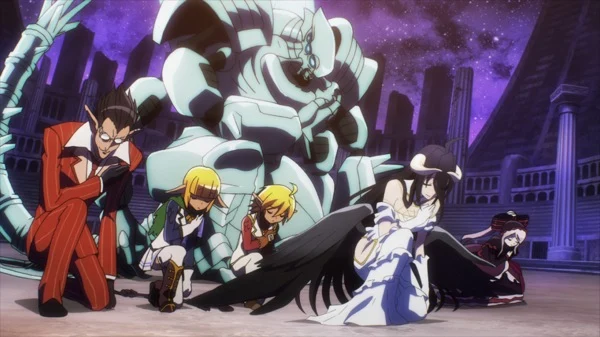
What does Nazarick already believe?
Momonga stays in his guild’s fortress as an online game approaches closure. When the expected disconnection fails to happen, the familiar surroundings have become unfamiliar in a different way. His skeletal avatar remains, and the non-player characters answer him as living people.
Their loyalty is an enormous advantage. He does not have to recruit every attendant or prove his right to enter his own stronghold. The creations of absent guildmates provide a household, an inheritance and a position from which to act.
They also arrive with expectations. A follower who assumes the ruler possesses extraordinary wisdom may interpret a decision differently from someone who knows the ruler is investigating. Reverence can make it harder to establish a shared account of what is uncertain.
The imposing skull helps the comedy. The body projects a kind of fixed assurance that the premise does not require its occupant to possess. Power is visible. The knowledge needed to make a sensible choice is much harder for an observer to see.
What can a low rank teach him?
In episode 5, Ainz and Narberal enter E-Rantel’s adventurer guild as Momon and Nabe. They begin at copper, the lowest rank, where only simple jobs are available. The ladder governs their access to work even though it says very little about their actual strength.
The guild is not making the same mistake as a follower who assumes the ruler knows everything. It has never met him as that ruler. An unfamiliar armoured adventurer has arrived with an unfamiliar companion, and the institution has a category for newcomers. To the viewer, the copper badge understates a familiar power. To the guild, it is an ordinary starting point for someone whose public record has barely begun.
There is a difference between asking whether he can destroy an obstacle and asking what the obstacle tells him. An institution can reveal what strangers value, how they assess newcomers and which abilities they expect to encounter. Learning those things gives the excursion a purpose beyond finding a fight that might finally be difficult enough.
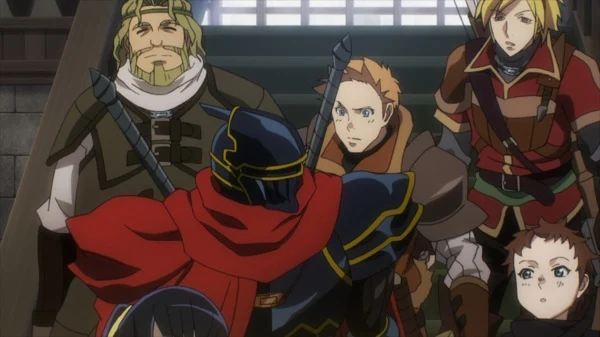
Where does the tension go if the lead is so strong?
One answer is into the distance between an action and another person’s understanding of it. Devoted followers, cautious strangers and the ruler himself can attach different meanings to the same display. The opening makes room for uncertainty without first taking his advantages away.
That will not satisfy every preference. A reader primarily interested in narrowly balanced fights may still find an overwhelming protagonist less exciting. An Overlord discussion about overpowered leads brings that disagreement into view: intelligence-gathering and other characters’ perspectives can matter to one reader without replacing the kind of danger another wants.
Nor does enjoying the comedy oblige us to treat the viewpoint character as benevolent. Nazarick’s internal loyalties do not guarantee kindness to people beyond its walls. The unsettling possibility is that an uncertain ruler can still make decisions with immense consequences for everyone else.
The low adventurer rank is useful because it changes the question. The fortress has already answered whether its ruler deserves obedience. The world outside can still make him ask what he needs to know before deciding what to do.
Sources
Official archives and the discussion include later events. The selected scenes are from original first-season episodes 1 and 5.
- Original official introduction and first-season story archive, for the game-closure premise and original setting.
- Licensed first-season record and licensed series listing, for the series identity and early adventurer setup.