
A city can look most inviting when it is advertising things its protagonist cannot safely reach. Akudama Drive and Cyberpunk: Edgerunners fill their urban worlds with light, technology and spectacular movement. Their openings then give that abundance a less welcoming meaning.
The problem is not simply that something violent happens among beautiful buildings. Both stories make access matter. Who can obtain help? Who gets treated as respectable? What happens when the city assigns you a role you did not choose? The surroundings offer an enormous number of possibilities while narrowing the protagonist’s room to act.

How does an ordinary person become out of place?
Akudama Drive begins with a woman who considers herself ordinary. The official first-episode account draws her into an arrest and a job involving infamous criminals. The label attached to someone matters before there has been time to understand the person underneath it.
That is a useful way to make the city threatening. The heroine does not arrive as a master criminal fully equipped for its rules. Her attempt to get through an everyday situation becomes entanglement in a category with much more dangerous expectations.
The early job makes the loss of freedom physical. Episode2 places the group under collar-based coercion while an execution unit pursues them. Expertise and spectacle do not make the participants free. A city can provide advanced technology without providing a safe route out of somebody else’s demands.
What does an emergency service promise?
Night City presents a different boundary. David’s original-series predicament is tied to a world of expensive institutions, bodily upgrades and unequal opportunity. The official Cyberpunk description of Trauma Team connects medical rescue to being able to afford a plan.
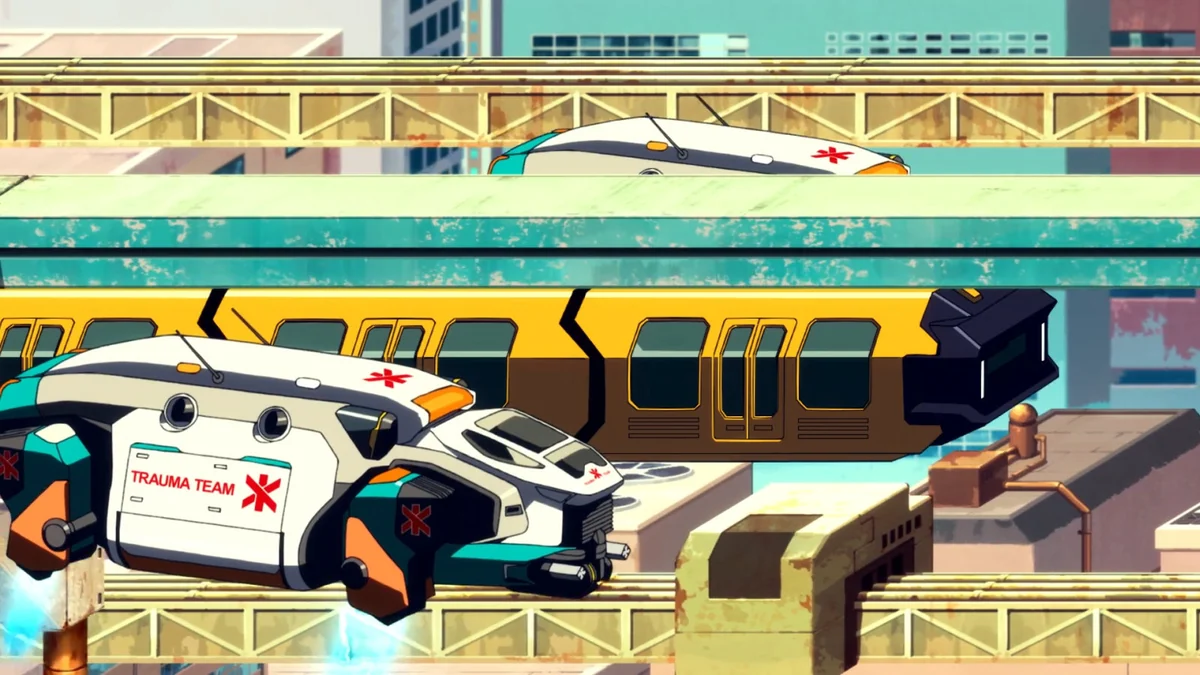
Seeing the aircraft raises an uncomfortable question: can you use the service? Its existence does not tell you whether it will come for you. Technological capability and access to that capability are separate things.
The distinction keeps the city’s brilliance from becoming neutral decoration. A high-tech environment may contain astonishing ways to save or improve a body while requiring the person in need to meet a condition first. The spectacle becomes more pointed when the viewer can see both the resource and the barrier.
Why keep the surroundings so attractive?
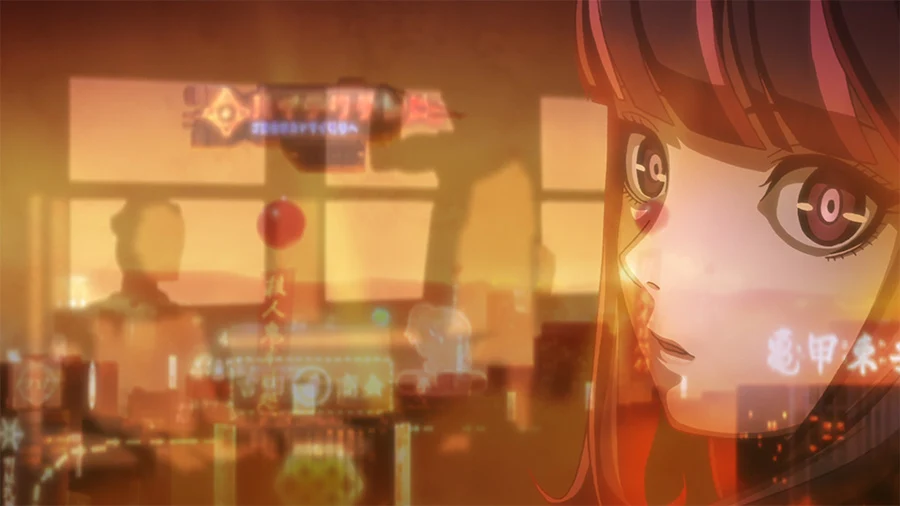
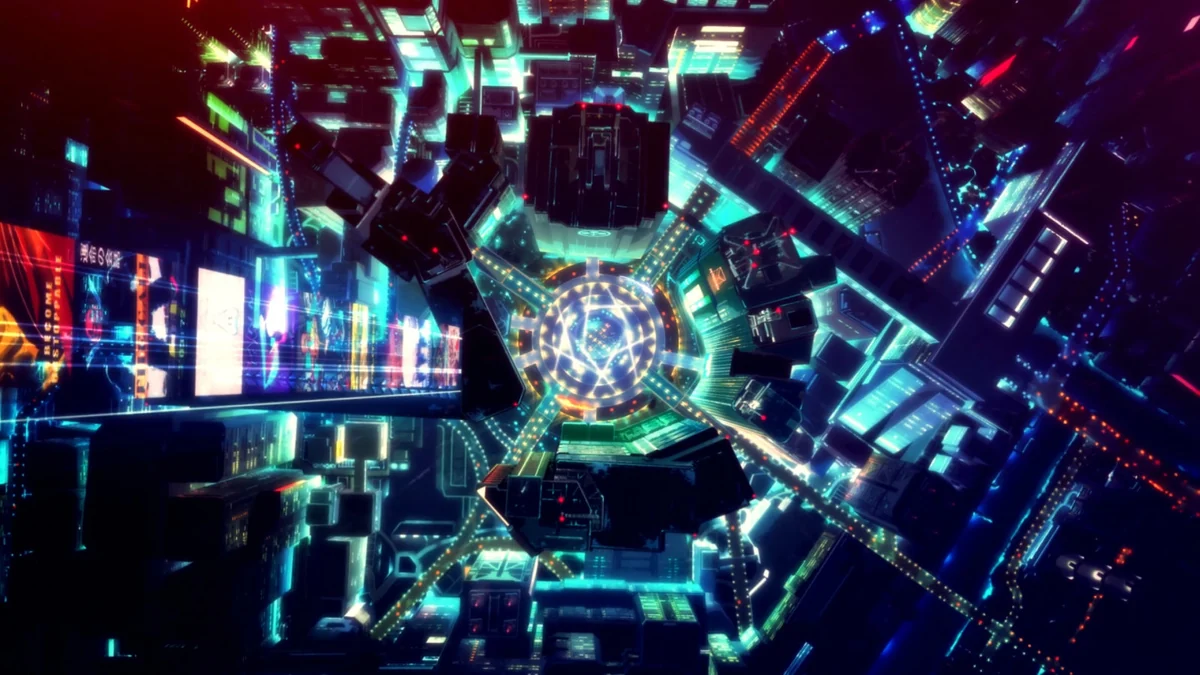
The images pull the viewer towards the place. Warm reflections make a passing window inviting; dense, saturated signs give the eye more to explore. That visual pleasure does not have to be denied for the story’s hostility to register.
It can sharpen the contradiction. There is plenty here, but plenty is distributed through institutions, money and classifications. Seeing possibility everywhere makes exclusion more specific than a uniformly ruined world would. The question becomes why this person cannot use what visibly exists.
The two series do not make identical arguments. Akudama Drive’s opening stresses criminal labels and forced participation in a compressed crime adventure. Edgerunners places David within a city whose opportunities and services impose their own terms. Those different mechanisms are more interesting than declaring that neon automatically means corruption.
Is an impressive city enough on its own?
No image can guarantee that a story’s consequences will feel persuasive. An Akudama discussion includes viewers who enjoy the aesthetics while finding the action or later story less affecting. The objection is useful: a striking setting and emotional investment are different achievements.
These opening examples suggest what can connect them. A small object, a legal label or a medical subscription gives the environment something concrete to do to a person. The beautiful city becomes hostile through an encounter, rather than through a caption informing us that the future is bad.
The lights can remain beautiful. What changes is the question of who gets to live comfortably beneath them.
Sources
The source sites and forum contain later story information. This comparison does not borrow later character fates or endings.
- Akudama Drive official episodes 1, 2 and 3, for the opening entanglement, coercion and city mission.
- Official Cyberpunk: Edgerunners site and original-series glossary, especially Trauma Team and Night City, for institutional context and selected illustrations.
- Official Cyberpunk explanation of Trauma Team’s medical plans, for the game-world link between affording a plan and medical extraction.
- Netflix’s original-series overview, for David’s city predicament. This Feature makes no claim about the sequel or the real operation of medical services.