
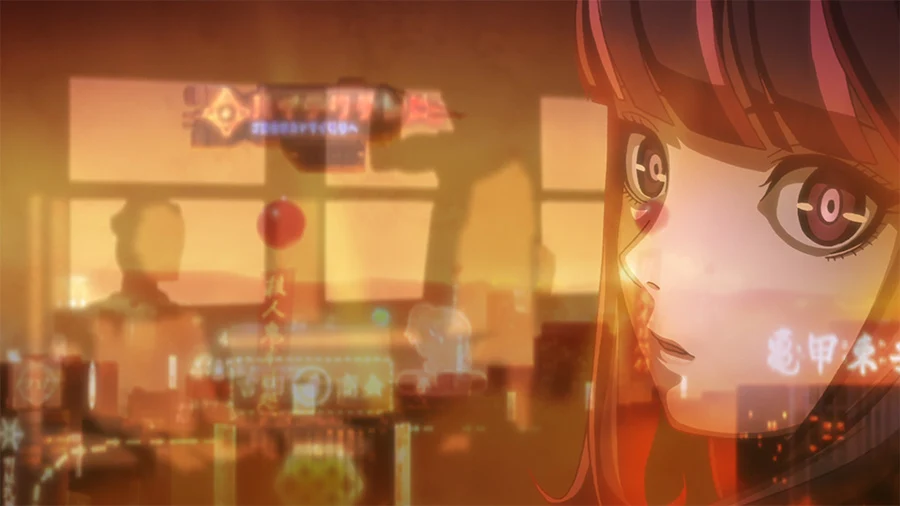
Kansai glows. Signs, screens and coloured light crowd its streets, making even an ordinary evening look extravagant. The society beneath it is much less inviting. An old war has left Kansai subordinate to Kanto, while notorious criminals known as Akudama operate inside its distorted, technologically advanced world.
An ordinary working woman gets caught in a misunderstanding and is arrested. At almost the same moment, several Akudama accept a lucrative job to break someone out of the police station. Their attack puts her in the middle of a story she was not trying to join.
Akudama Drive begins with the momentum of a crime caper. The more interesting question is what happens to a person whose attempt to get through a bad situation makes it harder to return to ordinary life.
How does an ordinary person enter a criminal’s story?
The heroine is first identified as Ordinary Person. Beside the Akudama’s imposing job titles and the enormous sentences they face, her label tells us almost nothing about her. She has a job and a life, but neither has prepared her for the people breaking into her place of detention.
Her disadvantage makes the opening legible. The specialists understand dangerous work; she is trying to survive being mistaken for somebody who belongs among them. Joining their group does not immediately provide their knowledge, confidence or appetite for violence.
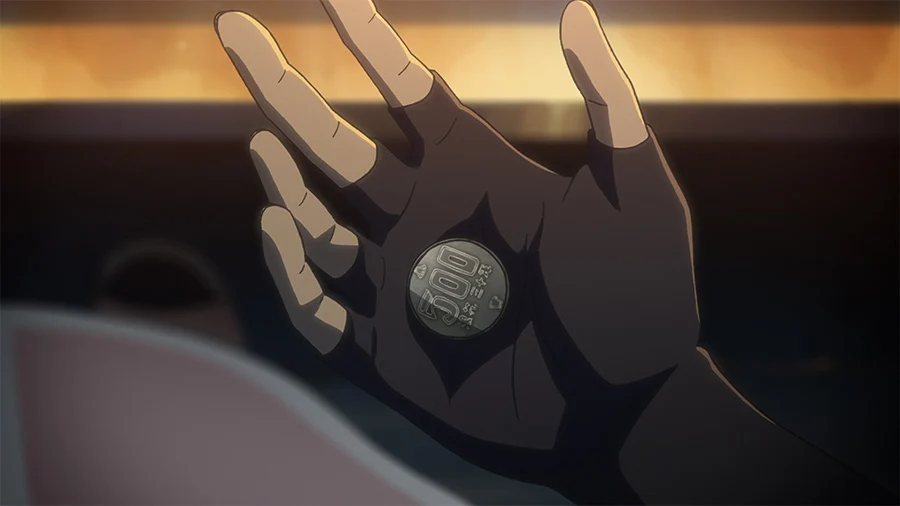
The official designs reinforce the difference. Ordinary Person appears in practical clothes, with a bag and an uncertain sentence where the others have long numbers. The criminal figures have the kind of introductions that tell you immediately how society has classified them. She has not yet acquired such a stable place in its story.
That makes her a useful centre for an ensemble that could otherwise become a parade of extraordinary abilities. Every new complication can be measured against somebody who cannot simply punch, hack or drive her way past it.
What holds these specialists together?
Their labels give an immediate sense of what each can do. Courier is a driver who will transport almost anything and takes absolute pride in the job. Hacker is drawn to the challenge of systems that seem impossible to break into. Expertise makes them useful to a plan, but it does not give them the same reasons for participating.
The team’s first shared task is followed by coercion. Bomb collars stop its members from walking away, and the next target is the Shinkansen, the train connecting Kansai to Kanto. The job is not merely a convenient excuse for the cast to become friends. Someone has made cooperation a condition of staying alive.
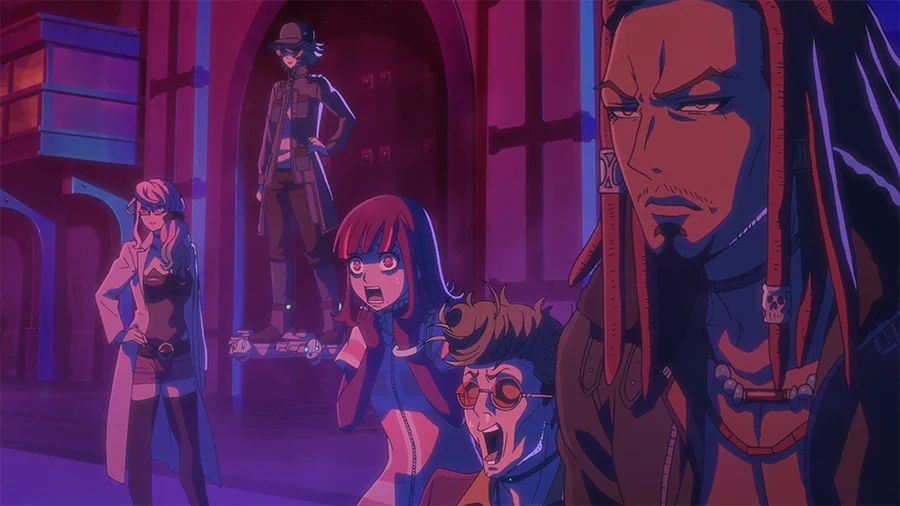
The early mission develops into an infiltration with strict security and limited time. By episode 3, the heroine must face the possibility that doing what she is ordered to do will make her an actual participant in the crime. A label imposed through a mistake can begin to shape the choices available afterwards.
That is the tension underneath the caper. Escaping an immediate threat and preserving the person you thought you were may not lead in the same direction.
Why is the city so inviting and so hostile?
The palette does not reserve beauty for safe places. The episode-one window layers the heroine’s face over reflected signs and warm light. Elsewhere, a corridor turns its occupants blue and magenta. The city can make an alarming person or situation look spectacular.
Character designer Cindy H. Yamauchi adapts Rui Komatsuzaki’s original designs for animation, while Tomohisa Taguchi directs the Studio Pierrot production. The distinct silhouettes and colour contrasts let a crowded criminal ensemble remain recognisable without needing ordinary names for everyone.
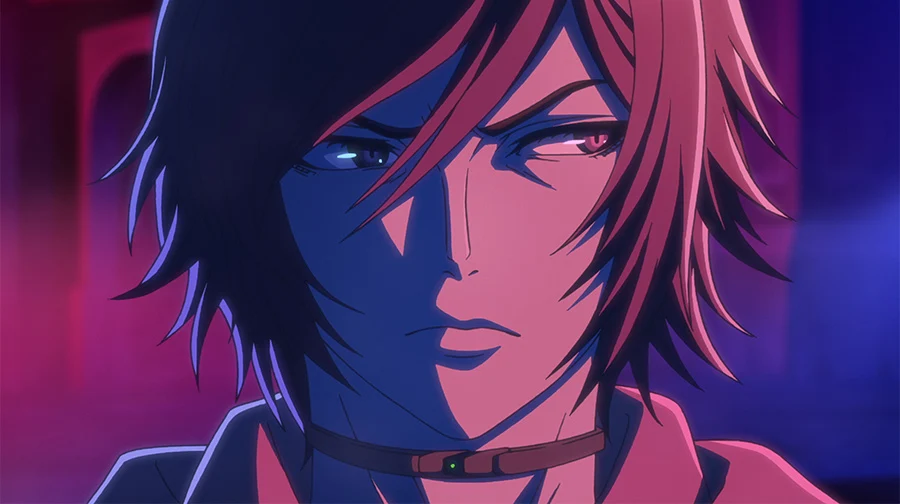
Authority supplies another kind of threat. The Executioners are a police unit specialising in eliminating Akudama. They give the criminals opponents who do not approach every encounter as an opportunity to negotiate. The ordinary woman’s difficulty is not simply choosing the nicest person in the room; the room’s rules are dangerous too.
This is a violently heightened setting. Its action involves enormous damage, brutal injuries and bodies treated as disposable. The bright surface should not be mistaken for emotional lightness or an assurance that the people caught in it will be safe.
Is this connected to Danganronpa?
It shares creators, not a required backstory. Kazutaka Kodaka supplies the original story concept and Komatsuzaki the original character designs; the pair also worked on Danganronpa. Akudama Drive is an original television anime, with a new setting and cast. You do not need to play a game or finish another series before starting.
Its compressed route is part of the invitation. The early jobs provide clear objectives, then expose the heroine to conflicts that cannot remain an amusing misunderstanding. Expect a crime adventure that develops beyond the opening’s team-up premise, rather than twelve interchangeable missions. If you want the city explained as patiently as the action is staged, its speed may leave you wanting more room between crises.
Where should you begin, and which final episode is this?
Start with episode 1, SE7EN, and continue through episode 12 of the original 2020 series. There are twelve episodes, not a separate sequel to watch after the finale.
The final episode also has an extended director’s cut. The official complete-series Blu-ray includes that version; the earlier final volume listed it as an extra. It expands the same ending and does not become episode 13.
For the home-video route, allow about four hours and fifty-five minutes. The BBFC-listed edition gives eleven episodes at 24 minutes and the finale at 32, making 296 minutes. This is an approximate edition-based planning total; a service carrying the broadcast finale may have a different runtime.
What does the original trailer introduce?
Crunchyroll Dubs’ official trailer introduces the original 2020 series. It includes violent action.
Original 2020 series · Crunchyroll Dubs · official trailer
Loading the player connects to YouTube. Playback does not start automatically.
Watch on YouTube · Poster: original-series episode 1 still. © 2020 Pierrot, TooKyoGames/Akudama Drive Production Committee Licensed by Funimation Global Group, LLC. All Rights Reserved.
Sources
Later synopses, character-page alternate versions and detailed classification advice contain major spoilers.
- Official introduction, for the world, original-anime identity and creators.
- Official episodes 1, 2 and 3, for the arrest, coerced team and first infiltration setup.
- Official profiles for Ordinary Person, Courier and Hacker, for the original designs and roles.
- Official staff credits, for the adaptation of the original character designs.
- Complete-series Blu-ray and original final volume, for the extended finale’s edition relationship.
- BBFC’s classified edition, for runtime and specific content guidance.