
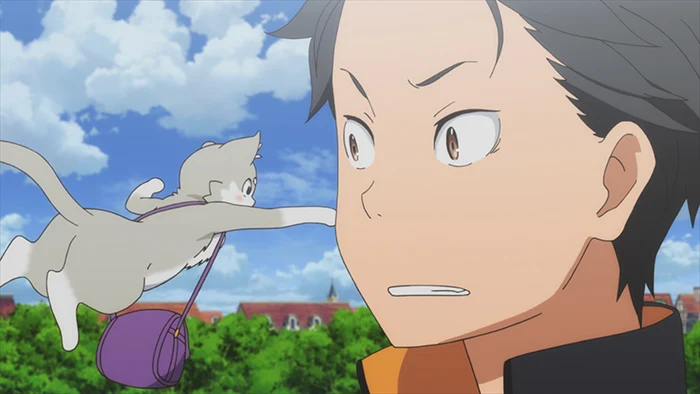
Subaru Natsuki leaves a convenience store and finds himself in another world. The unfamiliar city looks like the beginning of an adventure he already knows how to imagine: perhaps somebody has summoned him, perhaps an extraordinary ability is about to reveal itself, perhaps being the newcomer makes him important.
Then local thugs beat him, and a silver-haired girl has to help.
Re:ZERO gives Subaru something extraordinary, but it does not make his first assumptions reliable. Return by Death sends him back to an earlier point when he dies. He can try again while remembering what went wrong. His body is still vulnerable, the people around him do not share those experiences, and knowing that danger is coming does not automatically give him the means to stop it.
What has actually travelled with him?
The opening puts an ordinary young man in a place where his expectations are more useful for making guesses than for winning a fight. He recognises the shape of a fantasy adventure before he understands the city, its people or his place among them.
That distinction starts before the first reset. Subaru wants the reassuring role of someone chosen for a special purpose, but the world is not waiting to explain that purpose to him. A moment can be exciting and humiliating within the same encounter.
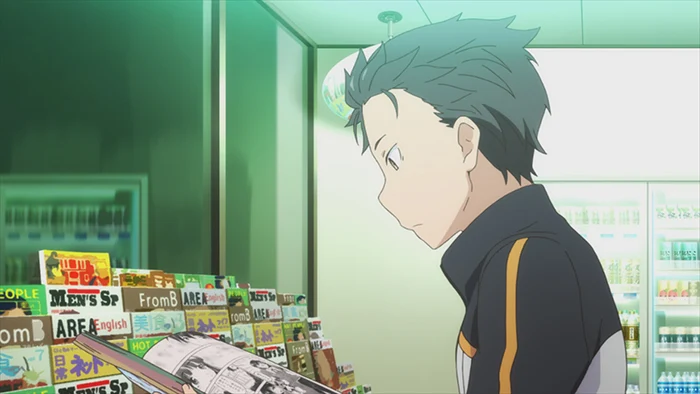
The convenience-store image makes that starting point concrete. A tracksuit, fluorescent light and packaged goods belong to a recognisable routine. Carrying the same person into a sunlit fantasy city does not transform his judgement at the same speed as the scenery.
The story is therefore interested in more than whether he has a useful ability. It asks how he interprets other people, how confidently he expects to be understood and what he does when the encounter refuses to match the story in his head.
Why does helping Emilia become personal?
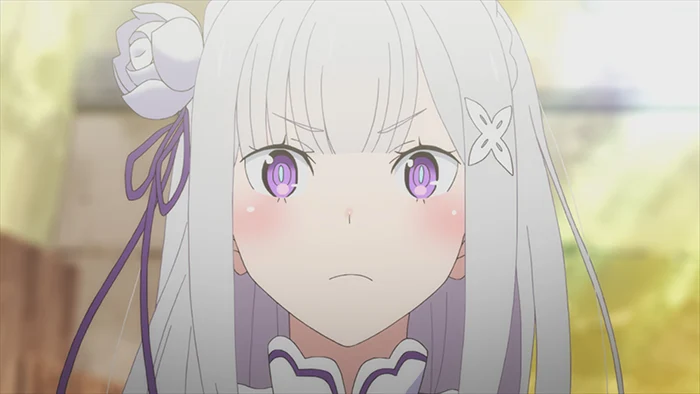
Emilia, the silver-haired girl who helps him, has a problem of her own: a stolen insignia. Subaru joins her search because he wants to repay her kindness. The first adventure begins with an exchange between people rather than a command from a distant authority.
Her helpfulness matters because she is already occupied. She does not exist only to welcome Subaru into a fantasy. There is something she needs to recover, and his wish to help has to meet the circumstances of her life.
Felt, a young thief connected to the stolen object, gives that search somebody else’s priorities to negotiate. Reaching a person, getting them to listen and obtaining what you need are different obstacles. A memory from a previous attempt cannot simply be handed over as proof to somebody who never experienced it.
That asymmetry makes trust an important part of the thriller. Subaru may feel urgency, familiarity or affection that another person has no reason to recognise. The same conversation can mean very different things to its participants.
What can another attempt fail to fix?
A reset provides information, but information is not strength. Subaru can know a place is dangerous and still have to enter it with the same vulnerable body. He can care about a person and still misunderstand how to reach them.
The early mansion story extends the problem into a different sort of routine. Subaru begins working alongside Rem and Ram, trying to find a place in a household. Chores, relationships and a hoped-for outing with Emilia become things he wants to preserve. The stakes are not confined to surviving an obviously threatening street.
The horror lies partly in how ordinary something can look before it becomes unsafe. A friendly face or a familiar room does not certify the future. Repetition asks the viewer to pay attention to small changes while Subaru carries the fear of larger ones.

The bright setting is useful to that tension. A busy skyline, warm roofs and a fast-moving figure offer the energy of an adventure. Subaru’s unusual experience does not remove that attraction; it changes what returning to the same place might mean.
This can be a demanding way to tell a fantasy. The story spends time with panic, mistaken confidence and attempts that do not work. Subaru’s desire to help is not a guarantee that his behaviour is wise or pleasant. If you want the summoned hero’s special ability to settle his place immediately, this is a much more uncomfortable relationship with being special.
How should you start the television route?
Start with season 1, originally released in 2016, then continue through seasons 2, 3 and 4. The original numbered route contains 25 + 25 + 16 + 19 = 85 episodes through the completed fourth season, as recorded in October 2026. That is a released endpoint for this introduction, not a claim that the whole franchise is finished.
The first season also has an alternative Director’s Cut, arranged into longer instalments. Choose one presentation of that season, then continue to season 2; watching both is not required. The 85-episode count above uses the original 25 episodes. Its first episode is already double-length and may be labelled 1A and 1B by a release, without becoming two separate story starting points.
The facts panel’s roughly 35 hours uses a nominal 25-minute allowance. Several episodes run longer, so treat that as a broad scale indicator rather than an exact playlist total or a promise that each episode fits a short break. Memory Snow, The Frozen Bond and the short bonus series are separate from this television count and are not prerequisites for the first episode.
Later-season trailers and character pages can reveal identities or outcomes well beyond the opening. Begin with season 1 if you want to discover those developments with Subaru.
Sources
Official episode archives and licensed disc synopses contain major story spoilers.
- Official first-season archive, especially the introduction and original episodes 1–5, for the arrival, reset premise, insignia search and early household setup.
- Anime Limited’s first-season Part 1 and Part 2, for the original 25-episode presentation and double-length opening distinction.
- Official disc archive and fourth-season broadcast information, for the released route’s endpoint and fourth season’s nineteen episodes.
- Crunchyroll’s licensed listing, for the premise, Director’s Cut presentation and broad content categories.