
What if the sky were somewhere you could fall?
Patema lives among tunnels, pipes and the remains of an industrial complex. She wants to explore beyond the places her community considers safe. When an excursion takes her into the surface world, open air becomes a terrible discovery: gravity pulls her towards the sky. The ground that reassures everyone around her offers no protection at all.
Age, a boy from the surface, finds her and tries to help. To him she is upside down. To her, he is the one standing the wrong way round. Their meeting establishes the central rule of Yasuhiro Yoshiura’s film with unusual economy: a person can describe the same place truthfully and still mean its opposite.
There is an immediate adventure in working out how these two bodies can occupy one space. Holding on lets their opposing pulls counterbalance one another. A simple embrace becomes support, transport and a risk. Letting go is no longer an abstract expression of trust.
Why is helping Patema a dangerous choice?
Age’s home, Aiga, is an authoritarian society whose teachings condemn people who fell into the sky as sinners. Its rules join a physical direction to a moral judgement. Patema arrives as a frightened person needing help, but the authorities already have a category for her.
That makes Age’s curiosity consequential. He cannot treat her as an interesting visitor and carry on as before. Keeping her safe puts him at odds with the people who expect obedience. Patema, meanwhile, has to rely on someone whose most ordinary surroundings are lethal to her. Courage means different things for them: he must question what he has been taught, while she must accept help without being able to put her feet on reassuring ground.
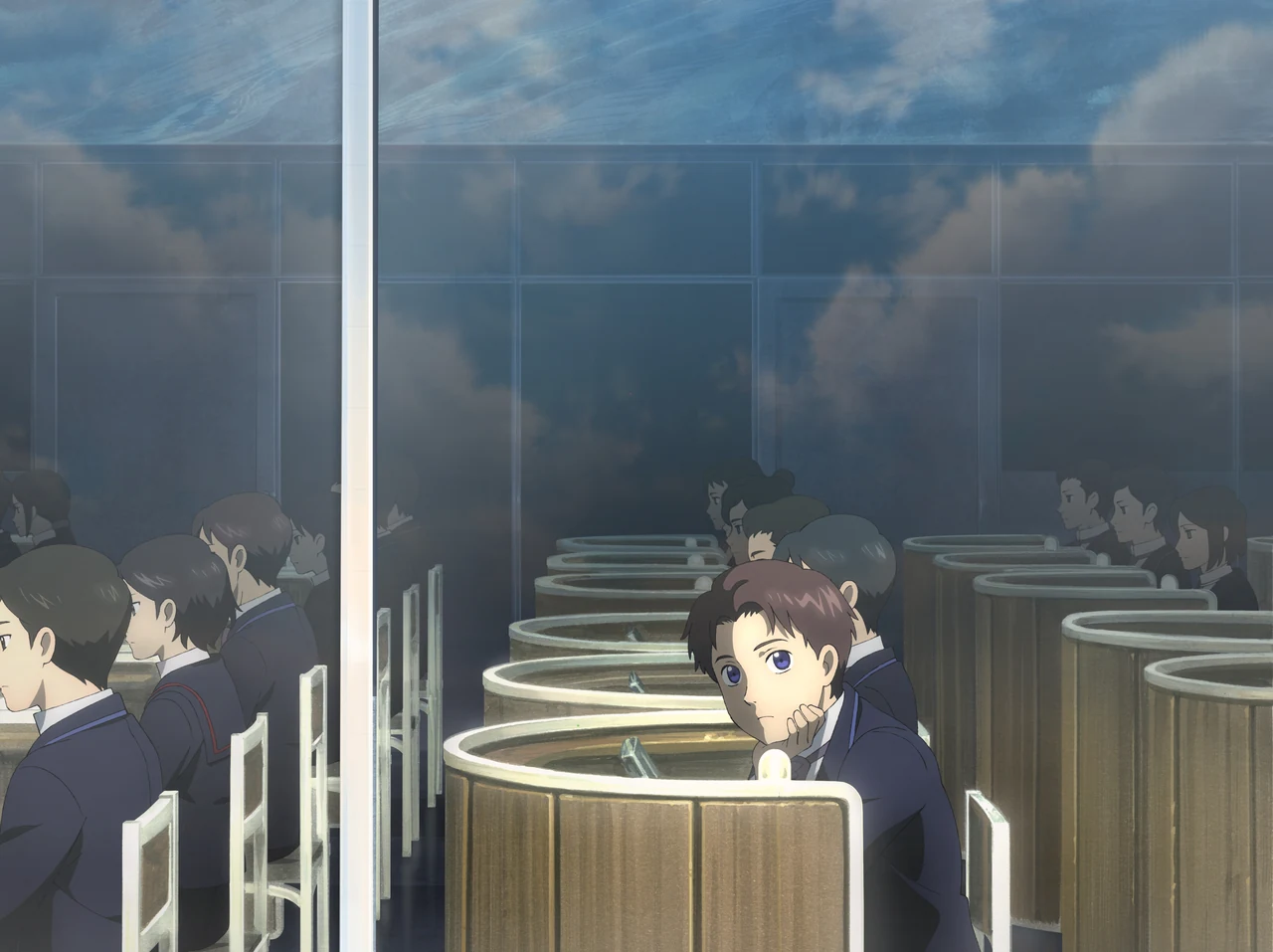
The romance grows out of that awkward dependence. They cannot begin from the assumption that what feels safe to one will comfort the other. It is an appealingly concrete basis for getting to know someone: notice what frightens them, adjust your own movements and learn how to keep them close without putting them in danger.
How does the film make both viewpoints feel real?
The image can turn to match the person whose experience matters at that moment. A room that looked secure becomes an exposed drop; someone apparently hanging from a ceiling can be standing quite normally. Adam Starkey’s Starburst review identifies these rotating viewpoints as the film’s strongest device. The effect is more than a puzzle to solve. It asks the audience to exchange one character’s sense of balance for another’s.
The contrast works in confined spaces as well as open skies. Shelves, doors and beams provide familiar reference points, making it possible to understand where each person could fall. The film can keep its fantastic rule visible while giving the pair practical problems to negotiate.
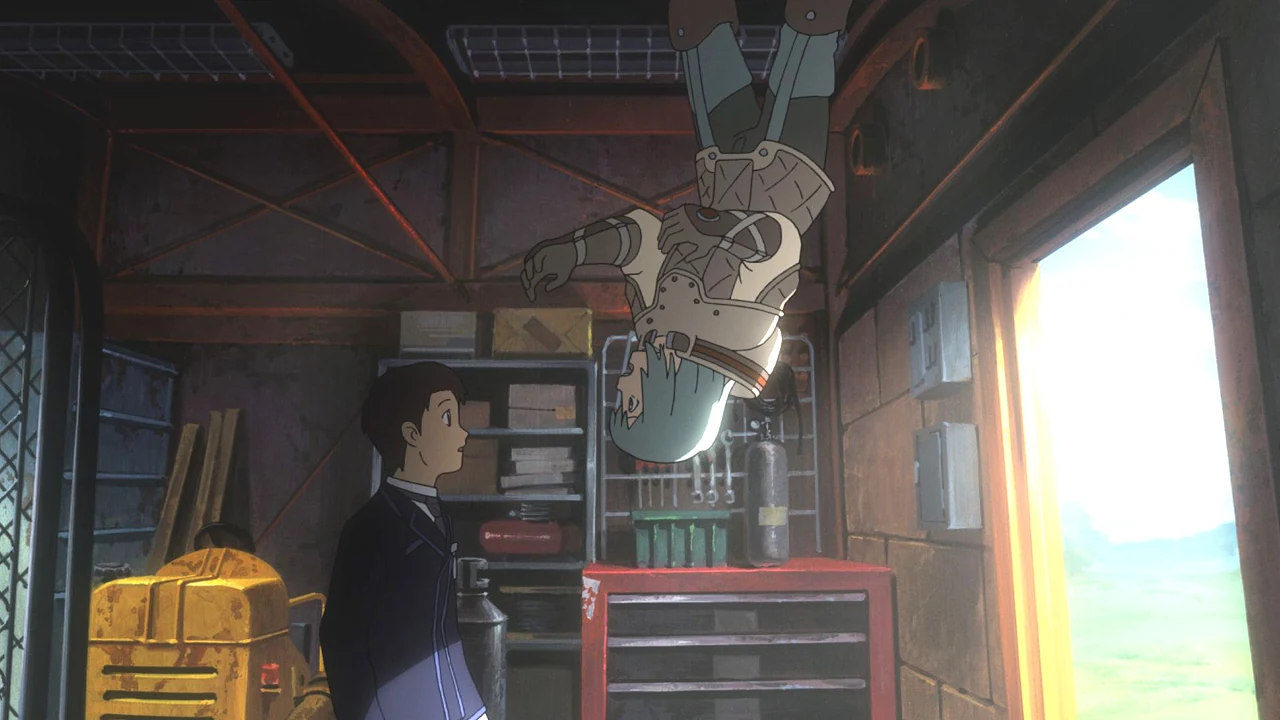
Yoshiura described that connection explicitly in an Animate Times interview: he wanted inversion to express the emotional distance between Age and Patema, rather than serve only as a surprise. The mechanics are doing character work. Moving closer is something the pair must physically learn.
There is room for comedy inside the danger, too. Writing for the distributor’s All the Anime blog, Andrew Osmond singles out Patema’s insistent demands interrupting a romantic musical mood. It is an apt complication: the situation may look tender from outside, but she is still trying not to fall. Affection does not instantly remove fear.
Where does the adventure feel less surprising?
The villainy is more conventional than the geography. A regime that fears the outsider provides clear obstacles, but less uncertainty about whom to oppose. Brian Tallerico’s RogerEbert.com review finds the central relationship compelling while criticising the surrounding narrative and thin villains. Starkey is warmer about the writing, so there is no need to treat that reservation as an agreed verdict.
The useful distinction is between the physical and political pleasures of the film. Its most distinctive question is how two people can help each other when their bodies obey opposite rules. The pursuit surrounding them supplies urgency, though it does not always match the inventiveness of that encounter. Come for the shifting viewpoints and improvised partnership; the world also has mysteries whose explanations are better discovered in the story.
Where should you start?
Watch the 2013 feature, allowing approximately 99 minutes. The separately released Beginning of the Day shorts are not a viewing prerequisite. JFDB lists 99 minutes; the BBFC’s UK cinema record is just over 98 minutes, so this is a rounded allowance rather than an exact duration for every edition.
The official UK trailer previews the peril and may include later locations or discoveries. Skip it to preserve the film’s spatial surprises.
2013 film · All the Anime · UK subtitled trailer
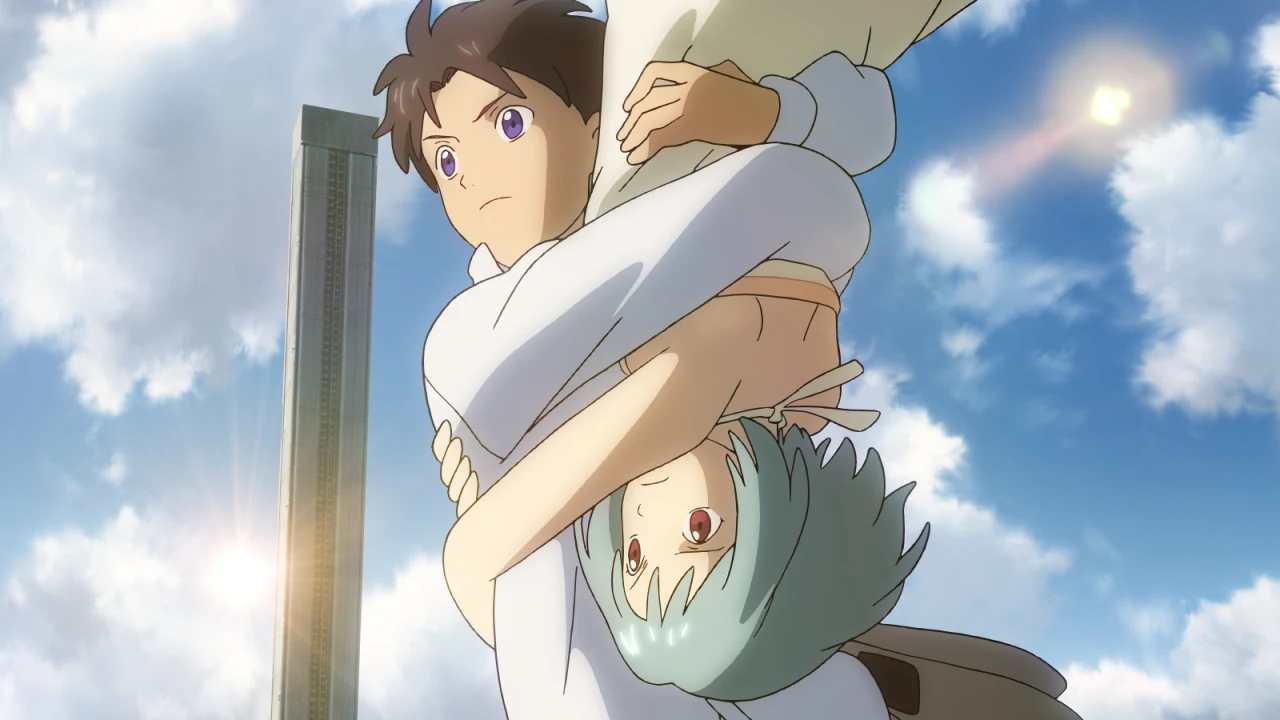
Loading the player connects to YouTube. Playback does not start automatically.
Watch on YouTube · (c)Yasuhiro YOSHIURA/Sakasama Film Committee 2013
Sources
The distributor synopsis, interview and reviews discuss discoveries beyond the opening; some explain the world and ending.
- GKIDS: Patema Inverted: premise, character roles and official stills.
- JFDB, operated by UNIJAPAN: Japanese release on 9 November 2013, original story, director and 99-minute listing.
- Yasuhiro Yoshiura interview, Animate Times: the relationship between inversion, camera viewpoint and emotional distance.
- Adam Starkey, Starburst: visual orientation and a favourable reading of the adventure.
- Brian Tallerico, RogerEbert.com: the central pairing, narrative reservations and villains.
- Andrew Osmond, All the Anime: physical comedy and perspective; published on the UK distributor’s blog.
- BBFC: UK editions: edition-specific running times and content guidance.