
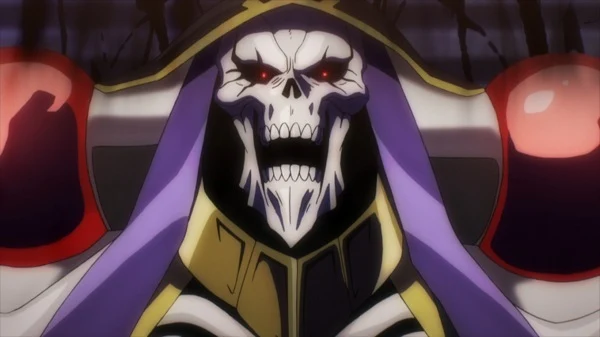
An online game is about to close. Momonga stays in the guild’s fortress until the end, surrounded by the creations and possessions that remain after his friends have gone. The appointed time arrives, but the expected disconnection does not. His skeletal avatar is still there. The fortress’s inhabitants are answering him as living people.
Overlord begins with authority already in place. Momonga does not have to work his way up from the weakest adventurer: the inhabitants of Nazarick recognise him as their ruler. What he lacks is a reliable explanation of the world beyond its walls and of what his new position will require.
What survives when a game stops behaving like a game?
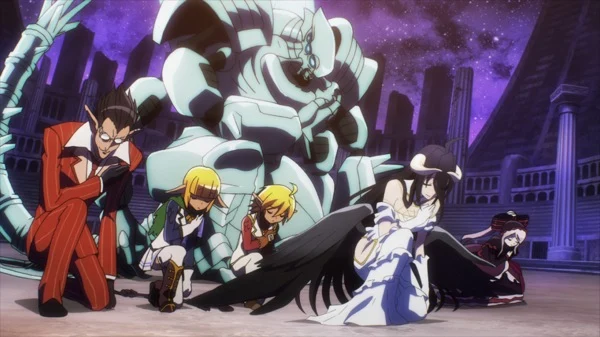
Nazarick is a home full of the traces of absent companions. Its inhabitants were originally non-player characters, beings created to serve roles within the game. Their new independence makes that inheritance more complicated. They have loyalties, personalities and expectations of their own.
Their devotion offers Momonga support, but it also puts pressure on him to behave like the ruler they believe him to be. Admitting uncertainty can feel much harder when everyone around you assumes you possess extraordinary wisdom.
The skeletal body makes the distinction visible. There is no ordinary human face available to carry every hesitation. The imposing skull and elaborate robes project certainty, while the premise places an uncertain former player inside them. A great deal of the story’s interest sits between the performance of power and the knowledge needed to use it.
Why leave a place where everyone obeys?
Absolute authority at home does not explain the surrounding society. Money, institutions and the strength of possible opponents have to be investigated. Even a very powerful person can make a poor decision with incomplete information.
In original episode 5, the ruler and Narberal, one of Nazarick’s attendants, enter the city of E-Rantel and register as adventurers under the names Momon and Nabe. They want information and money, but the guild assigns them its lowest rank, copper. That limits them to simple jobs, whatever strength they possess.
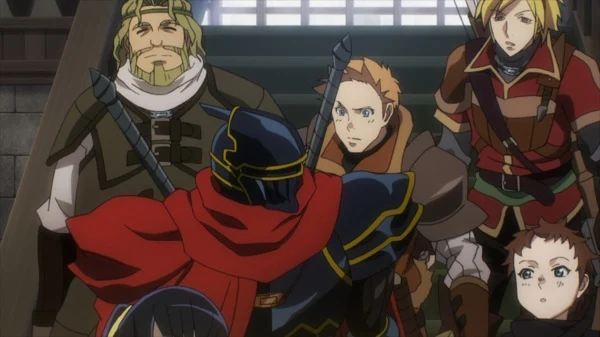
An invitation from a silver-ranked adventurer team offers a way into that working world. Other adventurers have contacts, experience and standing that the newcomers have not acquired locally. The problem gives someone extraordinarily powerful a reason to listen to people who could never threaten Nazarick on equal terms.
That gives the fantasy two scales. Inside the fortress, Momonga must live up to the reputation he has inherited. Outside it, he has a new reputation to build. The imposing ruler and the low-ranked adventurer are two performances with different audiences, and neither tells those audiences everything about the person underneath.
Is power the same thing as being the hero?
The story’s viewpoint should not be mistaken for an assurance of benevolence. Nazarick is a stronghold of monsters with intense internal loyalties. Protecting that household is not automatically the same project as protecting everybody outside it.
That distinction makes Overlord a darker use of the transported-player premise. The central question is not whether the strongest person can defeat the next enemy. It is what a powerful ruler decides to pursue, what followers infer from those decisions and how those plans affect people who have no comparable strength.
There is comedy in the distance between appearance and uncertainty, but also cruelty, bloody violence and sexualised material. The inhabitants’ distinctive designs can be entertaining without making their world a comfortable place to live. Expect a fantasy of hierarchy and expanding influence, rather than a reassuring party of equally vulnerable friends.
Where should you start?
Begin with the 2015 first television season, then continue through seasons 2, 3 and 4. Each contains 13 episodes, for 52 in this television route. A nominal 24-minute allowance gives about 21 hours.
The two earlier compilation films retell television material. The Sacred Kingdom is a continuation film, separate from those compilations and from this 52-episode total. Ple Ple Pleiades is a separate short-form companion, not required preparation for episode 1.
What is the original series trailer?
The first promotional video is for the 2015 television adaptation. It shows more of the series than the original setup described above.
Original 2015 series · mediafactory · first PV. Opens YouTube.
Sources
Later episode and film descriptions reveal major outcomes.
- Official original-season introduction and story archive, especially episodes 1–2 and episode 5, for the changed game world, the pressure of loyalty and the copper-ranked adventurer setup.
- Licensed original-series record, for the first-season identity and route; corresponding records for seasons 2, 3 and 4.
- Official film site, for the separate Sacred Kingdom edition identity.