
Why does Naruto want the village to notice him?
The Hidden Leaf Village trains ninja to carry out missions, from everyday jobs to work that can get them killed. Its leader, the Hokage, is someone the village respects and depends upon. Naruto Uzumaki wants that position with the furious certainty of a child who has very little respect coming his way.
He is loud, troublesome and behind his classmates at the Ninja Academy. The adults’ hostility has a deeper cause: the Nine-Tailed Fox that once attacked the village is sealed inside him. Naruto has grown up carrying the consequences of something he did not choose. Becoming Hokage would mean the people who avoid him finally having to say his name with pride. Official series premise.
That makes a small act of acceptance matter before any grand victory is possible. Iruka, his academy teacher, sees a child where others see a threat. The opening makes recognition something Naruto can receive from one person, not only a prize waiting at the end of a career. Official opening-story account (also contains later franchise outcomes).
His ambition is easy to understand; his conduct is not always easy to endure. The pranks and boasting are funny partly because they are so excessive, but they also keep exposing how badly he wants a response. Naruto’s energy gives the story its invitation: someone this determined to be noticed is going to make trouble wherever he goes.
How can these three children become a team?
Graduation puts Naruto alongside Sasuke Uchiha and Sakura Haruno under the supervision of Kakashi Hatake, an experienced ninja with a covered face and an unhurried manner. They are Team 7 by assignment before they have much reason to choose one another.
Sasuke is the talented classmate Naruto wants to beat. Naruto likes Sakura; Sakura likes Sasuke and initially has little patience for Naruto. The early comedy makes this triangle awkward rather than harmonious. In episode 3, Naruto even impersonates Sasuke in an attempt to win her attention. His ability to transform is useful magic put to a very childish purpose. Official episode 3 synopsis.
Kakashi’s first survival exercise sharpens that competition. Three students face a test presented as having room for only two successes. Each has a reason to secure their own place; their teacher has reasons to care about how they treat one another. The apparent mismatch between a team assignment and an individual contest gives the lesson its bite. Official episode 4 synopsis.
Sasuke’s reserve also has more behind it than looking impressive. Revenge gives his pursuit of strength a different destination from Naruto’s hunger to belong. Their rivalry can make them work harder, yet becoming stronger does not mean the same thing to each boy. That difference makes cooperation worth watching: accepting help from the person you measure yourself against is its own difficult achievement.
Sakura brings another measure of ability. The early chakra-control training, which teaches the children to manage the energy behind their techniques, allows her to excel where the boys struggle. The story does not develop that promise equally. In a rereading of the early manga, Moonlit Media Room points to the gap between her competence and the opportunities she receives beside Naruto and Sasuke. That is a useful reservation about the shared story, rather than a reason to dismiss her concern for the team. The anime later gives her a more exposed defensive role during the exams, when caring about her teammates requires action.
What makes the first dangerous mission different?
An escort job takes Team 7 out of the village to protect Tazuna, a bridge-builder. The Land of Waves introduces a more disturbing meaning of ninja work: these children are entering conflicts in which adults hire people to kill. Their opponent Zabuza and his young companion Haku bring their own bond into that world.
Naruto’s wish to be a great ninja now has to survive an encounter with what ninja are asked to do. Loyalty may mean protecting someone; it can also mean making yourself useful to someone who treats your life as expendable. The tension is already present in this first substantial mission, well before the series grows into larger conflicts. It gives the adventure an emotional question beyond whether Team 7 can win: what sort of people will this work teach them to become?
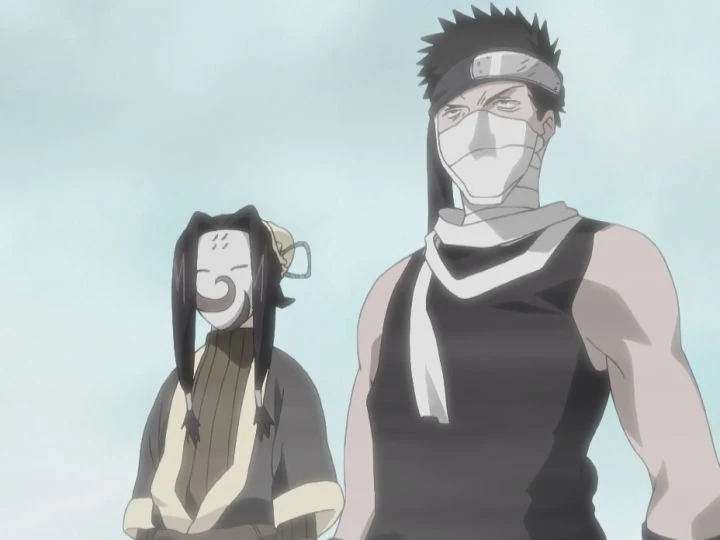
Why do the fights reward paying attention?
A useful early example is the battle in which Zabuza traps Kakashi in a sphere of water. The team’s strongest fighter is suddenly unavailable. Naruto and Sasuke have to solve a problem together using techniques they already know, including transformation and shadow clones, which create physical copies of Naruto. The pleasure lies in how familiar tools can conceal an unfamiliar plan.
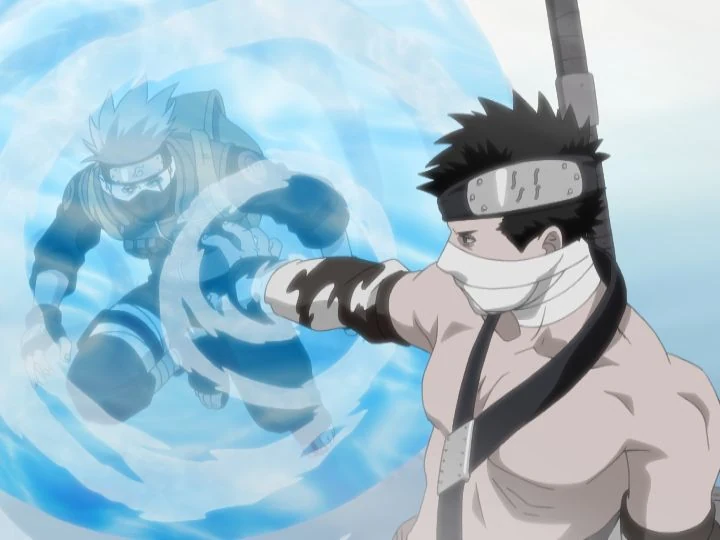
The composition makes the constraint legible: Zabuza occupies the foreground while Kakashi is enclosed behind him. The scene turns the boys’ usual comparison of ability into a question of coordination. It is a particularly clear example of the series making a relationship part of a tactical problem. The official anniversary retrospective describes their combined strategy; it also reveals the mission’s outcome, so save that link for afterwards.
Later, the Chunin Exams, tests for promotion beyond beginner rank, expand the range of opponents and techniques. An assessment of skill becomes a meeting place for children with different teachers, loyalties and expectations. Ryan’s Anime UK News review of the exam episodes finds much of the appeal in the cast becoming more distinct as their fighting styles emerge.
Those explanations have a cost. The anime repeatedly pauses to unpack a move, recall an earlier encounter or return to an emotional turning point. Ryan notes repeated footage in the exam volume; Dex Fragg at Anime Craves finds the pauses particularly frustrating during the Land of Waves. Understanding a trick and feeling the fight advance are different pleasures, and Naruto can favour the former for longer than a viewer wants.
Is there room for the team to be silly?
Plenty. Episode 101 gives Naruto, Sakura and Sasuke a shared objective of rather less consequence: discovering what Kakashi looks like under his mask. Their teacher becomes the mystery they all want to solve. That shift is a useful part of the appeal, letting the same children who compete and worry together spend time on something ridiculous. Official episode 101 synopsis.
The humour also includes sexual transformations and voyeuristic behaviour played for laughs. Those jokes can sit awkwardly beside the care the story gives to loneliness and loyalty. They are part of the original series’ tone, alongside the broad faces, impatience and embarrassment that make its young cast feel young.
Where should you start, and how far does this run go?
Start with Naruto episode 1. The original 2002–2007 run has 220 episodes, about 88 hours at a 24-minute planning allowance including credits. The opening team formation occupies episodes 1–5; the first mission outside the village runs through episode 19. That gives you an early view of both the comedy and the more dangerous work without needing to promise yourself the whole series.
The story continues in Naruto Shippuden, a separately numbered series. Films and Boruto are separate from these 220 episodes. The Naruto watch-order guide explains the transition and a shorter original-series route that preserves mixed episodes and one comic detour.
Trailer warning: VIZ’s Set 1 promotion includes later original-series characters, powers and combat imagery. Save it for later if you want to discover those in the episodes.
Original Naruto · Set 1 · VIZ
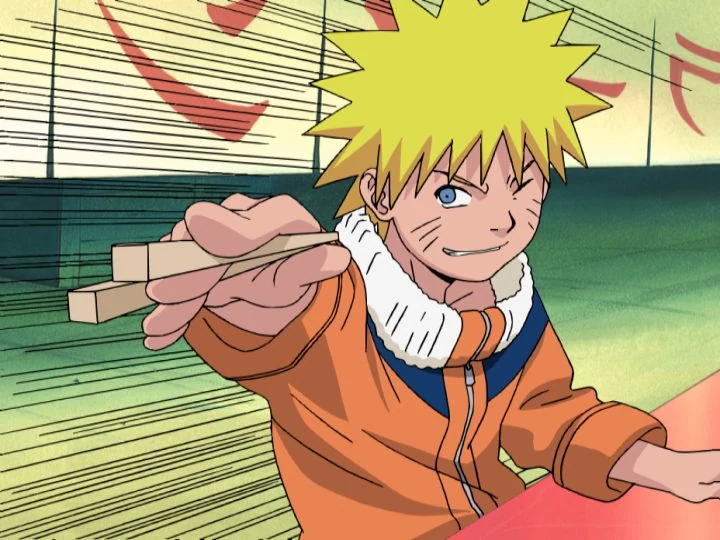
Loading the player connects to YouTube. Playback does not start automatically.
Watch on YouTube · ©2002 MASASHI KISHIMOTO. Source: NARUTO Official Site.
Sources
The episode descriptions, retrospectives and criticism below contain story outcomes. The official About page also describes later franchise developments.
- Official original-series page and opening-story account: village, ambition, isolation and Team 7.
- Official episode 3, episode 4, episode 10 and episode 101: the team’s opening friction, survival test, chakra training and mask comedy.
- Official anniversary retrospective: early arc ranges, team tactics, exam scenes and the three selected introduction stills.
- Ryan, Anime UK News, Naruto Unleashed 2:1: exam-world detail, character appeal and repetition in this thirteen-episode volume.
- Dex Fragg, Anime Craves, Land of Waves: a less favourable view of the opening mission’s prolonged tactical explanations.
- Moonlit Media Room, Land of Waves rereading: character relationships and Sakura’s underused strengths; principally a manga reading, not an animation assessment.
- Common Sense Media: content guidance and reservations about the series’ sexual humour and stereotypes.
- VIZ’s original-series catalogue, first release’s episode count and duration, and Studio Pierrot’s title archive: original scope, the planning multiplier and broadcast years.
- VIZ’s Set 1 trailer: promotion for the original series’ opening 27 episodes.