
The detailed skip route below covers the original Naruto only. Its 220 episodes and Shippuden’s 500 make a 720-episode television route before films or Boruto. No film is required between the two series.
For the complete original television experience, watch all 220. For a shorter route, use the ranges below. It keeps 131 episodes, including every episode Anime Filler List marks as wholly or partly adapted from the manga, plus episode 101 for a lighter Team 7 adventure. It is a practical selection, not a promise to remove every scene added by the anime.
The skip table covers original Naruto only. Films and Boruto have separate places below.
Which original Naruto episodes can you skip?
Watch 1–25, 27–96, 98–101, 107–135, 141–142 and 220, in that order. These are continuous original-series numbers, not a streaming service’s season numbers.
| Optional episode(s) | What you leave out | Resume at |
|---|---|---|
| 26 | A comic report and recap around the exams. | 27 |
| 97 | A hot-spring side adventure. | 98 |
| 102–106 | The Land of Tea escort mission, centred on protecting a runner. The following episode can refer to the preceding adventure. | 107 |
| 136–140 | Most of the Fuma Clan mission. Episode 141 concludes this adventure before its important character material, so the jump lands inside a story. | 141, then 142 |
| 143–219 | The rest of the prison-related mission and a long sequence of extra missions and character outings. Episode 220 still opens by concluding the last of them. | 220, watched whole |
The omissions total 89 episodes: 1 + 1 + 5 + 5 + 77. The 131 retained episodes plus those 89 equal the full 220. At 24 minutes per episode, the shorter route is about 52 hours, compared with 88 hours for the full original run. You save roughly 36 hours. These are rounded planning estimates including credits, based on VIZ’s 648-minute listing for its first 27 episodes; adverts, recaps you manually skip and edition differences change the actual time.
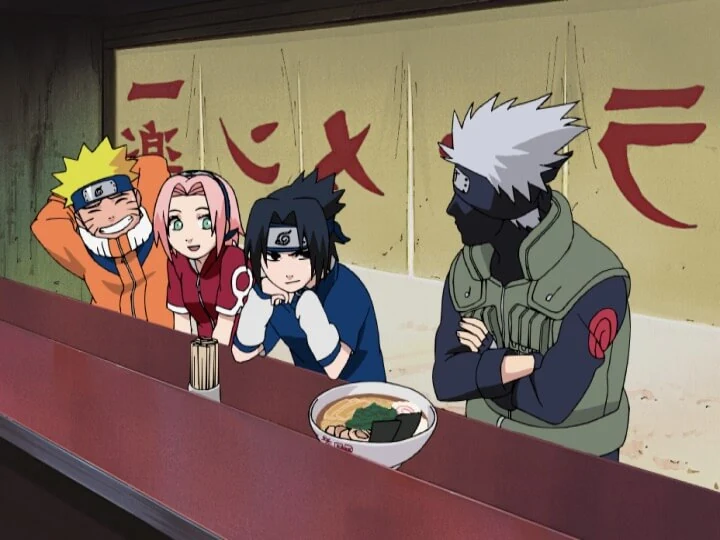
“Filler” is a source-adaptation label, not a quality rating. The two linked lists below expose later episode titles and story details. The Anime Filler List classifications put 101 in the filler group, producing 90 optional episodes if it too is omitted. Anime Filler Guide’s chapter map treats 101 separately as databook material and lists the same 89-episode omission set used here. Our reason to retain it is simpler: it gives all three students a common comic objective, discovering what Kakashi hides beneath his mask.
Which episodes must survive the big jumps?
Keep 99, 141, 142 and 220 whole, as well as the other mixed episodes already included in the watching ranges. Mixed means an episode contains both adapted material and additional scenes. A broad “everything after 135 is filler” rule erases useful transitions.
Episode 141 combines the conclusion of a side mission with a decision about Sakura’s training. 142 includes material about Naruto’s next training arrangements while opening another side story. 220, titled Departure, closes the final extra mission and supplies the actual handoff towards Shippuden. Both specialist lists preserve manga material in these episodes; the official summaries also show why 142 and 220 contain more than isolated adventures.
Keeping them does leave joins. At 141 and 220, you will meet the end of a conflict you skipped. At 142, you will see the beginning of one you will not follow. If finishing every introduced conflict matters more than saving time, watch the complete run. There is no need to mistake those references for a missing episode on your service.
This guide does not use minute-by-minute cuts. The chapter-map source itself gives different times for different editions, and keeping the full episodes avoids trimming out the wrong conversation. It also leaves their anime-original scenes intact.
What do the extra episodes offer?
The late original-series missions spend time with combinations of characters outside the central trio. For instance, 148–151 take Naruto on a search with Team 8, while 203–207 turn towards Kurenai and a former pupil. If those characters interest you, their complete blocks give you something specific to choose rather than treating 77 episodes as one undifferentiated obstacle. Both blocks sit inside the optional 143–219 range, so adding either means adding its four or five episodes to the 131 total.
The trade-off is that these adventures postpone the next stage of the central story. Andrew Girdwood’s contemporary review of Naruto Unleashed 8:1 finds some improvement in its smaller stories but remains frustrated by that wait. Choosing a side story for its cast is a different proposition from watching it because you expect the central conflict to move forward.
What comes after the original episode 220?
Choose Naruto Shippuden, beginning with episode 1, and follow its own numbering through 500. It continues Naruto’s story; it is not a remake that allows you to bypass Team 7’s beginnings. Some databases add the original run and call the first Shippuden episode 221. Match the series title as well as the number.
The shorter route above applies only to original Naruto. It is not a Shippuden filler list. Shippuden’s 500 episodes are additional, and its own interruptions and adaptations need different choices. The full two-series route is 720 episodes; using this guide’s original-series selection and watching all of Shippuden gives 631.
Boruto: Naruto Next Generations belongs after Naruto and Shippuden, and starts a later-generation story with its own episode 1. Its first part runs to 293 episodes. That is a defined part boundary, not a claim that 293 is the final size of the entire Boruto franchise. Neither Boruto nor the separate Rock Lee comedy is homework for beginning Naruto.
Where should the films go?
For a first watch, keep the television route simple. Save the three original-era films until after original episode 220, then watch them in release order if you want more adventures with the younger cast:
- Ninja Clash in the Land of Snow (2004)
- Legend of the Stone of Gelel (2005)
- Guardians of the Crescent Moon Kingdom (2006)
You can also continue straight to Shippuden and return to them later. Their placement here is a convenient viewing recommendation, not a claim that they take place after the original finale.
For the later films, finish Shippuden before working through this release-order list:
- Naruto Shippuden the Movie (2007)
- Bonds (2008)
- The Will of Fire (2009)
- The Lost Tower (2010)
- Blood Prison (2011)
- Road to Ninja (2012)
- The Last: Naruto the Movie (2014)
- Boruto: Naruto the Movie (2015)
This conservative route lets the television series introduce its people and abilities first. It does not recreate the historical alternation of film releases and broadcasts, or claim an exact point between episodes where every film fits.
The Last deserves particular attention: it develops a relationship in the period after the central conflict. Watching it after Shippuden means filling in part of the background to the television epilogue, rather than discovering those developments in strict story order. It is therefore more connected to the continuing characters’ lives than the earlier additional adventures. VIZ’s description gives away the relationship, so its link is in Sources below.
Boruto: Naruto the Movie is optional if you follow Boruto: Naruto Next Generations. The television series later retells and expands the film’s story in its Chunin Exams arc, with changes and additional material. You can watch the film to compare the versions; it is not an extra chapter needed to complete the television story. Begin the TV series at episode 1 and follow its own continuity rather than using the film to replace a block of episodes.
Where should you resume after a break?
- Finished original 100? Our route keeps 101, then jumps to 107.
- Finished original 135? Continue at 136 for everything, or watch 141, 142 and 220 for the shorter route, with the joins explained above.
- Finished original 142? Resume at 143 for the full run or 220 for the shorter route.
- Finished original 220? Start Naruto Shippuden episode 1. The films can wait.
- Already partway through Shippuden? Resume at the next Shippuden episode. The original-series table does not apply.
Save the series name and continuous episode number in your bookmark. “Season 5, episode 1” can mean different things on different services. Match a title when necessary, but be careful: episode titles and platform summaries can disclose outcomes.
Content: the original includes bloody combat involving children, death, bereavement, frightening creatures and sexual humour. Later entries have their own content advice; an original-series rating should not be treated as a rating for every film and continuation.
Sources
Episode titles, detailed synopses, chapter maps and film descriptions contain substantial spoilers, including later relationship outcomes. The links establish scope and route evidence, not current streaming availability in your region.
- VIZ: original Naruto and Shippuden: 220 and 500 episodes respectively. The original first release supplies the 24-minute planning allowance.
- Anime Filler List and Anime Filler Guide’s episode-to-chapter table: specialist classifications, mixed exceptions and the difference over episode 101.
- Official original-series episodes 101, 141, 142 and 220: mask-comedy premise and transition context. Both Guide images come from the episode 101 gallery.
- Andrew Girdwood, Geek Native, Naruto Unleashed 8:1: a contemporary reservation about waiting through the later original-series side stories.
- Studio Pierrot’s television archive and film archive: distinct productions and Japanese film release dates.
- VIZ’s original-film collection and Urian Brown on The Last: original-film identities and the later film’s relationship story. The latter openly describes the end of the main conflict.
- Official Boruto part-one announcement and VIZ’s October 2026 collection: the announced 293-episode boundary and the released collection. The old anniversary-project announcement is not a current release schedule.
- VIZ’s Boruto film synopsis, official Boruto episode 62, and Artes Collective’s film/TV comparison: the shared exam storyline and its expanded television treatment. These sources disclose later characters and outcomes.
- Common Sense Media’s original Naruto content notes.