
How do you begin a life you cannot remember?
Rakka remembers falling in a dream. Then she emerges from a cocoon in Old Home, a rambling building inhabited by young people with grey wings and halos. They call themselves Haibane. They have food, rooms, routines and questions of their own, but no ready explanation that can restore her missing past.
Outside is a town enclosed by enormous walls. Rakka has to learn its restrictions while finding a place among people who already know how to live there. The immediate problem is not how to escape. It is how to get dressed, accept help, go into town and become useful when almost everything about your existence is unfamiliar.
Haibane Renmei gives those ordinary difficulties the space usually reserved for a quest. Its mystery matters, but so does the possibility that a person can be welcomed before anyone understands where she came from.
What makes Old Home feel like a home?
The other Haibane respond to Rakka’s arrival with practical attention. Reki, one of the older residents, takes responsibility for her. A halo has to be fitted; wings have to be accommodated. The first episode’s painful emergence of those wings makes the body underneath the angelic imagery impossible to ignore. This new life is vulnerable from the beginning.
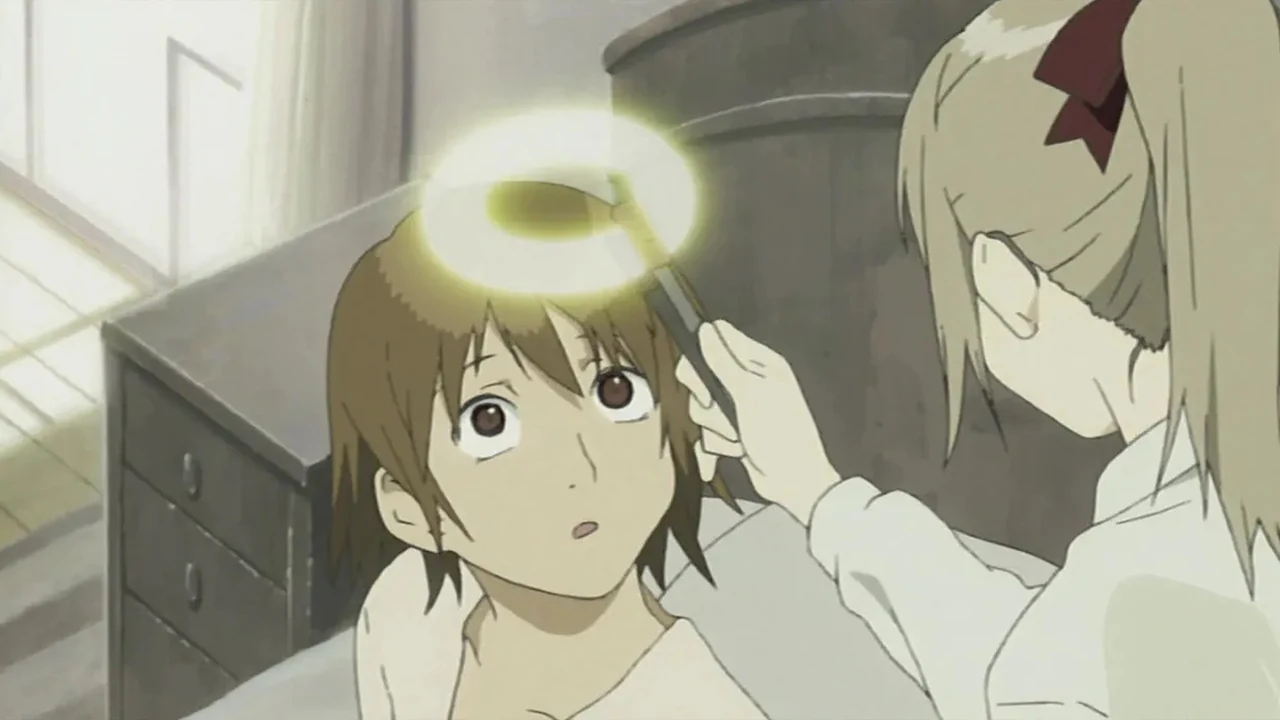
There is humour in it too. Rakka’s halo makes her hair stand up, a small indignity for someone whose appearance already feels strange. Molly Drury’s Otaku News review points to that joke as an example of the series’ gentle comedy. A radiant symbol can also be an awkward thing to wear.
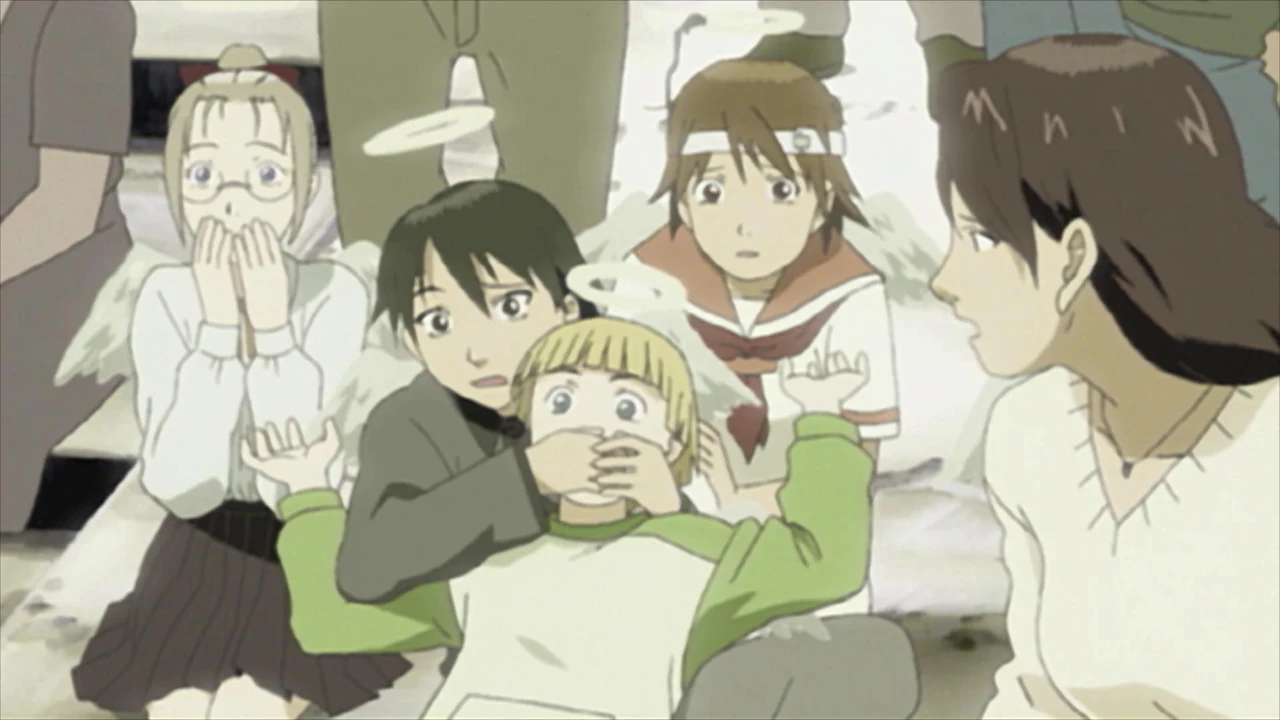
Reki is especially important because she already occupies the position Rakka needs somebody to fill. She can guide a newcomer and look after the younger children. That apparent assurance makes a useful question possible: how much do you know about someone when you have mostly seen them taking care of other people? The series gradually gives that question more weight without requiring Rakka to understand it on arrival.
Why spend time looking for a job?
Rakka’s search for work takes her into the lives of the other Haibane. With Kana, she encounters rubbish hauling and clock repairs; a day at the library offers a different relationship to the town and its knowledge. These are ways of meeting people through what they do, rather than through a succession of introductions.
Work also changes the scale of Rakka’s uncertainty. She cannot answer where she came from, but she can discover what a particular task needs from her. A repaired object or a shared errand offers a manageable piece of a world whose largest rules remain out of reach.
The town’s restrictions make belonging more complicated than simply being liked. Haibane have a prescribed place in the community and must learn how exchanges and permissions work. The kindness around Rakka does not remove that separation. It makes the tension more interesting: she can feel looked after and still wonder why life has been arranged this way.
Does the quietness mean nothing is wrong?
The soft colours and domestic routines can make Haibane Renmei look like a promise of uncomplicated comfort. It is more emotionally demanding than that. The story moves towards loneliness, grief and the difficulty of accepting help. Its gentle passages establish relationships that give those feelings consequence.
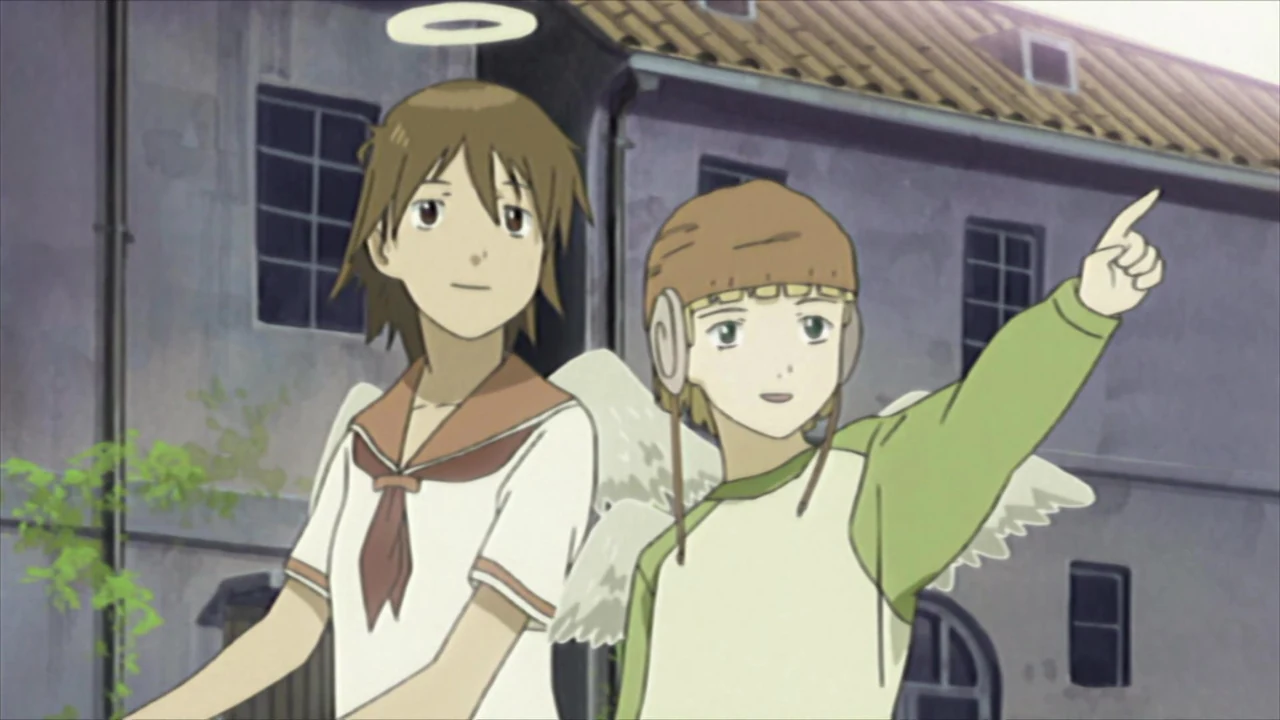
The visual world helps hold the two tones together. Grey-green interiors, worn surfaces and small wings make Old Home feel lived in rather than celestial. The halos stand out, but they share the frame with cupboards, clothes and the bodies of people trying to get through a day. Richard Durrance’s UK Anime Network review values the nuances of those characters; darkstorm’s Anime UK News review likewise finds the central character drama compelling, while questioning the balance of attention across the cast.
The series’ uncertainty is a real dividing point. It leaves substantial questions about the town and its rules open. Darkstorm finds that frustrating, whereas Durrance regards a world that seems to continue beyond the characters’ immediate story as part of its strength. Expect an emotional story with mysteries around it, not a final diagram explaining the purpose of every wall, rule and symbol.
That distinction need not make the details unimportant. A restriction can shape someone’s life even when its ultimate origin remains unknown. The drama asks what the Haibane can offer each other within those limits.
How should you approach the series?
Begin with episode one and watch the complete 13-episode 2002 series in order. The early visits and jobs are part of getting to know the household, rather than a prologue to skip. MVM lists 325 minutes for its complete edition, roughly five hours 25 minutes; individual digital listings can use shorter runtimes.
The wings and youthful cast do not make it a uniformly light watch. Alongside the bloody opening transformation, later material involves self-destructive feelings and implications of suicide. The story’s questions about memory are best discovered without reading character explanations beforehand.
The trailer includes bloody wing growth, distress and later imagery beyond this introduction. Skip it to preserve the series’ mysteries.
2002 series · official English-release trailer
Loading the player connects to YouTube. Playback does not start automatically. Availability varies by region.
Watch on YouTube · © 2002 Yoshitoshi ABe/Aureole Secret Factory. Licensed by Funimation Productions, Ltd. All Rights Reserved.
Sources
These sources discuss later events and interpretations. Several distributor summaries also disclose more than the opening premise.
- MVM’s complete-series listing, for episodes 1–13 and the approximate duration.
- Apple TV’s series and early-episode listings, for the year, credits and work-related setups in episodes four and five.
- Molly Drury’s review, Otaku News, for the halo joke and domestic tone.
- Richard Durrance’s review, UK Anime Network and darkstorm’s review, Anime UK News, for contrasting readings of the character drama and unresolved setting.
- B. Teteruck’s feature on the series, Crunchyroll, for further discussion of its visual world. Contains major spoilers.
- Mio Bryce’s study in Papers, 16:2 (2006), pp. 71–76, for the story’s suicide implications and competing interpretations. Contains major spoilers.