
The world ends without giving its inhabitants time to understand what happened. A flash of light turns humanity to stone. Thousands of years pass, buildings collapse and plants reclaim the places people once lived. When a teenage science enthusiast called Senku wakes up, modern civilisation has become something he remembers rather than something he can use.
Dr. STONE asks what it would take to make that knowledge useful again. Knowing that glass exists is a long way from holding a working lens. Remembering a medicine does not provide the equipment or ingredients to manufacture it. Between an idea and the finished object lie materials, labour and people who have to be persuaded to help.
That gap makes a very good adventure.
What can you build when the factories are gone?
Senku’s first advantage is an extraordinary memory and a determination to keep testing things. His friend Taiju brings stamina and an uncomplicated willingness to work. Together, they begin with immediate problems: food, shelter and a way to release other people from their stone shells.
The pairing keeps knowledge from becoming a magic command. An experiment has to be repeated, materials have to be gathered and somebody has to do the heavy work. Senku can see possibilities far beyond their present equipment, but a clever explanation does not lift a log.

Image credits
Dr. STONE
©米スタジオ・Boichi/集英社・Dr.STONE製作委員会
Image sourceThe story’s invention roadmaps turn a remote goal into a chain of smaller tasks. A project needs one material, which needs a tool, which needs another material. The suspense comes from watching the chain acquire links. An unglamorous intermediate step can matter as much as the object at the end.
There is room for comedy in the difference between Senku’s confidence and everybody else’s workload. He approaches a huge undertaking with the excitement of someone who can already picture the result. His companions are often the people looking at how much carrying, digging or hammering that result entails.
Who gets to decide what comes back?
Reviving people introduces a problem that chemistry cannot settle on its own. Tsukasa, an exceptionally powerful young fighter, wants to choose which parts of humanity deserve a second chance. Senku’s ambition to restore civilisation runs into someone who sees its destruction as an opportunity to prevent the old world from returning.
That conflict gives the rebuilding a political edge. A discovery can provide care, comfort or a weapon. Deciding who receives its benefits matters as much as making it work. The series has fights and opposing camps because its people disagree about the future, not simply because the next piece of equipment needs a guardian to defeat.
Other people make Senku’s idea of progress less solitary. Kohaku leads him towards a village and gives scientific work an immediate human purpose: her sister Ruri is ill. Chrome, who has been investigating the world with the resources available to him, meets someone who can explain discoveries he has approached independently.

Image credits
Dr. STONE
©米スタジオ・Boichi/集英社・Dr.STONE製作委員会
Image sourceChrome is especially important to the pleasure of the premise. The restored world does not belong only to a genius carrying answers from the past. Curiosity is already present. Senku can give it new names, techniques and possibilities; he also needs the people who know this landscape.
Why can a small invention feel so important?
An early medicine project creates a reason to care about a complicated manufacturing chain. It is not enough to announce that science will improve life someday. There is a person who needs help, and each obstacle has a cost in time.
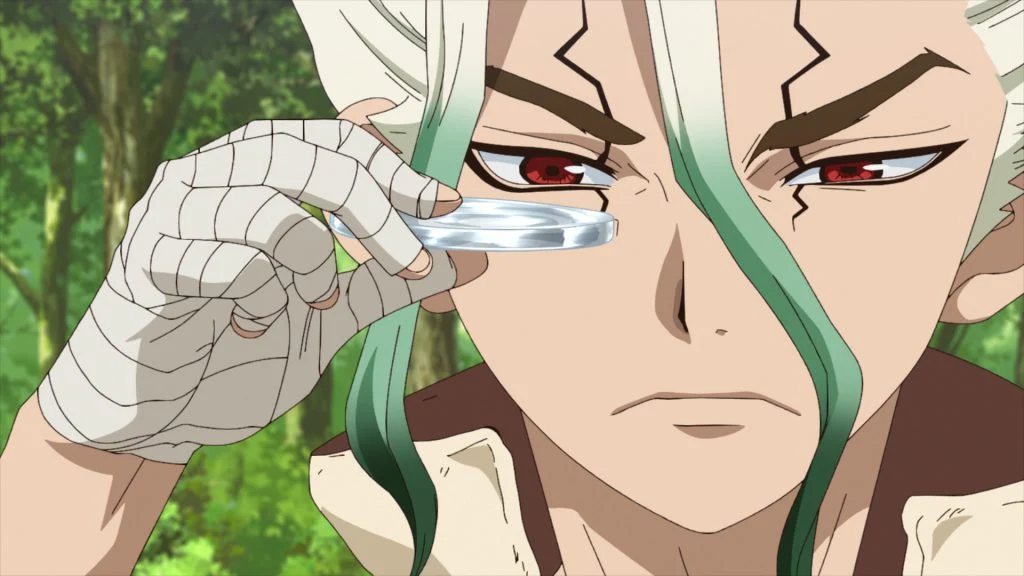
The glass project offers a smaller, more intimate example. Suika, a child who struggles to see clearly, gives the work a purpose beyond accumulating technology. Senku turns to Kaseki, a village craftsman, because an understanding of glass still needs someone able to shape it. Scientific knowledge and practised hands become parts of the same achievement.

Image credits
Dr. STONE
©米スタジオ・Boichi/集英社・Dr.STONE製作委員会
Image sourceThe imagery makes that meeting of scales easy to grasp. Huge trees surround a small handmade shelter; a dark mineral sits in an outstretched hand; Senku examines a transparent lens close to his eye. The setting is vast, but progress repeatedly becomes an object that somebody can hold.
This is also the rhythm to expect. Explanations and preparation occupy space that another adventure might give to continuous combat. Learning what the next invention requires is part of the reward. If you mainly want action, the process can feel like a long interruption. The story treats science as dramatic possibility, with extraordinary characters and compressed projects, rather than a realistic timetable for rebuilding an industrial world.
Where should you start, and where does this route end?
Watch in release order: Dr. STONE (2019, 24 episodes), STONE WARS (2021, 11), the Ryusui TV special (2022), NEW WORLD (2023, 22), then SCIENCE FUTURE (2025–2026, 37). The special belongs between seasons two and three and introduces the voyage’s captain; it is part of the story route rather than a recap to discard.
That is 94 episodes plus one special, about 38 hours and 30 minutes, with 54 minutes for Ryusui. That count includes the special as the 95th instalment. Platform season labels can split a season into broadcast parts, so use the titles above to keep the order clear.
SCIENCE FUTURE concluded the main television story on 25 June 2026. A further anime, Dr. STONE TERRAFORMING, was announced on 10 October. It is a continuation after that completed story and is outside this released viewing total; the announcement does not make it a new starting point.
What does the original trailer introduce?
TOHO animation’s 2019 first main promotional video introduces the original television series. Its launch date belongs to that first release.
Original season · TOHO animation · main PV 1
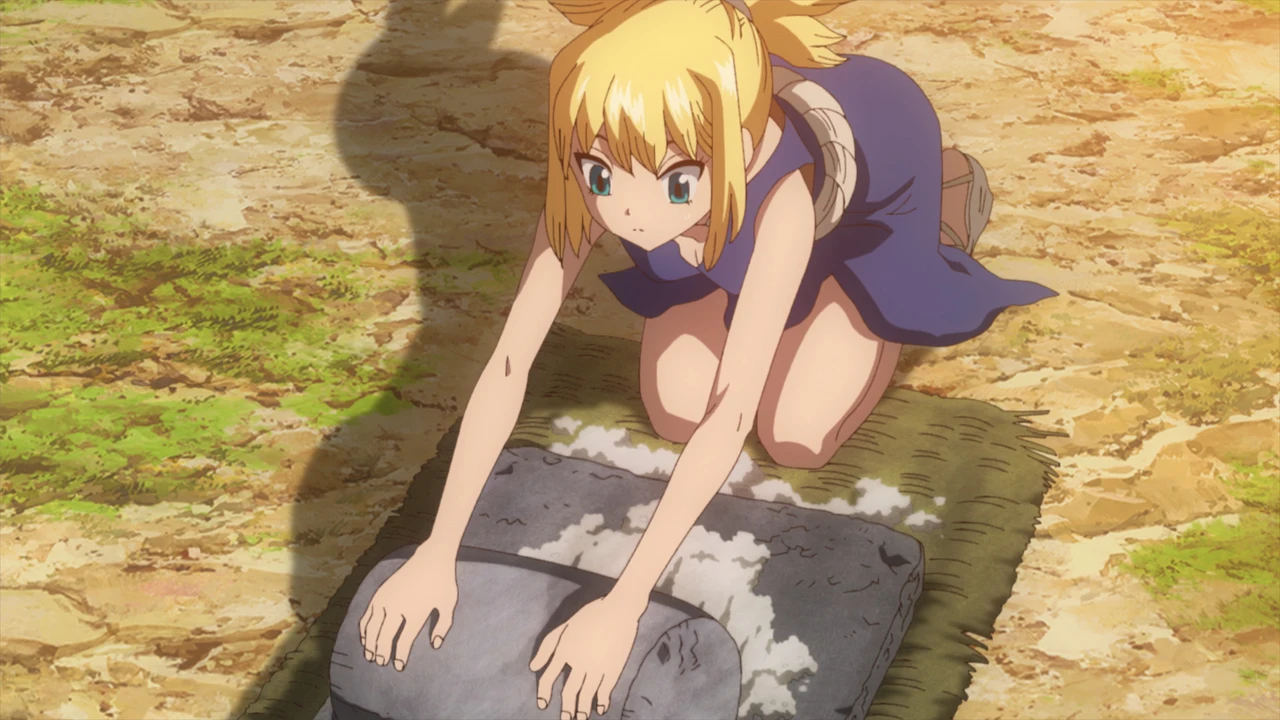
Loading the player connects to YouTube. Playback does not start automatically.
Watch on YouTube · Poster: original-series episode still.
Image credits
Dr. STONE
©米スタジオ・Boichi/集英社・Dr.STONE製作委員会
Image source


