
What kind of world is Dorohedoro?
In the Hole, ordinary people live with the consequences of somebody else’s magic. Sorcerers visit from another world and use human beings to practise on, leaving damaged bodies behind. Magic is not simply a wonderful talent. For the people receiving it without consent, it is a form of power they cannot answer on equal terms.
Caiman has a lizard’s head and no memory of how he acquired it. With his friend Nikaido, he hunts for the sorcerer responsible. His method is alarming: he puts sorcerers’ heads inside his mouth, where another presence seems to be checking who they are. The investigation begins with a mystery inside a mystery, and with a protagonist whose response to being victimised is hardly gentle.
That is the invitation offered by Dorohedoro, adapted from Q Hayashida’s manga: a fantasy in which pursuing an impossible identity can coexist with wanting a good plate of dumplings. Its inhabitants have learned to live with things that look extraordinary from outside. Their arguments, appetites and attachments make the world feel inhabited long before its mysteries become clear.
The Hole even has an annual night when the dead return. In episode 3, this becomes a local event that Caiman and Nikaido take part in, bringing supernatural horror into the rhythms of the neighbourhood. That mixture of the macabre and the matter-of-fact is central to the show’s humour. Its people do not stop having ordinary concerns just because their ordinary world is bizarre.
What holds Caiman and Nikaido together?
Caiman has an urgent goal, but he also needs somewhere to return when another lead fails. Nikaido runs the Hungry Bug, a restaurant in the Hole, and makes the gyoza he loves. She is a powerful fighter as well as his companion in the search. Their partnership gives his investigation a home and a person whose safety matters alongside the answer.
That balance matters because an amnesia plot can reduce everyone else to a clue. Nikaido has a business to run and a life beyond Caiman’s missing past. Her willingness to help is an active choice, not merely a job assigned by the premise. As the search draws attention, keeping that shared life intact becomes harder.
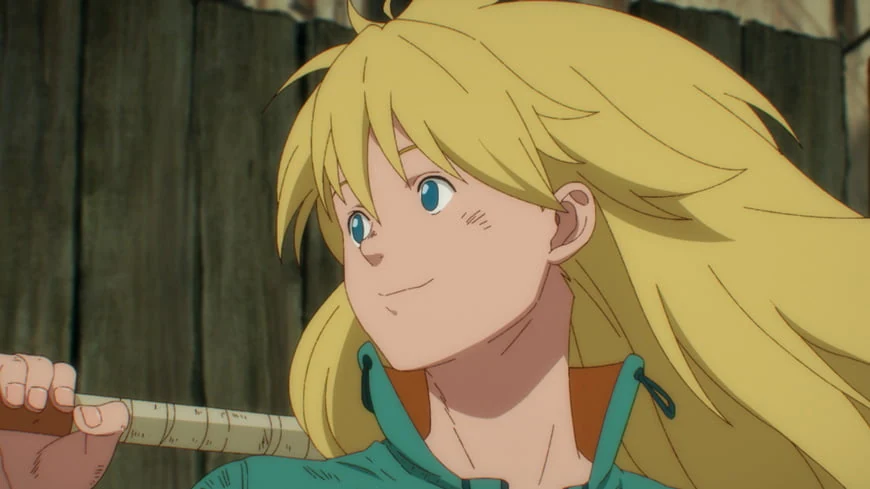
Meals keep the relationships tangible. A dish can matter to someone even when the surrounding world treats bodies as disposable. SuperWooper’s first-season review at Star Crossed Anime makes a useful observation about those scenes: eating together gives characters room for ordinary conversation amid the violence. Gyoza gives Caiman an uncomplicated pleasure in a life otherwise defined by questions. The restaurant also gives the story a place where companionship can take the form of feeding someone, arguing with them or simply having them around.
Why spend time with the people hunting them?
The sorcerers do not form one anonymous enemy. En runs a powerful business empire and commands a family of associates; his magic transforms things into mushrooms. Shin and Noi work as his cleaners, a polite label for assassins. Shin’s destructive magic and hammer make him dangerous, while Noi can heal damage. Their abilities make them useful to the organisation and to each other.
The show gives these opponents scenes that do not depend on Caiman being present. They eat, bicker and work together. In an early dinner-party assassination, Shin’s complaint about Noi’s choice of cutlery makes workplace instruction part of an appalling act. The joke depends on their comfortable relationship: the scene is also about how two colleagues talk to one another while doing a job.
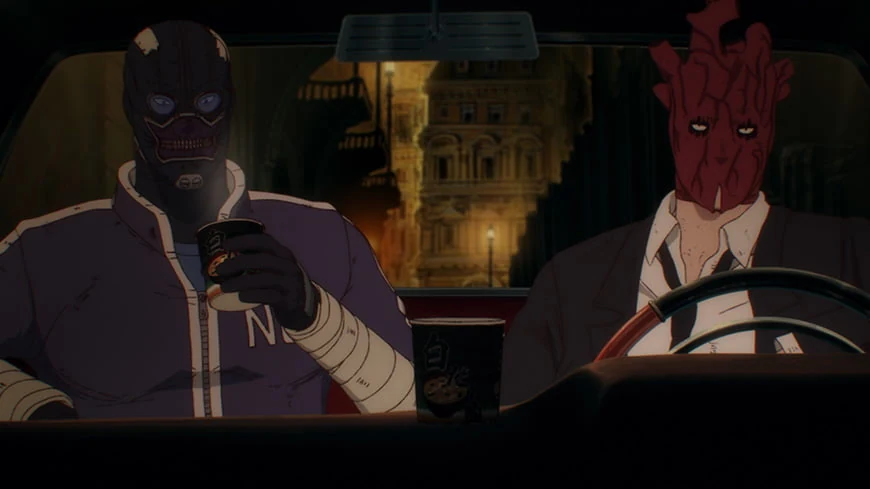
That shifting attention gives the story several centres of interest. Caiman and Nikaido’s partnership has a counterpart in Shin and Noi, while En’s household brings another set of loyalties and squabbles. Jonathon Wilson’s first-season review points to the personalities on both sides of the divide as a major strength. A pursuit that initially seems to belong to one man can become an ensemble story in which a favourite character lives somewhere else entirely.
The affection is selective, and that keeps the conflict alive. Someone who is a dependable partner can be a terrifying opponent to another group. The audience gets to know both versions without the story sorting everyone into an uncomplicated good or bad side.
Why does the animation look so unusual?
MAPPA’s adaptation combines 3D character animation with drawn work and richly textured environments. In the first season, Shinji Kimura served as both worldbuilding designer and art director. The crowded, worn surroundings give the strange inhabitants somewhere solid to live; they are not floating against a generic fantasy backdrop.
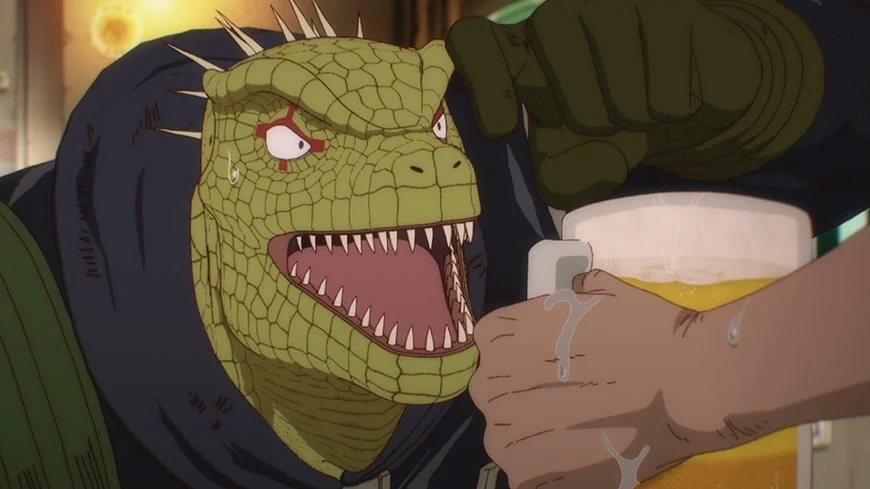
The production choices are especially apparent in Caiman. His scales, snout and wide mouth have to work for conversation as well as violence. In CGWORLD’s interview with the first-season production team, the artists describe how 3D helped preserve his intricate scales, and how they developed different jaw movements for closer and more distant shots. They also limited conspicuous camera moves around the models to help the drawn and 3D elements sit together. Those are purposeful compromises in adapting a densely drawn manga, rather than an attempt to make the characters look photorealistic.
The busy textures and substantial character shapes give the comedy an unusual physical presence. A reptilian jaw has to deliver a casual line; a frightening mask becomes the face of somebody sitting in a car with a drink. The designs remain strange even when the situation is familiar. That is part of the fun of letting this world become ordinary.
The blend is not seamless for everyone. SuperWooper finds the first season’s models less convincing than its detailed environments, while Wilson finds the CG effective in the broad action. Their different responses capture a real feature of the adaptation: the drawn world and modelled bodies have distinct textures, and the contrast is visible.
How does the second season open up the world?
The continuation broadens the conflict around En’s family and the Cross-Eyes, another faction with an interest in the world’s concealed history. It carries on the existing story, giving more of the ensemble room to pursue separate aims. The mystery becomes less a line from Caiman to one answer than a set of intersecting lives, each with its own incomplete view of what has happened.
That expansion also gives the adaptation more opportunities to move between moods. Amin at AniPanelPixel praises the second season’s more expressive CG faces, impactful action and sound direction. The same world can accommodate comic exaggeration and a more forceful action scene without giving up its recognisable cast and textures.
A larger ensemble does ask for more attention. DoubleSama’s season 2 review finds that moving among so many groups leaves too little time with each thread. If Caiman’s identity is the main attraction, the branching story may feel slower than its busy action suggests. The larger mystery remains unfinished, but the expanding web of relationships is a substantial part of what the continuation offers along the way.
Where should you begin, and what comes next?
Watch season 1 (2020), episodes 1–12, then season 2 (2026), 11 episodes. Listings that number continuously call the second season episodes 13–23. No manga knowledge is required. Allow about 9½ hours for those 23 main episodes, based on roughly 24-minute first-season episodes and the longer second-season entries in the BBFC’s Netflix records. Timings vary by edition. Netflix and the official streaming information offer starting points for checking your territory.
The optional Ma no Omake bonus material fits after season 1: six short side stories, sometimes bundled as one OVA or labelled a season 1 episode 13. That is different from season 2’s first main-story episode. Allow another half-hour for these glimpses of the cast’s everyday absurdities. Season 3 is announced, but is not part of the currently available two-season route; the anime has not yet reached the manga’s complete resolution.
The series contains frequent graphic violence, dismemberment, disturbing transformations, strong language and sexualised imagery or partial nudity. Its humour sits alongside that material. The opening two episodes establish both the central pair and the opposing cast, along with the show’s characteristic tone.
What does the original trailer reveal?
The original-series trailer contains bloody violence, threatening masks and bodily horror, along with action and character glimpses beyond the opening encounter. It is a Japanese-language promotional video for the first season, released before its 2020 debut; it does not require seeing season 2.
First season · TOHO animation · 2019
Loading the player connects to YouTube. Playback does not start automatically.
Sources
Official character and episode pages, reviews and production images can reveal later identities, violence and plot outcomes.
- Official English site and Japanese episode index and character profiles, for the world, seasons 1–2 and the season 3 announcement. Early episode pages: 1, 2 and 3.
- Netflix’s episode listing, Prime Video’s 11-episode season 2 listing and BBFC streaming records, for episode labels and approximate timing.
- Official bonus-short announcement and Blu-ray contents, for the six Ma no Omake stories.
- MAPPA’s production listing and CGWORLD’s first-season production interview, for the animation and art approach.
- SuperWooper, Star Crossed Anime, season 1 review and Jonathon Wilson, Ready Steady Cut, season 1 review, for character relationships, food and differing responses to CG.
- Amin, AniPanelPixel, season 2 review and DoubleSama’s season 2 review, for the continuation’s craft and ensemble trade-offs.
- Melissa Camacho’s Common Sense Media guidance, for content considerations, and the official first-PV announcement, for trailer identity.