
What happens when someone can enter your dreams?
The DC Mini is an experimental device intended to help therapists reach their patients through dreams. When the technology is stolen, the research team faces a particularly intimate kind of attack: someone can invade a mind from the inside. Finding the thief matters, but so does recognising when an apparently ordinary encounter has already become a dream.
Dr Atsuko Chiba investigates through Paprika, her lively, red-haired dream persona. Chiba is controlled and professionally guarded; Paprika moves through other people’s fantasies with a freedom her waking self does not show. They give the film two ways to approach the same problem: the scientist trying to contain a dangerous invention, and the imaginative guide willing to enter the disorder it releases.
Made at Madhouse and directed by Satoshi Kon, Paprika adapts a novel by Yasutaka Tsutsui. Its appeal lies in what animation can do with that premise. A drawing, a room or a body can stop being one thing and become another before there is time to settle on an explanation.
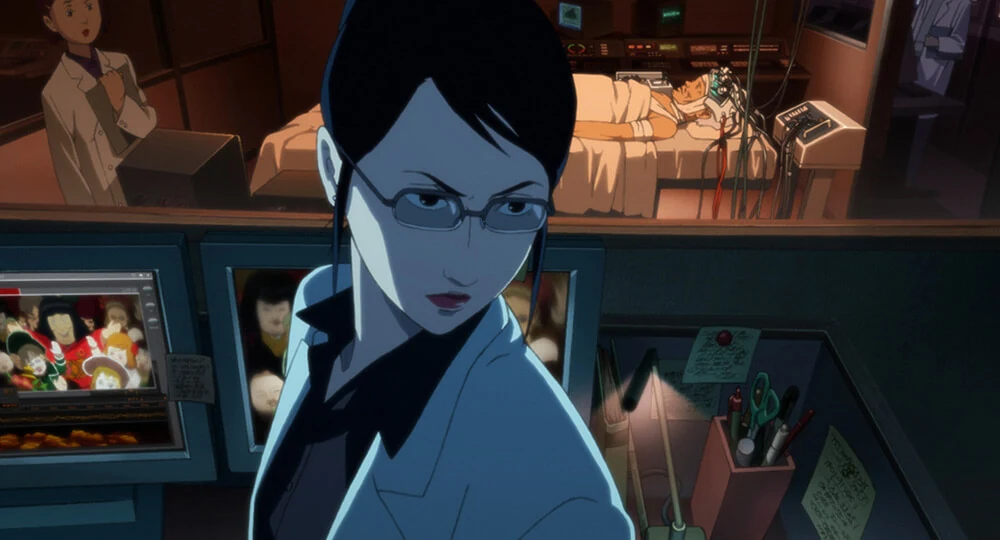
Who gives the dream chase its human stakes?
The device’s inventor, Kosaku Tokita, is absorbed in what his machine can achieve. Chiba brings a more guarded temperament to their work, but she needs his ingenuity to understand what is happening. Their partnership connects the abstract dream experiment to people who approach it differently: the inventor fascinated by possibility and the therapist trying to make that possibility useful to someone else.
Detective Konakawa approaches the technology as a patient as well as an investigator. An unresolved case troubles him, and his recurring nightmares throw him into recognisable movie situations, including a circus and a pursuit. A detective usually makes sense of other people’s actions; here he needs someone to help him understand his own imagination. That reversal gives Paprika a role beyond chasing a thief. She can be a companion through a bewildering private world.
The contrast between Chiba and Paprika adds another kind of curiosity. The professional restraint of one and the playful confidence of the other make the same person seem capable of two different relationships with the world. The dream persona is both a way of helping patients and an opportunity for the film to explore what a waking identity leaves out.
What makes the images and music distinctive?
The opening credits offer a compact demonstration. Paprika travels through advertising images, taking a ride on a rocket from a lorry’s logo and moving between billboards. These are not simply colourful backdrops. Flat pictures become places she can enter, so an everyday city ceases to be a reliable boundary between the possible and impossible.
Paul Jackson’s Midnight Eye review identifies the seamless movement between ordinary detail and fantasy as Kon’s particular strength. That observation helps explain why the dense environments matter. A convincing collection of small objects gives the next impossible movement something solid to disrupt.
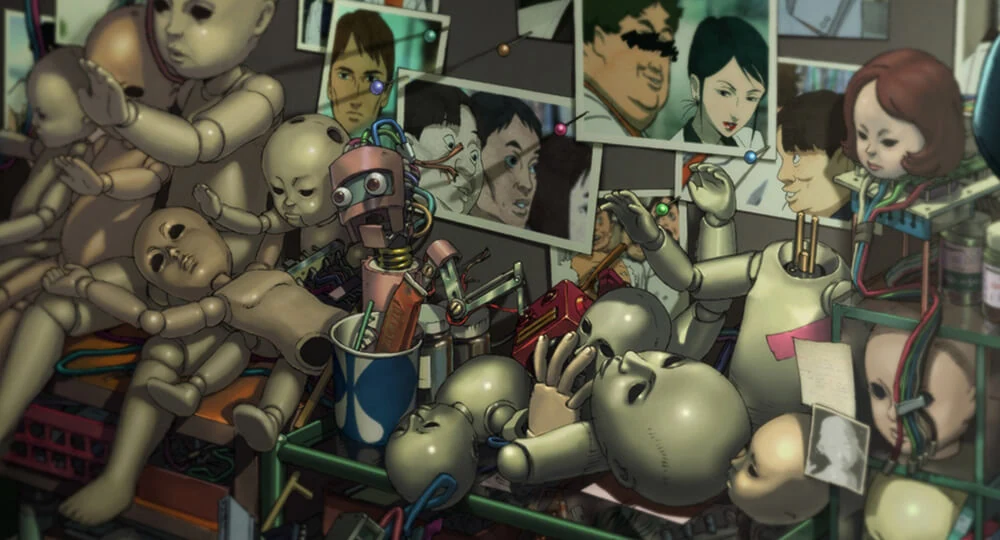
The recurring parade pushes that accumulation into motion: dolls, animals and household objects advance together as if the absurd procession were the most natural thing in the world. Susumu Hirasawa’s score gives it a relentless musical identity. Chants, percussion and electronic textures give this unlikely gathering a shared pulse. Anime Instrumentality’s soundtrack review describes the contrast between the crowded sound of “Parade” and the calmer electronic voice of the opening theme. That range matters: the score can propel a mass of clattering objects, then give Paprika’s movement a lighter, floating quality. The images have their own impossible geography; the music supplies a rhythm to travel by.
Why are dreams so closely connected to movies?
Konakawa’s dreams place a familiar investigator inside a succession of movie roles. Paprika moves between them with the ease of someone who understands that a change of scene can also be a change of possibility. The connection gives the film a playful way to explore imagination: a screen is something to look at, but in a dream it can become somewhere to go.
That freedom helps distinguish Paprika from a mystery built entirely around clues and rules. A visual association can carry the story into a new setting before an explanation catches up. Anthony Kao’s Cinema Escapist review treats this fluidity as central to the film, while acknowledging that it can make the plot hard to follow. The occasional loss of narrative clarity is a real trade-off, but the changes themselves are a large part of its invention and humour.
Which film should you start with?
Watch the 2006 animated feature directed by Satoshi Kon, allowing approximately 90 minutes. Neither Tsutsui’s novel nor Kon’s other films is a prerequisite. Sony’s Japanese theatrical release began on 25 November 2006; the official trailer’s “2007” title refers to its US release, not a sequel or remake.
The trailer may reveal later dream imagery and transformations.
2006 film · Sony Pictures Entertainment

Loading the player connects to YouTube. Playback does not start automatically.
Watch on YouTube · © 2006 MADHOUSE / Sony Pictures Entertainment (Japan) Inc.
Sources
The press kit, reviews and detailed content guidance discuss later scenes and the ending.
- Sony Pictures: Paprika: official film page and premise. Original Japanese still-source details remain in our image records.
- Sony Pictures Classics: press kit: runtime, character roles, adaptation and music credits. Contains a full synopsis.
- Sony Pictures Japan: 27 November 2006 release report: original Japanese theatrical opening.
- Paul Jackson, Midnight Eye: opening-credit transitions, environmental detail and the relationship between dreams and cinema.
- Anthony Kao, Cinema Escapist: unstable dream rules and their appeal and difficulty.
- zzeroparticle, Anime Instrumentality: Hirasawa’s contrasting musical textures.
- BBFC: Paprika and John Sooja, Common Sense Media: sexualised violence and fuller content advice.