
What if the neighbourhood had another layer?
Daikoku City has schools, old shrines and streets that children can explore on foot. It also has a second landscape visible through networked glasses: virtual pets, software tools and things that behave in ways their users do not understand. The technology is ordinary enough to play with. That does not make it harmless.
Yuko Okonogi, nicknamed Yasako, arrives in this city with her family and promptly loses track of Densuke, her digital dog. Another girl, Fumie, offers the expertise of a children’s detective agency. Their first problem is wonderfully specific: how do you recover a pet that has disappeared into a wall?
Den-noh Coil builds its science fiction out of this overlap. The wall remains a wall, yet the glasses reveal a problem an adult walking past might never notice. A familiar neighbourhood can contain a whole adventure without anyone boarding a spaceship.
Who knows the rules of this playground?
Yasako is learning the local customs as well as the technology. Fumie is quicker to act, treating investigation as something children can organise for themselves. Yasako’s grandmother runs the detective agency, so adult knowledge and children’s games meet in a more surprising place than a classroom.
Another newcomer, Yuko Amasawa, goes by Isako. She is difficult to approach and skilled at manipulating the digital world. Having two girls with the same given name makes their difference in manner especially clear: Yasako reaches towards a connection; Isako does not readily offer one.

An early confrontation puts that expertise into schoolyard terms. Daichi, who leads a group of boys, tries to recruit Isako. Rejection becomes a reason to attack her with digital tools. It is a contest about status as much as software: who gets to lead, who can embarrass whom, and what happens when the new child is better at the game.
This is an inviting way into a complicated setting. The characters have immediate wants before the viewer knows every technical term. You can understand the unfairness of ganging up on someone without understanding every weapon they use.
Why does a digital dog matter?
Densuke gives the technology an emotional claim on the children. Yasako is not searching for an interesting piece of code. She is searching for her dog. The opening rescue makes a distinction that the wider story can keep testing: knowing how something is made does not decide how much somebody cares about it.
The same city supports games, pranks and unsettling rumours. Its hidden spaces invite curiosity, while its automated cleaning systems can threaten the things the children value. Rules that seem clear from an administrator’s perspective become more difficult when a particular creature is in the way.
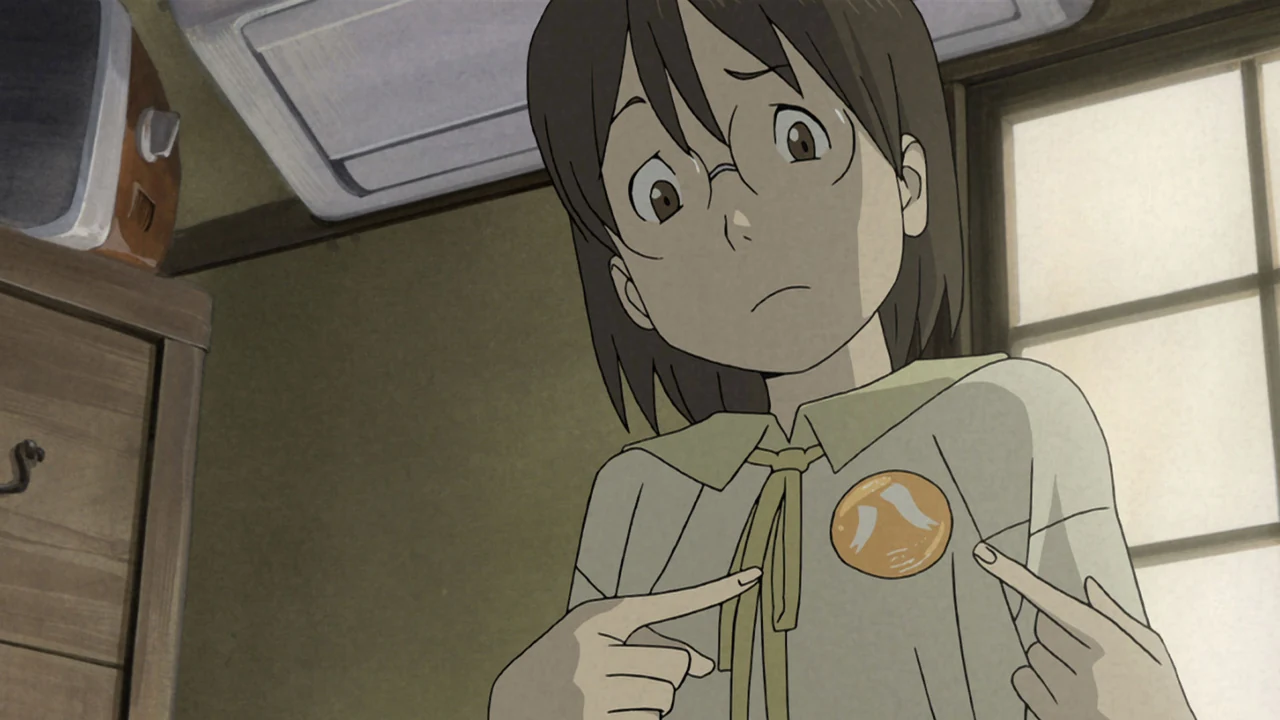
Loss gradually becomes part of this world, alongside the thrill of discovering what the glasses can do. The series does not need its younger characters to stop being children to take their attachments seriously. Their squabbles and ridiculous experiments give the more painful questions somewhere to live.
What gives the invention its texture?
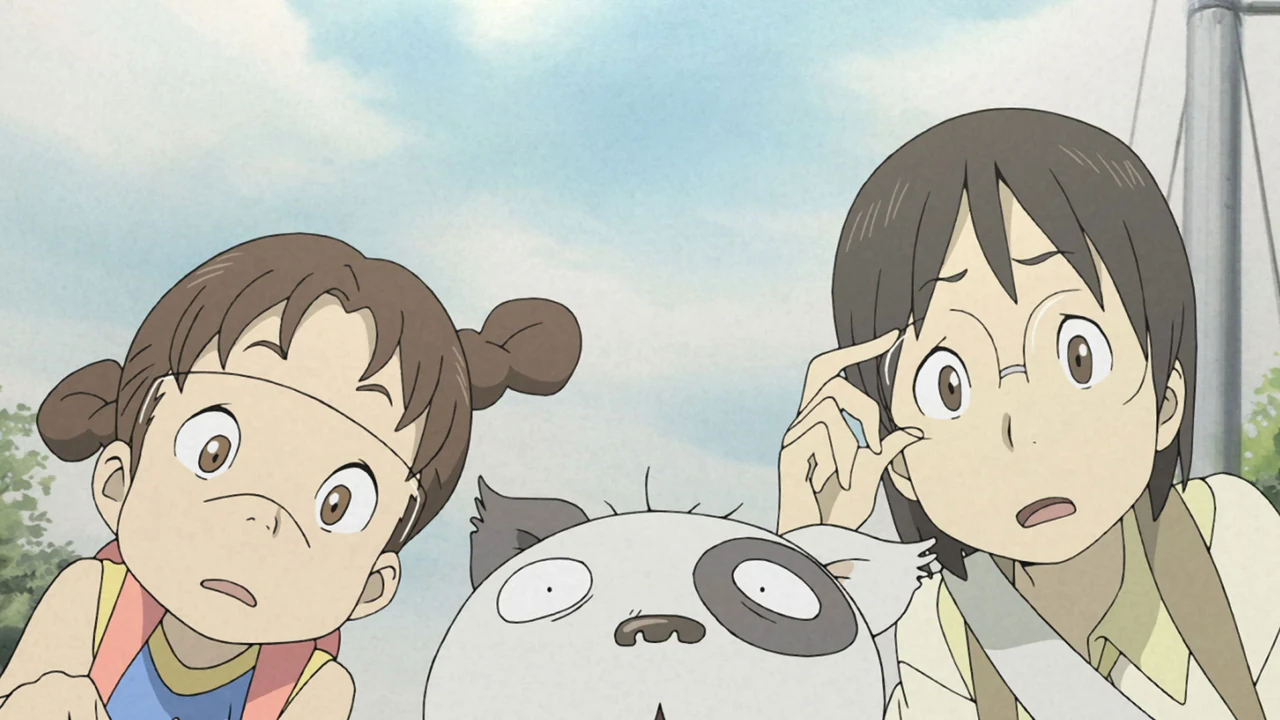
The design places expressive, simply outlined children against recognisable buildings and streets. In the opening still, Yasako’s lifted glasses, her sister’s open mouth and Densuke’s round eyes all direct attention towards the same unseen problem. The digital layer enters an environment with an existing physical shape, rather than replacing it with a featureless screen.
Andrew Osmond’s Animation World Network essay singles out the liveliness of the character animation, including moments of limited movement. The licensed E-SAKUGA drawing collection offers another way to examine the work behind those performances: its samples show successive poses, changing expressions and the lines used to plan them. A still can introduce the designs; the moving series supplies the timing.
The ingenuity also makes demands. The story develops a sizeable vocabulary, and its playful middle adventures interrupt the progress of the larger mystery. Osmond finds some of the closing explanations awkwardly delivered; Anime-Planet reviewer vivafruit is considerably less forgiving about the quantity of technical exposition. The shared caution is useful: the series asks you to enjoy experiments and detours before it gathers its questions together.
Where should you begin?
Watch the 26-episode 2007 series from episode one. The first four episodes introduce the missing-pet investigation, the children’s competing skills and Isako’s arrival. There is no prerequisite film or separate season to find first.
Allow roughly eleven hours. The estimate uses 26 episodes at about 26 minutes each, based on Bandai Channel’s episode listings; it is not a measured sum for every edition. Keep the recap in the sequence on a first watch, since it includes new material. The series’ novels and manga are separate versions, not required homework.
Sources
The reviews, official episode lists and retrospective material contain later revelations. Avoid them until afterwards if you want to preserve the mystery.
- Bandai Namco Filmworks’ anniversary site, for the premise and complete 26-episode listing.
- Bandai Channel: episode one and episode four, for the early situations and episode-length estimate.
- Andrew Osmond’s essay, Animation World Network, for character animation and the story’s changing rhythm.
- vivafruit’s review, Anime-Planet, for a contrasting assessment of the exposition and detours.
- E-SAKUGA’s licensed drawing-collection announcement, for production drawings and credited contributors.