
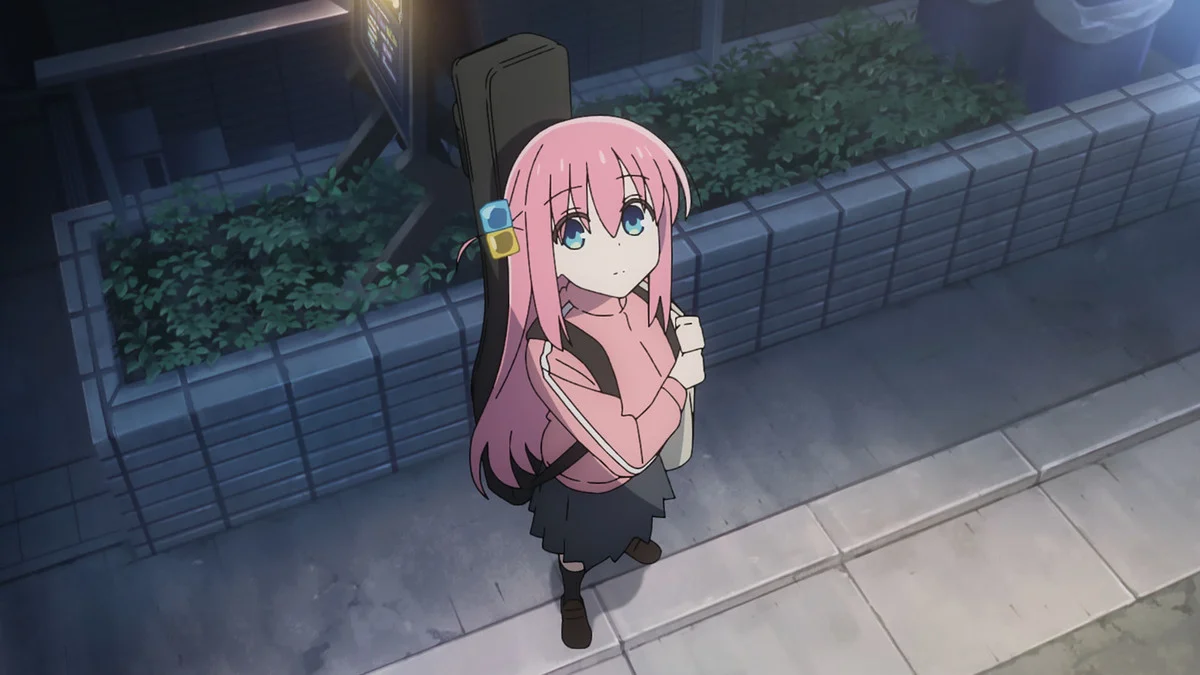
Hitori Gotō has spent years practising guitar in her room because she hopes that becoming a good musician will help her make friends. She has the skill she wanted, but no band. When drummer Nijika Ijichi invites her to fill in for a guitarist at a live music venue, Hitori is pushed into the social world that her solitary practice could not prepare her for.
Why does playing guitar not solve Bocchi’s problem?
Hitori’s nickname, Bocchi, captures how she has learned to think of herself: the person outside the group, watching from the edge. Her online guitar persona does not make conversation easier in person. She can imagine a future in which people admire her playing, but a rehearsal still means entering a room, reading other people and risking embarrassment.
Nijika’s invitation matters because it gives Hitori a task and a companion rather than demanding that she become confident first. The band’s bassist, Ryo Yamada, and guitarist-vocalist Ikuyo Kita bring different social energies and musical needs. Kessoku Band cannot function on Hitori’s talent alone. She has to listen, adjust and let the others hear what she can do.
The comedy makes that gap visible. Hitori’s private fears can become exaggerated images or abrupt fantasies, while the ordinary band setting remains a place with instruments to tune and songs to practise. The joke is not that social anxiety disappears when the music starts. It is that Hitori’s imagination can turn a minor interaction into a catastrophe, and that the other girls keep making space for her to try again.

Image credits
Bocchi the Rock!
©はまじあき/芳文社・アニプレックス
Image sourceWhat makes Kessoku Band a real group?
The band’s progress depends on more than the protagonist. Ryo’s reserved manner and Kita’s openness create different pressures for Hitori, while Nijika is the person who keeps inviting the group towards a shared goal. Their relationships do not resolve into a lesson that friendship cures anxiety. They build through repeated practical acts: showing up, sharing a stage, and allowing an awkward attempt to count as participation.
Critic Charles Hartford’s season-one review observes that the comedy comes through Hitori’s exaggerated perspective rather than making her the butt of the joke. He also describes the supporting cast as a support network that encourages her while accepting her panic and unusual reactions. His reading places the band’s encouragement alongside Hitori’s effort: she does not have to stop feeling anxious before she can contribute.

Image credits
Bocchi the Rock!
©はまじあき/芳文社・アニプレックス
Image sourceThe original season covers twelve episodes. The recap films Re: and Re:Re: are separate editions, and later television seasons follow beyond this starting point. The first season follows the band from Hitori’s awkward first invitation through the work of becoming a group.

Image credits
Bocchi the Rock!
©はまじあき/芳文社・アニプレックス
Image sourceIs this a quiet comedy?
It is warm, but not free of tension. Hitori’s fear of being seen can make even low-stakes interactions uncomfortable, and the series plays those moments for laughs. It also gives them consequences: avoiding people can keep her isolated, while a small choice to participate can open a path towards music with others. If you want a conflict-free background show, Bocchi’s social panic is still a form of conflict. Start with the original 2022 season for character comedy that lets Hitori change gradually.
For a promotional sample, see Original 2022 series PV · Aniplex. Trailers may include scenes beyond the early setup described here.


