
The second episode of Mushoku Tensei gives a remarkably gifted magic student a test that is not only about magic. Roxy takes Rudeus beyond his home. Leaving the house matters because the man who has been reborn as this child was frightened of the world outside, and that fear has followed him.
Reincarnation has changed his body and his possibilities. It has not supplied a clean psychological beginning. The old life remains present when it is inconvenient, rather than functioning only as a useful library of knowledge from another world.
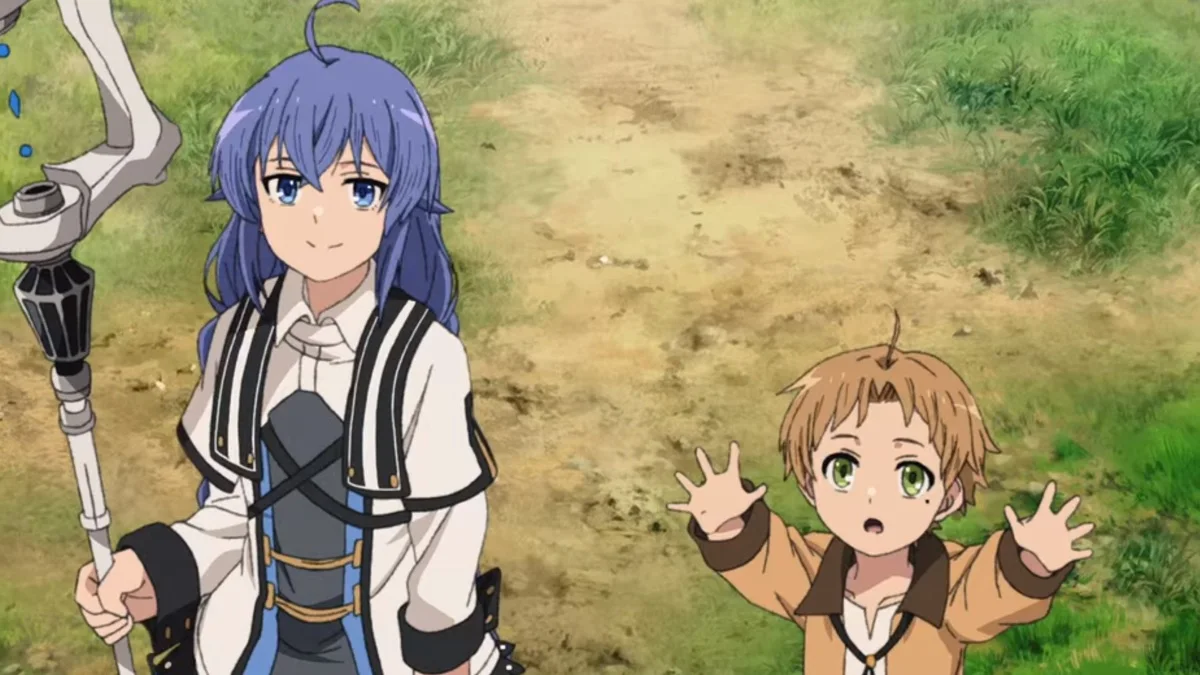
What does the second chance carry with it?
Rudeus retains an adult consciousness inside a young body. That arrangement can give the fantasy an appealing advantage: the learner has experience and the opportunity to begin studying early. Books, practice and instruction allow him to discover what this new world makes possible.
It also makes the word “child” insufficient as an explanation of who is acting. His body is young; his perspective does not begin at birth. Remembered habits, desires and fears complicate the promise that a different family and setting can make somebody different automatically.
The small body can make that mismatch easy to overlook. The opening image shows a child reaching towards something with curiosity. The premise asks us to hold another piece of information beside that ordinary-looking gesture: this learner already has a life behind him.
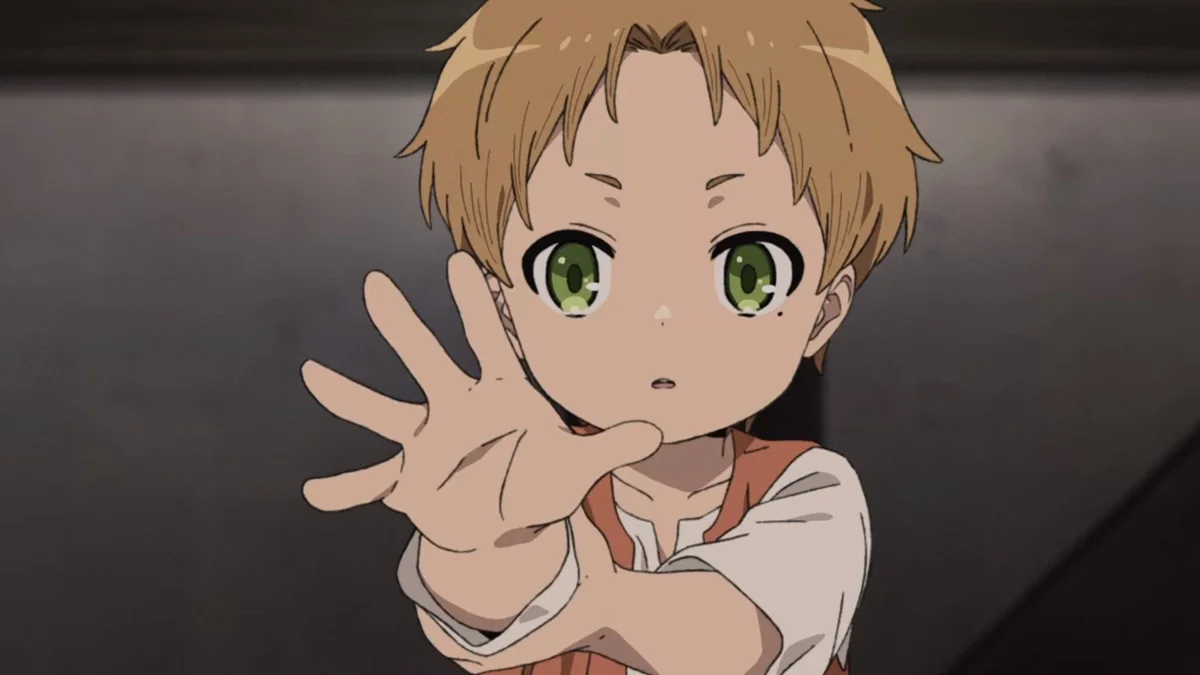
Why does Roxy’s test matter beyond the spell?
A magical exercise can have a visible standard of success. Going outside carries a different burden: Rudeus must enter a space associated with his remembered withdrawal. The story brings a teacher’s practical work into contact with something rawer than a gap in technical knowledge.
That does not make Roxy a cure or reduce her to somebody whose only function is repairing him. She arrives to teach magic. Her lesson becomes significant because teaching can take a pupil somewhere he would not have reached through solitary experiment.
The distinction keeps two kinds of progress separate. Learning an impressive ability can be quick and rewarding. Living among other people requires repeated contact with people who have purposes beyond admiring that ability. Talent cannot complete those encounters in advance.
Sylphiette’s early appearance in the village gives that wider world a concrete difficulty of its own. The encounter begins with another child being bullied. Rudeus has an opportunity to respond, rather than simply discover another resource for his personal advancement.
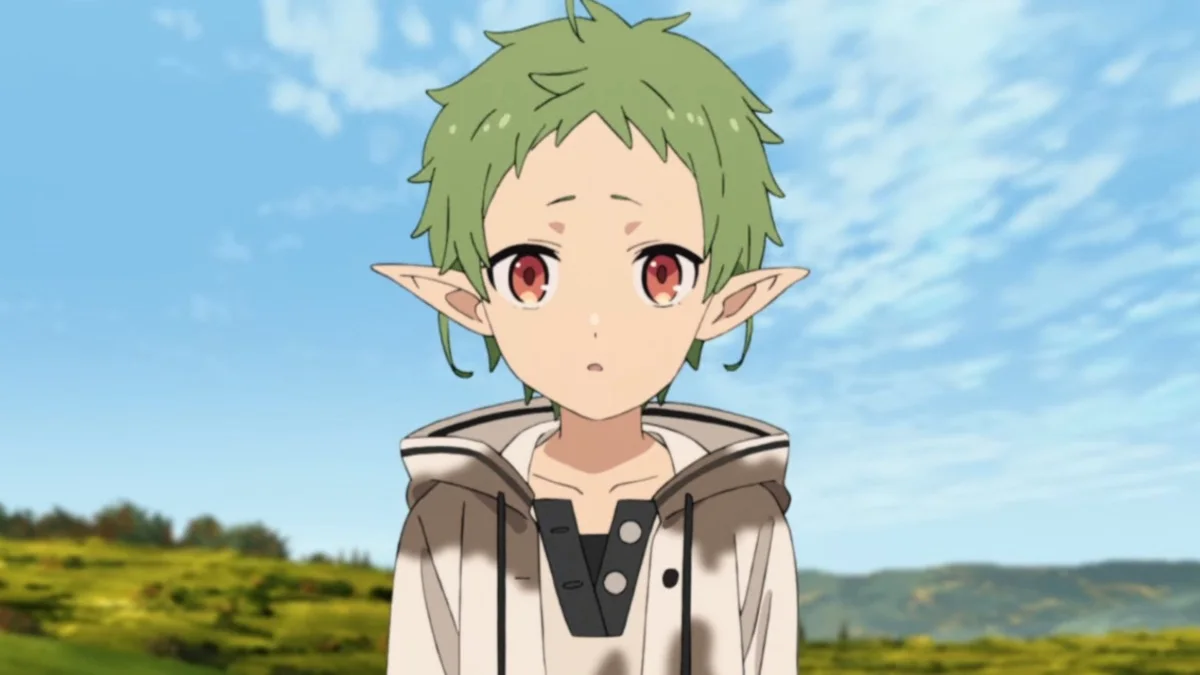
Is becoming more capable the same as becoming better?
It is tempting for a progression fantasy to let achievement answer that question. The protagonist learns, succeeds and becomes important, so the audience can read improvement in every new ability. Mushoku Tensei’s retained adult perspective makes that shortcut uncomfortable.
Its sexualised material and sexual misconduct cannot be made harmless by pointing to the new body. Nor does fear excuse harm. Sympathy for someone’s vulnerability and criticism of their conduct can coexist; neither requires pretending the other evidence is absent.
There is also a difference between a story depicting objectionable behaviour and a viewer accepting how that behaviour is framed. The opening premise does not resolve that disagreement for everyone. These early lessons can be interesting without serving as proof of eventual redemption or a demand that a viewer endure material they find unacceptable.
Roxy’s test supplies a more precise achievement to consider. Rudeus takes a step into the world despite a difficulty that survived the transition. A new life gives him another setting in which to act. What he does with other people inside it remains a separate question.
Sources
The series includes sexual misconduct, sexual violence, bullying and bloody fantasy violence. Linked classifications concern their named editions; later episode listings reveal major developments.
- Original episode 1 and Roxy’s episode 2 lesson, for retained consciousness, early learning and the test outside home.
- Licensed original episode descriptions, episodes 1–3, for the selected scenes and illustrations.
- New Zealand season 1 disc classification and Australian season 2 content advice, for edition-specific content categories, not a universal age recommendation or proof of a particular opening incident.