
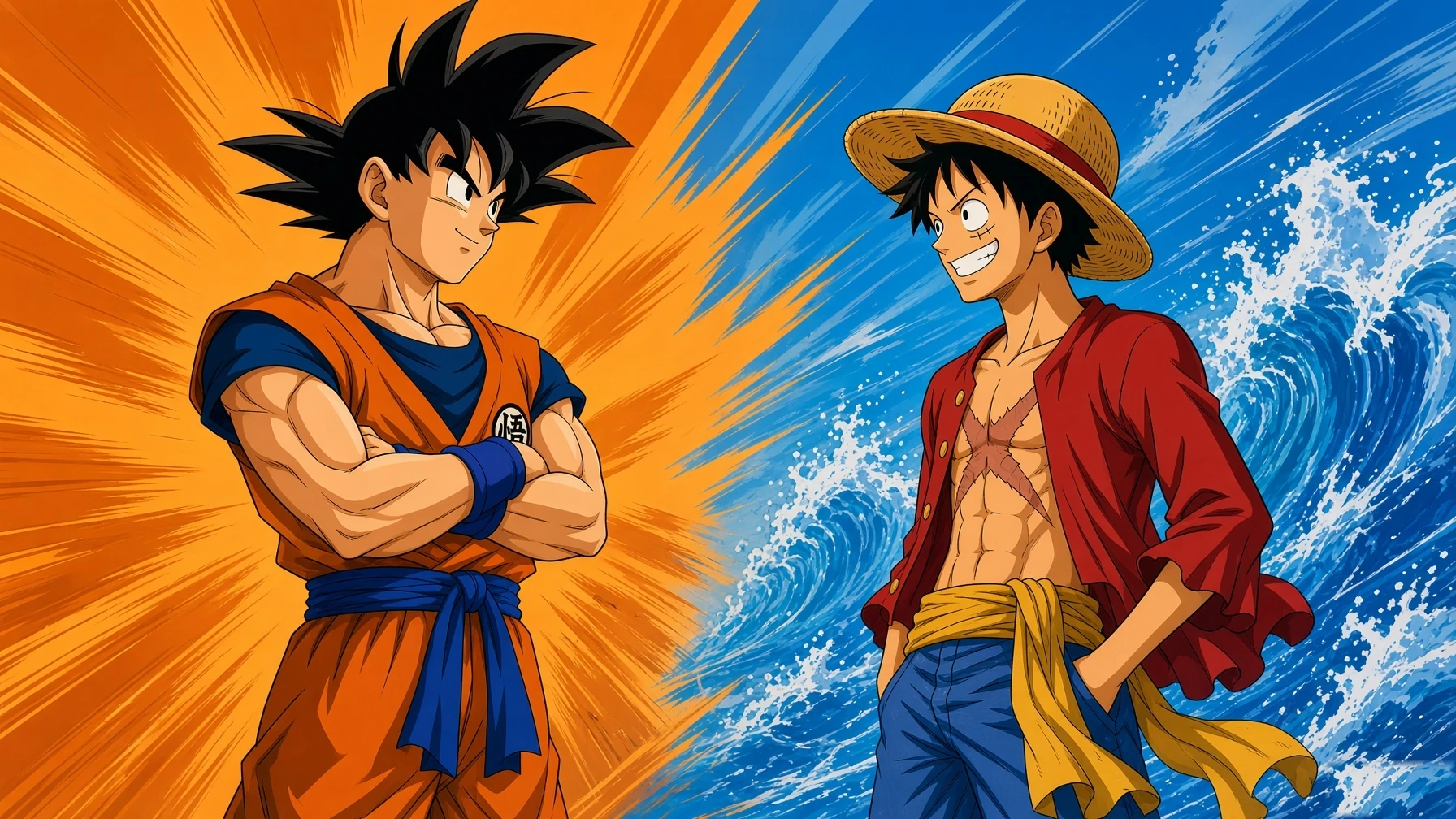
Goku is the stronger pick in a serious one-on-one fight. Luffy brings anticipation, powerful Haki-enhanced attacks and an ability to make an opponent deal with something absurd mid-battle. Those strengths would make Goku work differently. They do not, by themselves, close the gap between the kinds of force their anime stories show them handling.
This is a verdict on a hypothetical matchup, not an official crossover result. The fun lies in giving Luffy a proper case before deciding why it falls short.
Major power spoilers follow: this article discusses late transformations and combat developments from the original Dragon Ball Super TV series through the Tournament of Power, and One Piece through Wano. Stop here if you want those reveals intact. Linked episode accounts contain additional story spoilers.
Which versions and rules define this fight?
Our Goku is the character from the original Dragon Ball Super television series, ending at episode 131. Our Luffy is his Wano-era anime version, including Gear 5. Later manga abilities, films, games, promotional series and alternate versions stay outside the ring.
Both begin rested, with their usual abilities and no outside knowledge of their opponent. The setting is open land with room to move. Victory means knockout or surrender, with no allies, recovery items, ocean shortcut or destruction of the arena’s planet. Both are trying to win; neither deliberately prolongs the fight just to see another transformation.
For the crossover to function, assume their ordinary attacks and defences can interact across worlds. That does not make Haki and ki identical, or grant either one an automatic ability to cancel the other. Specific immunities still need evidence.
These rules also leave out a convenient cheat: giving one fighter unlimited access to his best state while remembering every limitation of the other.
Why does the Beerus fight matter?
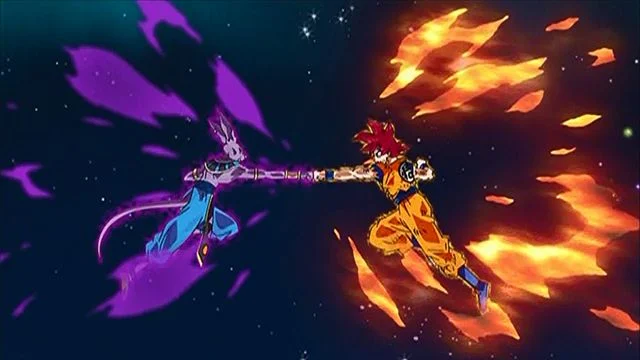
It is tempting to start with Ultra Instinct. The more important reference is much earlier: Goku’s clash with Beerus in Super episode 12. Fuji TV’s official synopsis describes their collisions threatening the universe, with Goku learning to cancel a dangerous impact by matching Beerus’s attack.
That is a shared clash with Beerus, not proof that every casual Goku punch destroys a universe. It still establishes an enormous scale of combat and an ability to adjust his technique under pressure. The argument for Goku does not require imaginary joules or a multiplier for every hair colour.
He can also apply pressure without exchanging punches at arm’s length. Kanzenshuu’s episode account records a Kamehameha against Beerus’s energy attack in the same fight. Range gives Goku another way to control an encounter rather than accepting whichever distance Luffy prefers.
The important distinction is between a demonstrated combat scale and a guaranteed finishing move. The first gives Goku a strong advantage here. The second would require knowing how every exchange unfolds, which these two separate stories cannot tell us.
How could Luffy disrupt Goku’s advantage?
Luffy has more to offer than surprise. In episode 870, he and Katakuri anticipate one another’s moves. His Snakeman attacks change direction and keep pursuing the target. This is an adaptive fighter solving a difficult opponent, not someone relying on a lucky first punch.
By episode 1028, Luffy uses Conqueror’s Haki to repel Kaido’s club without his foot touching it. Anticipation and a powerful strike give him a serious foundation before Gear 5 enters the discussion. Neither example establishes guaranteed evasion or an automatic route through Goku’s defences.
Gear 5 adds a different problem. In episode 1072, Luffy bounces from the ground, becomes enormous and turns Kaido’s dragon body into a skipping rope. Size, footing and the opponent’s own body become things he can play with.
That offers him a plausible route to an upset: read an opening, disrupt the expected response and land something substantial while Goku adjusts. His Haki makes that more credible than physical comedy alone. An opponent may understand how to dodge a punch without expecting the entire exchange to become a different sort of problem.
There is also an answer to ranged pressure. Episode 1071 has Gear 5 Luffy block Kaido’s Boro Breath. Goku having an energy attack is therefore not, by itself, the end of the argument. The unanswered question is whether Luffy can cope with the strength of this particular opponent’s attack, rather than whether he has ever faced one from a distance.
Does changing his surroundings make Luffy limitless?
The same episode that makes Gear 5 look wonderfully unreasonable supplies a limit. In episode 1072, Luffy takes a damaging hit, loses the form and becomes visibly exhausted before rallying. The recovery is impressive. It does not establish endless recovery against any opponent.
There is a tempting alternative reading. In his 2023 comparison for ComicBook.com, Nick Valdez favoured Gear 5 because its effects extend into the surrounding world. His opening suggests a power without apparent limits, but he later acknowledges a possible stamina cost and predicts that the fighters might adapt without producing a decisive winner. The versatility argument is worth taking seriously. It still does not establish that changing the environment makes Luffy the more powerful combatant.
His comparison also draws on manga-era Goku. That is not the version being used here. The environmental argument is worth considering without quietly importing that different scope.
Calling Luffy’s ability cartoon-like describes its presentation. It does not establish omnipotence, literal infinity or a rule that anything he imagines must happen. The Wano fight still has resistance, damage and cost. Those constraints are part of what makes his improvisation satisfying.
What stops Goku’s best state from being an automatic win?
Ultra Instinct does not earn a blank cheque. Fuji TV’s episode 130 synopsis initially gives Goku a speed and power advantage over Jiren, then has Jiren raise his level. The opponent can still respond.
Later in the episode, the strain of Ultra Instinct leaves Goku in severe pain and unable to finish the fight as intended. Valdez’s episode recap records that collapse. Treating the state as permanent, perfectly evasive or freely available on demand would ignore the evidence that makes it dramatic.
This verdict therefore does not depend on Goku starting with Ultra Instinct. His earlier clash with Beerus is the basis for the scale advantage. The later state adds a demonstrated possibility with a substantial cost, rather than a compulsory opening move.
Nor does greater power prove immunity to every unusual technique. Goku could be surprised or caught in an awkward exchange. Luffy could win an individual interaction. A likely winner is not a fighter who is incapable of making a mistake.
Why does Goku still have the stronger case?
Luffy’s best case combines anticipation, Haki, resilience and disruption. Reducing him to “a rubber guy” misses nearly everything that would make this encounter worth imagining.
But an upset argument still needs a way to turn those advantages into a knockout before the other fighter can respond. The cited Wano feats show remarkable versatility and endurance; they do not demonstrate the same scale as Goku’s exchange with Beerus. Under the shared-interaction assumption, that is the largest gap in the comparison.
There is no need to claim an exact speed ratio, a one-punch result or a numerical probability. Goku has the better evidence for winning; Luffy has credible ways to complicate the fight. That is a firmer conclusion than pretending the matchup can be calculated to a decimal place.
Equalise their strength, speed and durability, and the discussion changes. Luffy’s elasticity and improvisation become central tactical problems rather than tools that must overcome a large power disparity. Goku still has his experience and techniques, so even that version would not hand Luffy a free victory.
It would, however, be a different match. With the anime versions above and their demonstrated capabilities intact, the pick stays Goku. Luffy has the better chance of making the fight look unlike anything the audience expected. Goku has the better case for finishing it.
Sources
- Fuji TV’s original Dragon Ball Super programme page: the completed original television run. The scope here ends at episode 131, not every later version of Goku.
- Fuji TV, episode 12 and Kanzenshuu’s specialist episode account: the universe-threatening shared clash, cancellation technique and Kamehameha. The latter is secondary episode documentation.
- Official ONE PIECE.com accounts for 870, 1028, 1071 and 1072: anticipation, Conqueror’s Haki, blocked Boro Breath, environmental changes and exhaustion. These are anime episode accounts; linked manga volumes are not imported as separate feats.
- Fuji TV, episode 130 and Nick Valdez’s recap, 18 March 2018: Ultra Instinct’s initial advantage, Jiren’s response and Goku’s physical collapse.
- Valdez’s opposing comparison, 7 August 2023: an argument for Gear 5’s versatility. Its mixed manga/anime scope and no-limit suggestion are not adopted.