
Why does childhood come along on Taeko’s holiday?
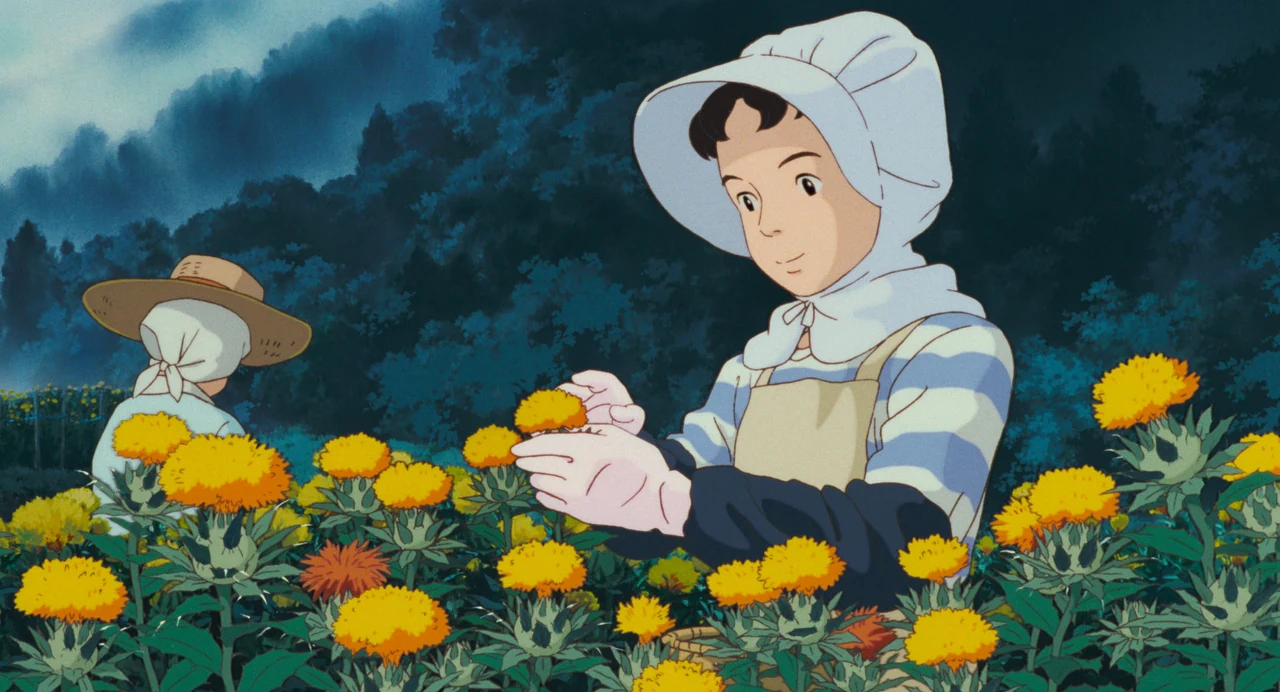
Taeko wants to spend her holiday picking safflowers. She is 27, works in an office in Tokyo, and is heading to relatives in rural Yamagata to help with the harvest. It is 1982, but her thoughts keep returning to her fifth-grade self in 1966. The child who wished she had somewhere in the countryside to visit has become an adult who can finally choose to go.
That does not make the younger Taeko easy to leave behind. Memories arrive with their own unfinished business: a classroom embarrassment, a crush, a disagreement at home. Isao Takahata’s Only Yesterday moves between those recollections and the adult holiday, allowing a small incident to matter long after everyone else has forgotten it.
One of its funniest examples is the family’s first fresh pineapple. The fruit promises an exotic treat, but preparing it becomes a household operation and eating it proves less wonderful than expected. The disappointment is comically modest. Nobody’s life has changed, yet for a child who has invested so much hope in the occasion, admitting that the treat is underwhelming is its own small ordeal.
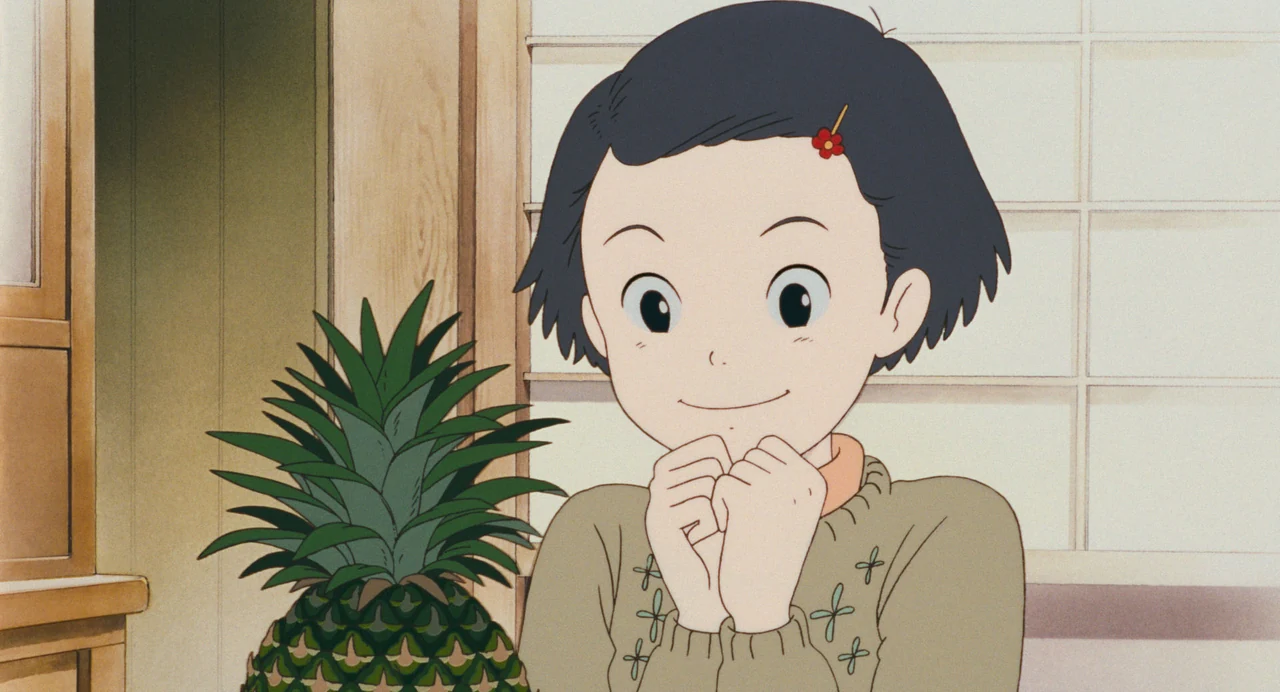
The family scenes can be funny without making childhood uniformly cosy. Taeko struggles with dividing fractions; at school, the onset of puberty becomes material for teasing. Adults and classmates can turn confusion into shame with very little effort. Remembering these episodes gives the grown woman something to reconsider, rather than simply a pleasant past to revisit.
What does working in the country change?
In Yamagata, Taeko meets Toshio, an organic farmer whose interest in the land comes from a life he has chosen. He has experience of the move away from office work that she can only imagine. Their growing companionship takes shape through conversation: farming, memories and the difference between liking a place and deciding to live there.
Toshio is valuable to the story as a listener as well as a possible romantic partner. He meets the adult who can tell an old story differently, rather than the schoolgirl fixed in her family’s recollection. Their exchanges give Taeko room to think aloud. James Berardinelli’s review notes how ordinary their conversations can be, while finding closeness in the way they share them.
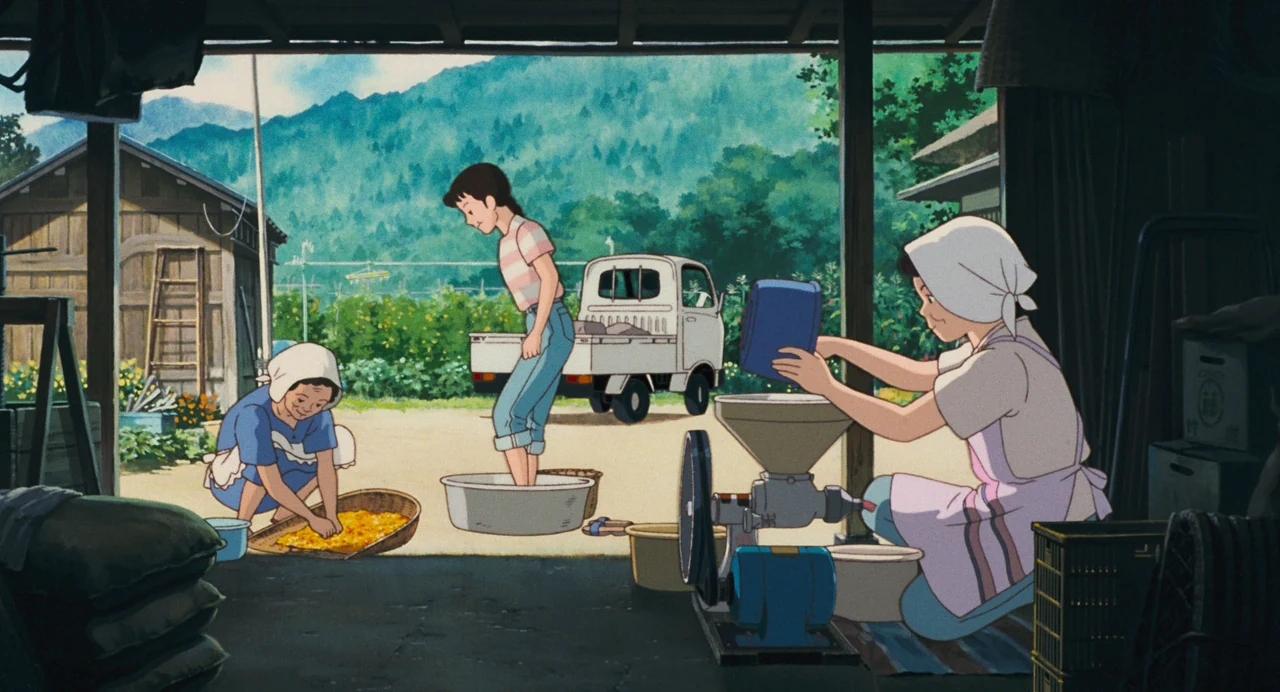
The rural setting keeps its work in view. Evan Minto’s Ani-Gamers review draws attention to a conversation about the girls who harvested safflowers yet could not afford the rouge made from them. Within the film, a beautiful crop carries a history of unequal rewards. Taeko’s pleasure in helping does not make the labour decorative.
There is a question underneath her enthusiasm: does she want this life, or the idea of it that she carried from Tokyo? The distinction gives the holiday its stakes. Country life is not an empty space into which she can pour every disappointed childhood wish. There are people already living there, with routines and knowledge she is only beginning to learn.
How does the film give memory a different texture?
The two periods do not simply look like the same world with different clothes. Childhood scenes often leave soft, pale areas around their settings; the adult countryside has denser colour and detail. Glenn Kenny’s review connects the flashbacks’ open space to the partial recovery of a remembered world. The contrast gives a person, a gesture or a playground room to stand out from its faded surroundings.
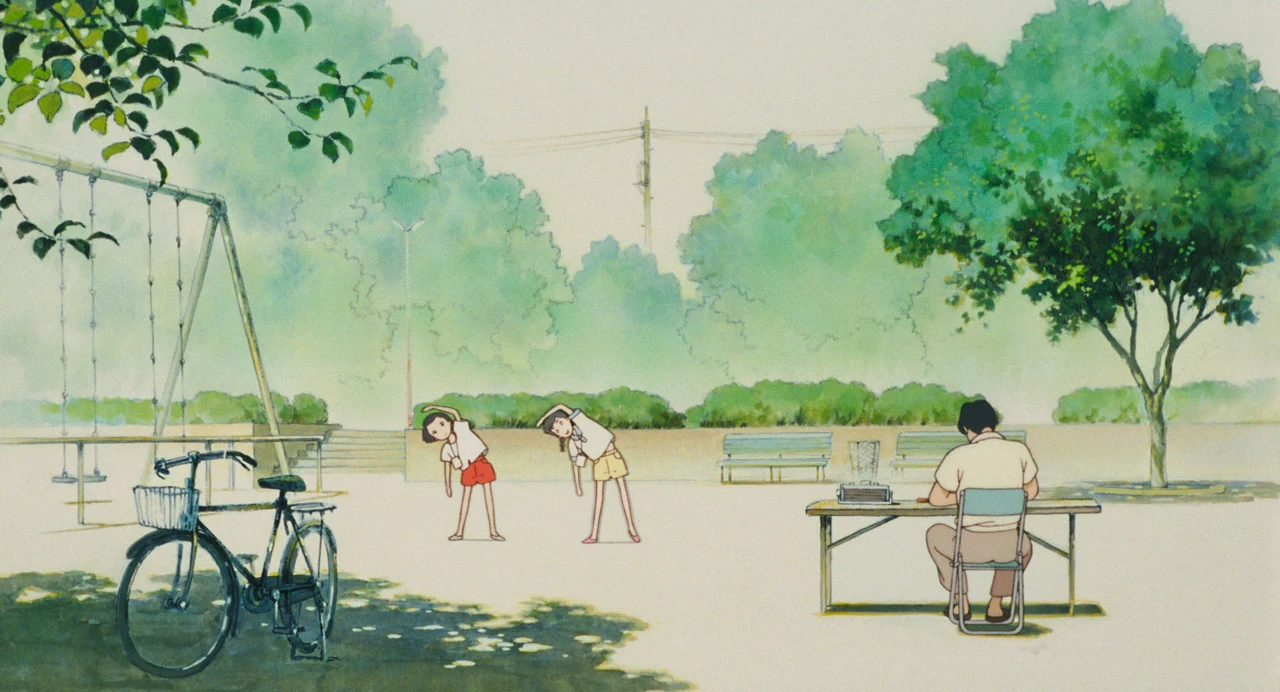
Animation also lets a recollection briefly exceed everyday reality. After an encounter with her crush, young Taeko’s happiness becomes a walk through the air. The moment turns an ordinary figure of speech into something visible without turning her story into a magical adventure. Feeling changes the world for a moment, then ordinary life resumes.
The shifts in time give the film an associative rhythm. A memory does not need to provide a clue or set up a later confrontation to deserve attention. That openness is also its demand on the viewer: conversations about farming and small domestic incidents occupy space that a more tightly plotted story would give to an obvious crisis. The connections accumulate through Taeko’s attention, and some remain questions rather than neat lessons.
Which film should you watch?
This is Isao Takahata’s 1991 animated feature, approximately 119 minutes using Studio Ghibli’s figure. It stands alone. The Japanese-language film and the later English dub tell the same story; Daisy Ridley voices adult Taeko and Dev Patel voices Toshio in the English version released in 2016.
Its gentleness includes uncomfortable childhood experiences. Family viewing may call for discussion of school teasing about periods, a father hitting his daughter, and the pressure to behave as other people expect. There is also nonsexual bath nudity and smoking. The linked review contains ending spoilers.
The English-release trailer may show later memories and moments in Taeko and Toshio’s relationship. Its release advertising refers to the 2016 edition.
1991 film · 2016 English-release trailer · GKIDS Films
Loading the player connects to YouTube. Playback does not start automatically.
Watch on YouTube · © 1991 Hotaru Okamoto, Yuko Tone/Isao Takahata/Studio Ghibli, NH
Sources
The linked reviews discuss the final decision and scenes during the credits.
- Studio Ghibli: Only Yesterday: director, original release, approximate runtime, credits and official stills.
- GKIDS: Only Yesterday: adult premise, English cast and disc specifications. Its disc runtime is 118 minutes; the approximate figure above follows Studio Ghibli.
- Ryan Lambie, Den of Geek: the pineapple sequence, visual transitions and the difference between romanticising rural life and choosing it.
- Evan Minto, Ani-Gamers: safflower labour, contrasting visual textures and the childhood flight of happiness.
- Glenn Kenny, RogerEbert.com: negative space in recollection and animation’s visible metaphors for feeling.
- James Berardinelli, ReelViews: Taeko and Toshio’s conversations and the detail in adult expressions.
- Sandie Angulo Chen, Common Sense Media: childhood experiences, family pressure and content guidance.
- Ken Burke, Film Reviews from Two Guys in the Dark: an alternative response to the childhood episodes and description of the communal-bath scene.
- GKIDS Films: official English-release trailer: the 2016 English edition of the 1991 film.