
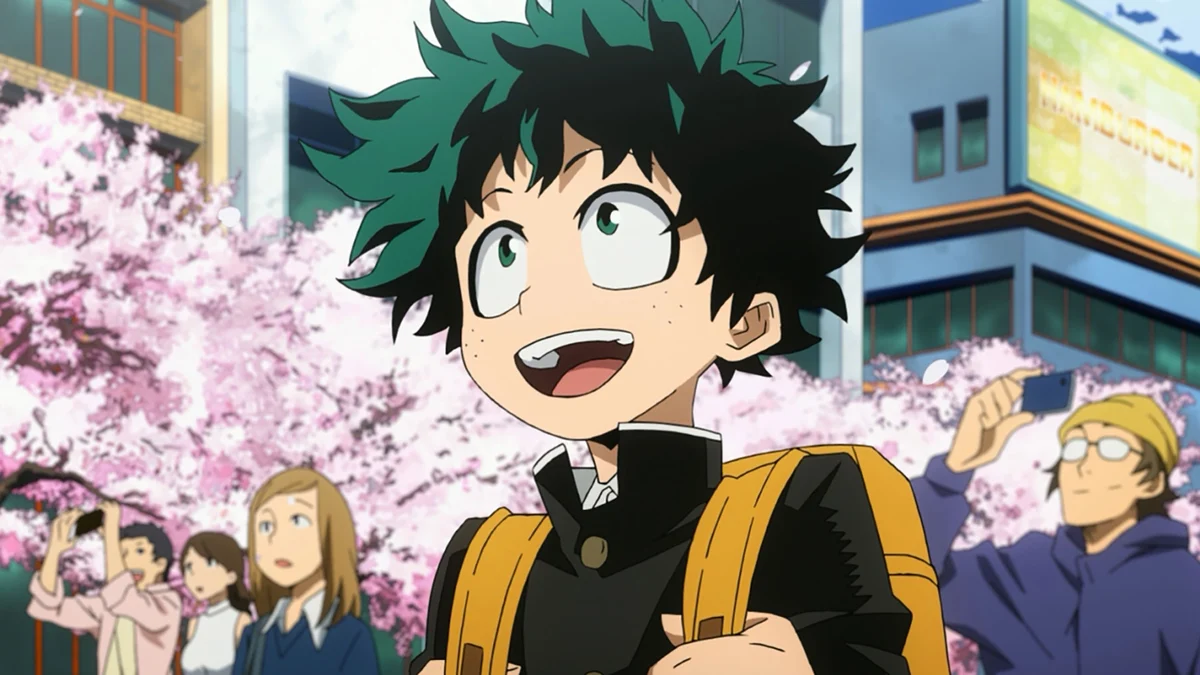
In Izuku Midoriya’s society, roughly four people in five are born with a superhuman trait called a Quirk. Those abilities shape ordinary life and make professional heroes seem like an attainable career. Izuku wants to enter U.A. High School’s hero course, but he has no Quirk. His ambition begins as a contradiction that the story takes seriously.
What makes Izuku’s dream difficult?
The first episode introduces him as an observant fan of heroes, someone who studies their powers and decisions in a notebook. That knowledge cannot change how other people classify him. His admiration for All Might meets a blunt social reality: a public ideal of heroism can coexist with a system that tells a powerless child he has no place in it.
Izuku’s first defining action comes before he has the strength to perform hero work. Faced with a friend in danger, he moves despite fear and without a plan. The moment gives All Might evidence of a quality that is not a Quirk. It also sets up the series’ central question: can courage become a skill, and what should training do with a person whose instinct outruns his ability?

Image credits
My Hero Academia
(C)堀越耕平/集英社・僕のヒーローアカデミア製作委員会
Image sourceWhy is U.A. more than a school setting?
All Might’s offer of a path to hero training comes with hard physical preparation. Izuku is not handed a finished identity; he has to build the capacity to use a power and then learn how to control it. U.A.’s entrance exam extends this lesson. Points go to combat against artificial villains, but the test also rewards a rescue decision that is not reducible to defeating an opponent.
Once Izuku joins Class 1-A, his classmates complicate the idea of a single heroic type. Their Quirks differ in usefulness, danger and temperament. Bakugo’s explosive confidence makes rivalry personal; Uraraka’s resourcefulness reveals how teamwork can alter a situation. The classroom gives the show a way to compare methods and motives without treating every student as a replacement version of the protagonist.
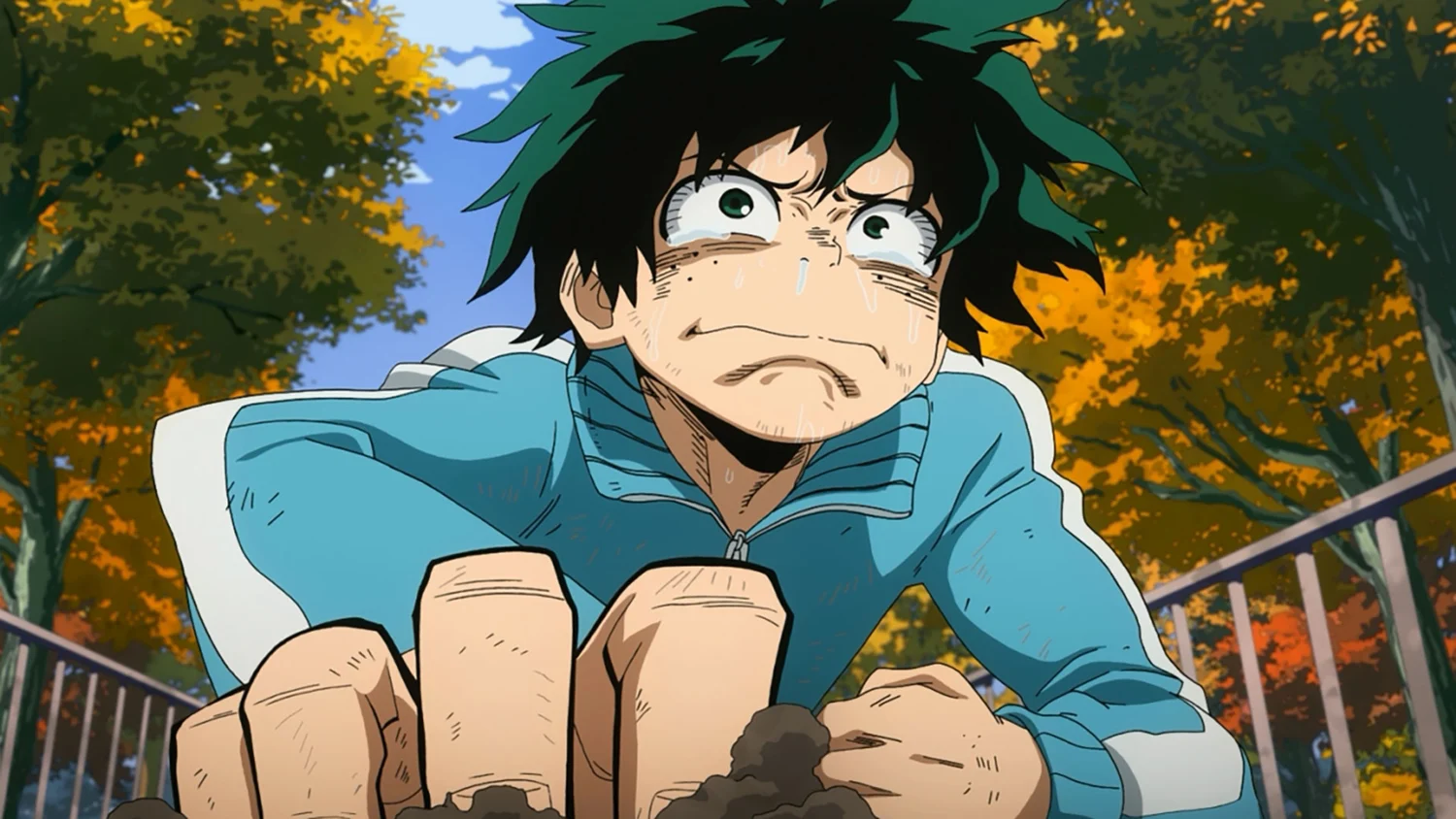
Image credits
My Hero Academia
(C)堀越耕平/集英社・僕のヒーローアカデミア製作委員会
Image sourceWhy does a classroom make powers interesting?
A Quirk is useful only in relation to a situation. An entrance test, a rescue and a team exercise do not ask the same thing of a student. Having a dramatic ability does not automatically supply judgement about when to use it, whom to protect or how to avoid hurting a partner. That is why the school can keep making the same power newly difficult without inventing a replacement for it.
Uraraka and Iida also make Midoriya part of a social world beyond his rivalry with Bakugo. He has to get to know the people beside him, not simply catalogue their abilities. His habit of analysing heroes is valuable; treating classmates as people rather than entries in that notebook is another part of the education.

Image credits
My Hero Academia
(C)堀越耕平/集英社・僕のヒーローアカデミア製作委員会
Image sourceWhat is the series’ heroic ideal?
It is a story about an institution and a profession as much as about superpowers. Heroes answer crime and disaster, but they also become public examples. All Might’s presence shows how one person can make others feel safe; Izuku’s admiration shows how that example shapes a child’s plans. The tension emerges when the symbolic role and the physical limits of the person carrying it meet.
The opening season is a compact entry into that tension, while the television route follows eight main seasons through episode 170. This television count excludes the epilogue More, films, OVAs, recaps and the Vigilantes spin-off. Start with season one, episode one, and treat the later seasons as the continuing story of this same class and profession.
In a season-one review, Anime UK News critic Onosume points to expressive faces as a strength of the origin story. Midoriya’s frightened determination and Bakugo’s clenched, hostile confidence give two very different faces to the same ambition. Costumes and powers may advertise the future heroes, but the early story also needs us to recognise the pupils beneath them.
For a promotional sample, see 2016 first-season PV · TOHO animation. Trailers may include scenes beyond the early setup described here.

