
What does it take to keep one child alive?
In the New Yogo Empire, a prince’s body has become a matter of state. Chagum carries the egg of a water spirit, and the imperial court regards his existence as a danger. His mother turns to Balsa, a travelling bodyguard with a short spear, to get him away from the people who should be protecting him.
That is a strong pursuit-story premise, but Moribito: Guardian of the Spirit keeps asking what happens after the immediate escape. A child needs shelter. An injured protector needs treatment. Someone has to pay for food, and someone has to find out what the spirit actually means. Balsa can fight the emperor’s hunters; she cannot solve every part of the job with the same weapon.
The resulting fantasy has room for both a dangerous forest encounter and the awkwardness of finding a place in a household. Its central pleasure is watching protection become a shared, continuing responsibility.
Why is Balsa more than a formidable fighter?
Balsa starts as a working professional. Her difficulty is applying what she knows while another person’s safety limits her choices. In the early confrontation with the hunters, separating Chagum from the fight matters more than displaying her skill to him.
Even her spear brings obligations. An early visit to a bladesmith turns equipment maintenance into a question of trust: the craftsman also serves the palace, and helping Balsa may mean defying its authority. The weapon has a maker, a history of use and a blade that wears out. That small chain of dependencies makes her profession tangible.

The people around her have skills she needs. Tanda is a herbalist who provides care and refuge; Torogai understands matters of the spirit world. Their presence makes Balsa’s competence more interesting, because being capable does not mean being self-sufficient. There is affection in this arrangement, but also work that must get done.
What changes when Chagum leaves the palace?
Chagum has to learn how ordinary life is organised. In episode seven, discovering that things cost money leads him to worry that he is a burden to Balsa and Tanda. The revealing part is the worry. He is trying to understand what these people are giving up for him, with very little experience of the world that makes their help necessary.
His place in the story therefore extends beyond being valuable cargo. Balsa must preserve his life while making space for him to acquire judgement. A prince who has been served by others now encounters the effort behind the services he took for granted. Their relationship grows through that difference in knowledge, rather than through an instant declaration that they are a family.
These domestic stretches change the rhythm after the opening danger. The series asks for interest in a boy learning to live somewhere, not just in whether the next assassin will catch him. For a viewer expecting an uninterrupted chase, that can feel like a substantial deceleration. It is also where the rescue begins to acquire a life worth preserving.
Why does the empire disagree about the spirit?
The court’s account of Chagum is powerful because it can authorise action against him. But official learning is not the only way people understand this world. Torogai’s knowledge and the traditions surrounding the spirit bring other accounts into the story. Finding out what is true becomes inseparable from asking whose explanation receives a hearing.
Shuga, a scholar at court and Chagum’s tutor, makes that tension personal. His concern for the boy exists inside an institution with its own hierarchy and expectations. The palace is more than a distant building that periodically sends enemies: it is a place where people must decide what loyalty requires.

There are dangers beyond human politics, too. The spirit belongs to a world adjoining the human one, and escaping imperial authority does not remove Chagum from that larger conflict. The story’s question becomes more demanding than finding somewhere the emperor cannot reach.
How does the setting support the people in it?
Director Kenji Kamiyama has described food as a way to show the country’s economic circumstances and differences in wealth. He also explained his decision to increase the colour saturation to evoke a landscape rich in water. Those choices connect the scale of the fantasy to things its inhabitants can eat, cultivate and depend upon.
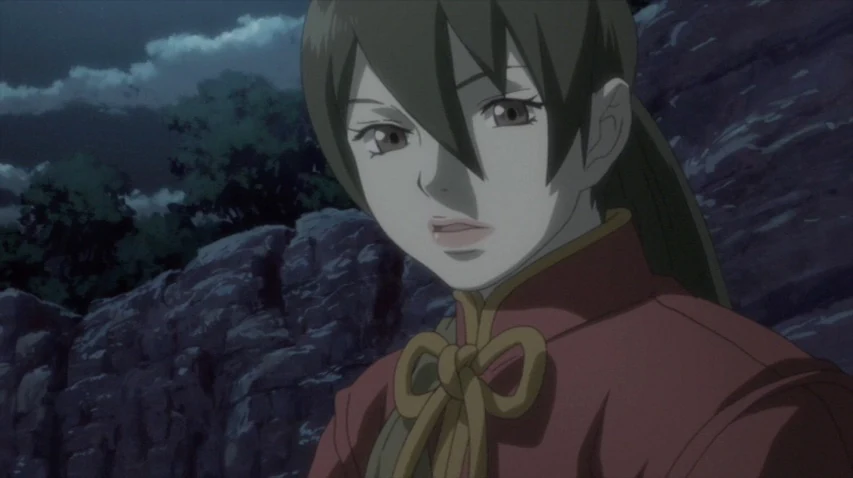
The stills give a sense of the setting through weathered working spaces and people equipped for different kinds of labour. Moribito offers places with a life beyond the next confrontation. In her Anime UK News review, Sarah praises both its landscapes and its staged fights. The invitation is to enjoy those fights as part of that world, with the slower intervals supplying people and places that matter when violence returns.
Where should you begin?
Start with episode one and follow the 26-episode animated series in order. The opening three episodes establish the rescue and pursuit; the following stretch reveals how much of the series concerns living under protection. MVM lists 650 minutes for its complete collection, approximately 10 hours 50 minutes. That is an edition-based allowance, not a stopwatch total for every release.
The novels and the later live-action adaptation are separate works. No familiarity with either is needed for this series.
The extended trailer previews battles and later supernatural imagery beyond the opening. Skip it if you want to discover those scenes in the series.
2007 series · VIZ official extended trailer
Loading the player connects to YouTube. Playback does not start automatically.
Watch on YouTube · © Copyright: Nahoko Uehashi/Kaisei-sha/ Guardian of the Spirit Production Committee. Under license by AnimeWorks 2008.
Sources
The episode pages and reviews below reveal more of the pursuit and later story than this introduction.
- Production I.G: series overview and credits.
- Production I.G: episode three, episode seven and episode eight.
- Kenji Kamiyama interview, Production I.G, on food, colour and the adaptation.
- Sarah’s complete-collection review, Anime UK News and Cauthan’s review, for independent critical readings.
- MVM’s complete collection, for the 26-episode boundary and approximate duration.