
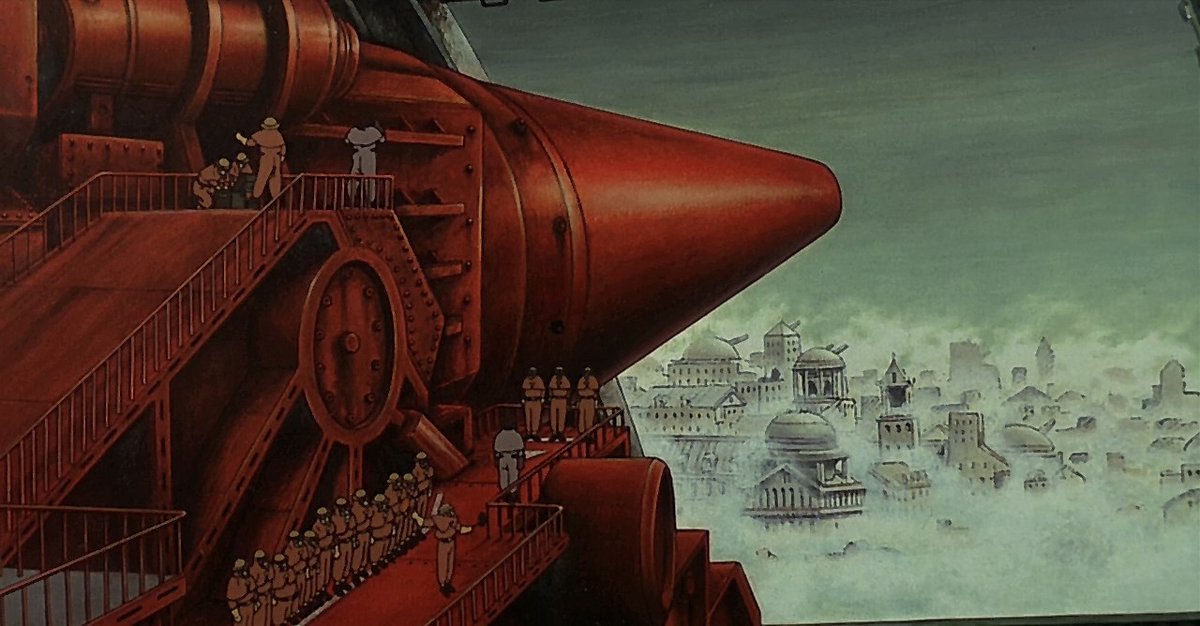
A salvage crew hears a distress signal and finds an opera singer’s world inside a wreck. A sick researcher takes the wrong pills and goes about his business while becoming a catastrophe for everybody else. A boy grows up in a city where the family working day and the school day serve enormous cannons.
Those are the three worlds of Memories, a 1995 animated anthology based on stories by Katsuhiro Otomo. Its roughly 113 minutes contain three complete shorts with separate directors and markedly different temperaments. The film offers a miniature Gothic expedition, a disastrous comic journey and a city portrait, without asking them to become chapters in one larger plot.
The contrasts give each new beginning a real change of company. An explorer, an unwitting carrier and a family inhabit different relationships with danger. Their practical lives make the extravagant settings approachable: someone is doing a job, trying to feel better or learning what adults expect him to become.
Magnetic Rose: a voice inside the wreck
Koji Morimoto directs the first short from a screenplay by Satoshi Kon. Its explorers, Heintz and Miguel, answer a distress signal and enter a derelict vessel. The grand interior they encounter belongs to the world of Eva, an opera singer whose presence seems to survive in a place that should have been left behind.
The space workers bring equipment and a reason for being there. Eva’s world introduces a different kind of invitation: rooms made for performance, attention and memory. A wreck is supposed to be the remains of something. The singer’s world challenges the visitors’ confidence about what is finished and what can still involve them.
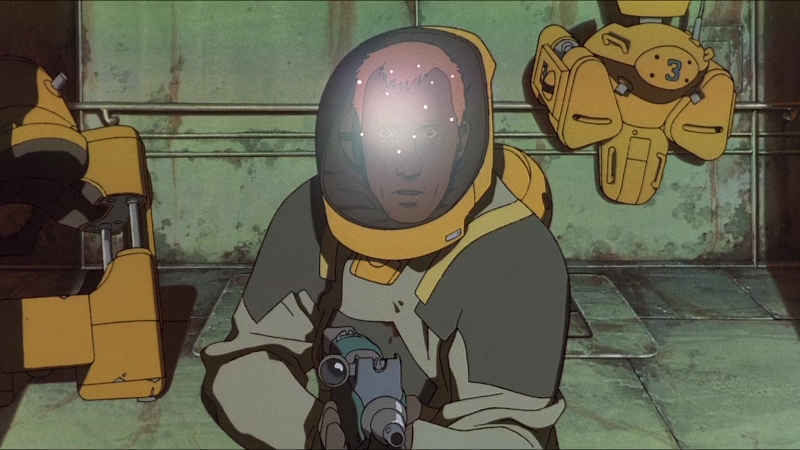
The men matter as more than bodies in space suits. In Andrew Osmond’s production account, Morimoto describes developing the explorers into characters for the film. Giving them lives beyond the vessel makes the encounter with somebody else’s past more substantial than an inspection of an extraordinary building.
Music belongs inside that setting. The opera singer gives the story a reason for a voice to command a room, and the production’s operatic recording used members of the Czech Philharmonic Orchestra and a singer, with a conductor following the film. Studio 4°C records that orchestral work as part of the operatic material; the anthology’s other worlds have their own musical identities.
Stink Bomb: the wrong medicine for an ordinary day
The second short is directed by Tensai Okamura, with story and screenplay by Otomo. A junior researcher suffering from flu takes pills he believes will help him. The mistake turns his body into a source of lethal gas. The person at the centre of the growing emergency does not understand that he is causing it.
His wish is comically small beside its consequences. Getting well and getting on with work would be a normal success. Instead, his movement towards Tokyo becomes a problem on an entirely different scale, involving people and institutions far beyond his immediate concern.
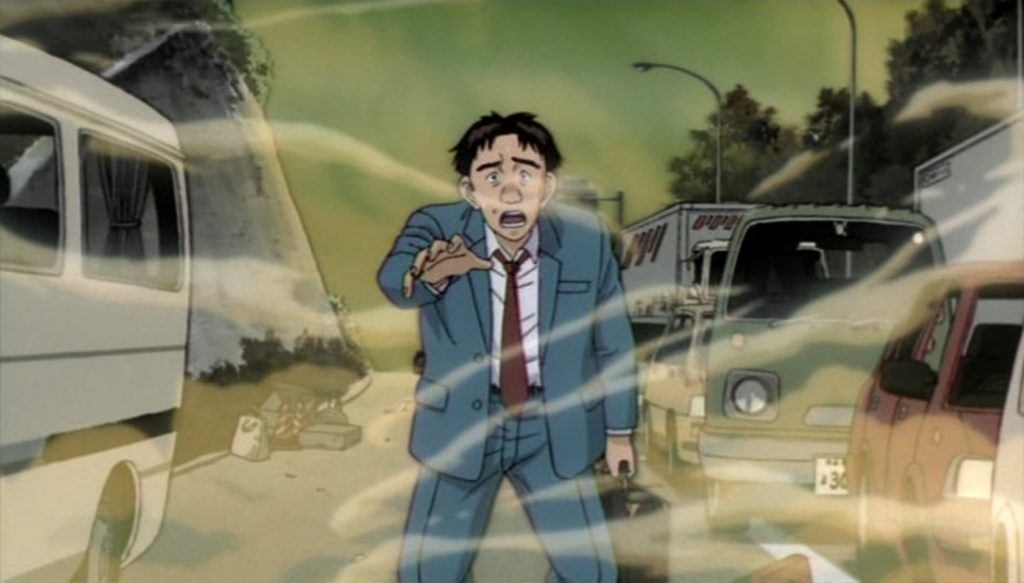
That distance gives the short its dark comic engine. The man in the suit and the people responding to the hazard do not possess the same information. Ordinary behaviour can become alarming when seen from outside his understanding. The joke does not require the consequences to be gentle.
Coming after Magnetic Rose, the change can be startling. The first short invites an intimate involvement with a haunted place. The second lets a much more mundane intention produce spectacular disorder. A viewer can enjoy the shift, or miss the emotional register it interrupts; the anthology makes room for that difference.
Cannon Fodder: a family in a city built to fire
Otomo directs the final short. A father, mother and son live in a dense industrial city organised around huge cannons. Work and school are connected to the same military purpose. The boy’s sense of an adult future grows inside the world his parents already help sustain.
The city is therefore more than an imposing background. Its machinery creates jobs, routines and ambitions. The household makes those systems visible at a human scale, while the colossal cannon makes a person’s part in them look very small.
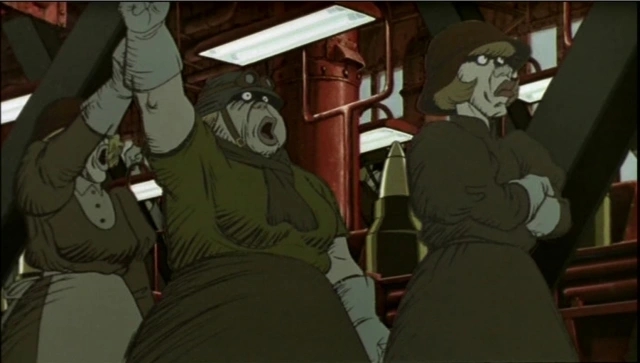
Studio 4°C describes the short’s one-cut construction: a continuous animated movement through the world, rather than a sequence of ordinary scene changes. It is an animation design, not an uninterrupted live-action take. The continuity helps connect different parts of the city into something like a single daily circuit.
Its enemy remains remote from that visible work. Instead of supplying another expedition or expanding emergency, the short asks what this way of life looks like while it is functioning as expected. That can be the most unsettling premise of the three, or the one a viewer finds hardest to enter. The companion Feature explores that disagreement without explaining the endings.
How different are the three shorts?
A discussion of Magnetic Rose includes readers who strongly prefer the first segment, alongside replies defending the comedy of the second or the experiment of the third. These reactions are a useful reminder to expect contrasts rather than a uniform tone. They do not establish that one segment is objectively the best.
The creative credits are equally worth keeping distinct. Kon writes Magnetic Rose; Morimoto directs it. Okamura directs Stink Bomb. Otomo’s role across the anthology does not make all three shorts one director’s work. The appeal is partly seeing how differently these film-makers use the space a short provides.
Where should you start, and how long is the film?
Watch the 1995 anthology in its existing order: Magnetic Rose, Stink Bomb, then Cannon Fodder. Allow approximately 113 minutes, excluding disc extras. No earlier film, novel or franchise entry is required.
Expect frightening space imagery, death, biological harm and military life, with substantial changes of mood. A later disc or platform date can identify an edition rather than the original production year. The three-part film is the work introduced here.
Sources
- Studio 4°C’s official production page, for the original 1995/113-minute anthology, separate directing/writing credits, operatic recording and Cannon Fodder’s continuous construction.
- Sony Pictures’ film synopsis and Discotek’s licensed edition page, for the three opening situations. Sony’s 2004 page label concerns that release presentation; the original film is dated 1995.
- Andrew Osmond’s production account for Anime Limited, including Morimoto’s explanation of developing the explorers as characters. The linked article discusses later developments beyond this introduction’s spoiler boundary.
- Anthology reactions, checked 26 October 2026, for the attributed difference in preferences. Plot and credits follow the production and distributor sources above.