
After a distress signal leads space workers into an opera singer’s abandoned world, Memories starts again with a man who wants to get over the flu. Later it begins again with a family getting on with life in a city built around cannons. Those are substantial changes of company. The three shorts do not promise the same kind of attachment, humour or payoff.
That can make the 1995 anthology feel uneven to a viewer who wants more of Magnetic Rose. It can also make its final segment more interesting than a ranking allows. Cannon Fodder asks us to attend to work and routine after the first two shorts have supplied more obvious emergencies. The apparent absence of a new crisis is part of its subject.
Why does the wreck still feel inhabited?
Magnetic Rose, directed by Koji Morimoto with a screenplay by Satoshi Kon, gives its explorers a reason to enter an unfamiliar place. They are answering a distress signal. Heintz and Miguel bring the expectations of salvage work into a vessel whose grand spaces belong to another kind of life: the world of the opera singer Eva.
That difference gives the film people to hold on to as well as architecture to admire. An opera house implies a performer and an audience. A derelict implies that an activity has stopped. Here, the singer’s presence unsettles that practical distinction between what is abandoned and what still seems to ask for attention.
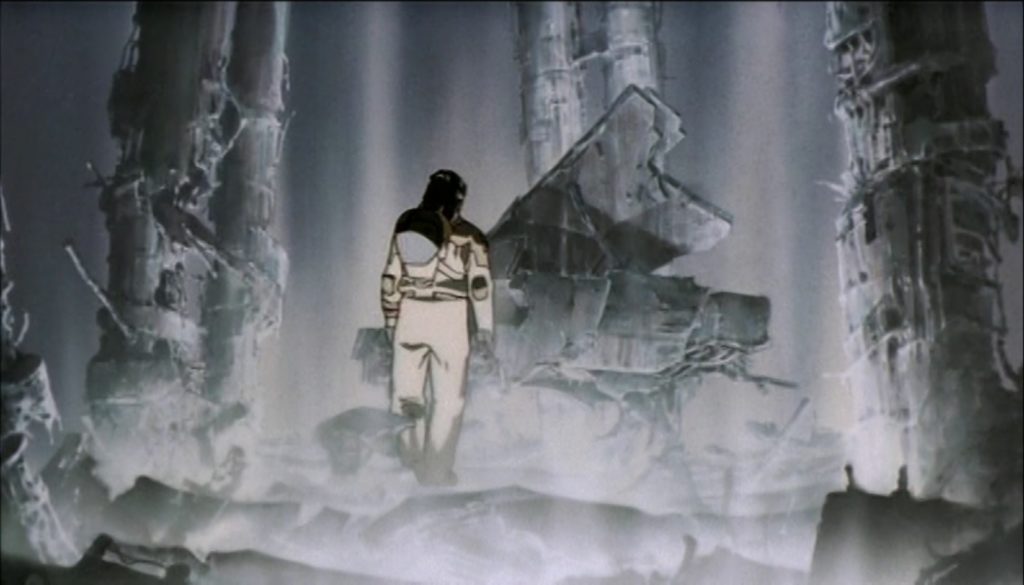
A piano in the vast interior makes that attention particular. The instrument has a human purpose even when the space around it is ruined. It encourages a question more intimate than “What dangerous thing is on this ship?”: whose life has made this place look the way it does, and what happens to a visitor who becomes involved in it?
Andrew Osmond’s production account describes Morimoto developing the two explorers as characters for the film. The elaboration matters because an expedition can otherwise become a guided tour of impressive sets. People with lives outside the wreck make the invitation to remain inside it more consequential. The setting has something to offer them as well as something to hide.
How does Stink Bomb keep its researcher unaware of the emergency?
Tensai Okamura’s Stink Bomb, written by Katsuhiro Otomo, replaces that Gothic invitation with a bodily mistake. A junior researcher takes the wrong pills while ill. His body becomes the source of a lethal hazard, while he remains unaware of the scale of the emergency around him.
The change produces an uncomfortable comic distance. The man wants to continue an ordinary day; other people must deal with what his presence does to it. A straightforward trip towards Tokyo becomes disproportionate to the intention behind it. The scale of the response can grow while the carrier remains an ordinary worker in a suit.
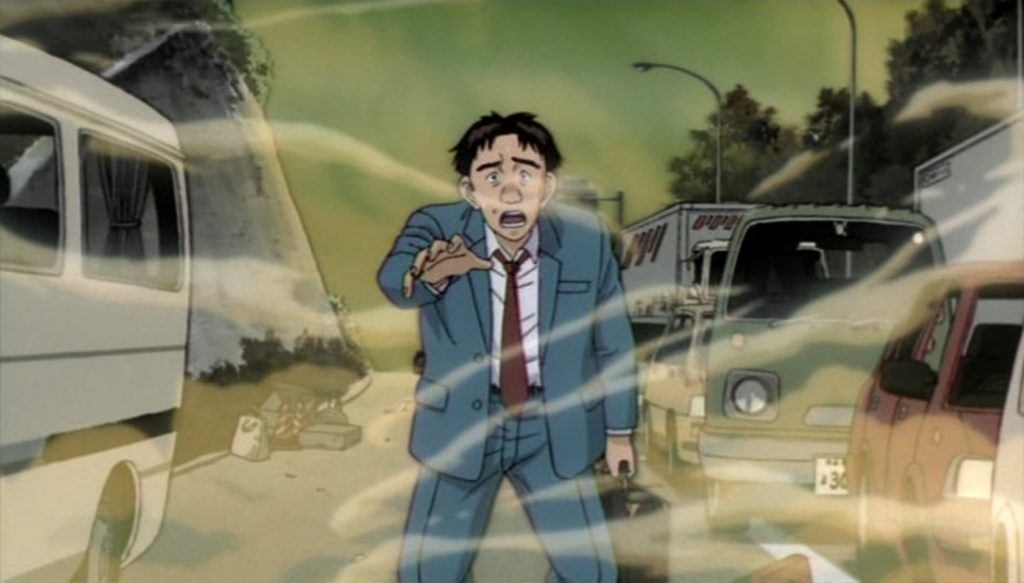
Coming after Magnetic Rose, the second short also changes how closely a viewer can share its central person’s understanding. The explorers recognise that the vessel is strange, even if they do not understand it. The researcher lacks the knowledge that would let him recognise himself as the threat. Comedy grows in that gap, without making the people exposed to him safe.
This is a real tonal disruption. Someone drawn to the first short’s intimate melancholy may find the second’s absurdity less affecting. The anthology gains range by making that break; it gives up the promise that the next story will deepen the same mood.
What happens when firing a cannon is a day’s work?
Otomo’s Cannon Fodder makes another break. Its family does not discover a weapon hidden in an otherwise ordinary city. The city already exists to operate enormous cannons. The father’s job, the mother’s labour and the son’s schooling belong to that purpose. Military life is something adults sustain and a child learns to imagine joining.
That makes the household essential. Vast machinery can suggest an abstract warning about war. Following a family places that warning inside things people need to do: earn a living, get through a shift, learn what counts as useful knowledge. A child can inherit an ambition before being able to question the system that makes it available.
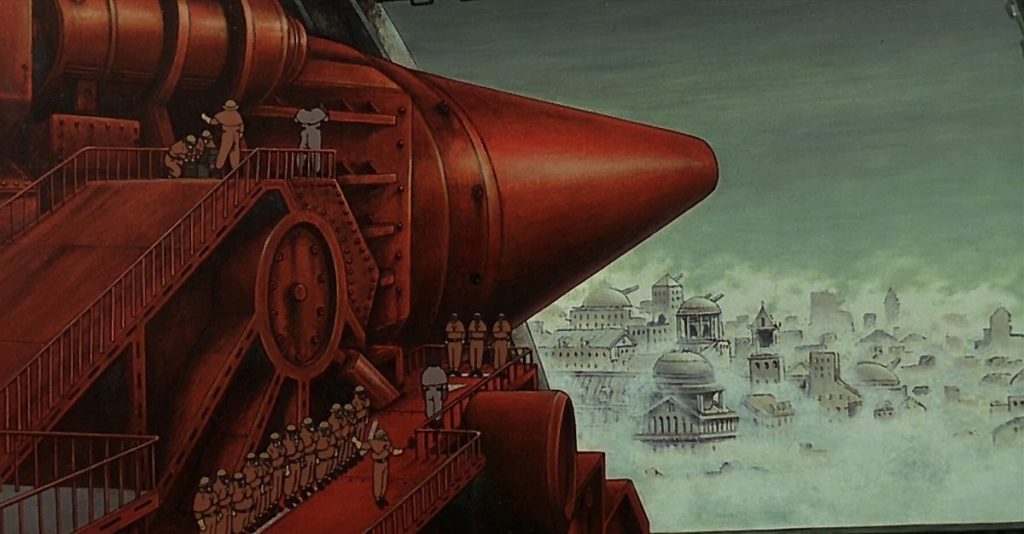
Studio 4°C describes the segment’s continuous, one-cut construction. In animation, this is a planned continuity of viewpoint, rather than a live-action camera surviving an uninterrupted take. Its movement can connect the household, workplaces and city into a single daily circuit. What might have been separate locations becomes the ordinary environment in which these people live.
That continuity needed changes of pace. In Jonathan Clements’ production account, Otomo recalls testing the storyboards with a video camera and finding the relentless movement uncomfortable to watch. He added pauses and slower passages. Moving through this city is a designed rhythm, with time spent at work, rather than a headlong tour of its machinery.
The unknown enemy remains distant from the labour devoted to it. The cannon is immense; the person operating a small part of it has a narrower horizon. The mismatch is there before a battle could supply a conventional climax.
Why can the final short feel out of place?
A Cannon Fodder discussion puts the disagreement plainly. m42a finds the segment aimless, with too little character interest to compensate for a buildup that seems not to arrive anywhere. joedono describes initially disliking it, then responding more strongly when treating it as a day in an unfamiliar world. These are different encounters with the same form, rather than evidence that a dissatisfied viewer has failed a test.
A later Magnetic Rose thread repeats the divide: one reader barely remembers the other shorts, while a reply defends the third’s portrait of a militarised society. The anthology permits that disagreement because its parts ask for different kinds of attention.
Magnetic Rose offers people entering a place shaped by a life. Stink Bomb gives us a life whose ordinary movement becomes a public disaster. Cannon Fodder stays with people for whom the apparatus of disaster has become ordinary. The final change can feel like a loss of dramatic intimacy. It can also leave a different question behind: what if the frightening thing is the day everyone expects to have again tomorrow?
Sources
For the original film’s date, length, separate directing/writing credits and three-part form, see Studio 4°C’s official Memories page. Its production notes document the one-scene, one-cut approach to Cannon Fodder. Discotek’s official Blu-ray synopsis supplies the premises. The 1996 Singapore International Film Festival programme provides period synopses, including the military context of Stink Bomb and the family routines of Cannon Fodder.
- Andrew Osmond on Magnetic Rose and Jonathan Clements on Cannon Fodder, for the explorers’ development and Otomo’s account of the final segment’s household, working life and changes of camera pace. These accounts discuss later events.
- Cannon Fodder reactions and the later anthology comparison, checked 26 October 2026; individual interpretations, not a ranking agreed by viewers.