
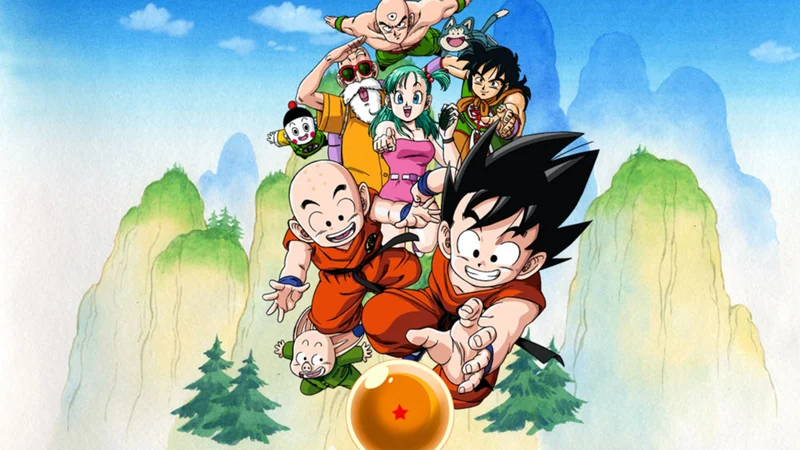
Goku lives alone in the mountains and has never met a girl before Bulma arrives looking for a Dragon Ball. He owns one of the seven objects that can summon a wish-granting dragon, but it is also a keepsake from his grandfather. Bulma needs help finding the others; Goku is curious about the world beyond his home. The bargain between them starts a journey that keeps changing its scale.
What kind of adventure is the original Dragon Ball?
The first television series is a comic road story before it becomes a sequence of martial-arts contests. Goku’s strength and appetite create immediate jokes, while Bulma’s inventions and ambition give the pair a practical reason to travel. They encounter people who want the Dragon Balls for their own purposes, so a playful search can turn into a problem of who should be trusted with a wish.
The people Goku meets matter as much as the objects. Master Roshi becomes a teacher, and Krillin begins as a rival student. Training gives their strength a direction: rather than simply being naturally powerful, Goku learns techniques and tests himself against other fighters. The World Martial Arts Tournament offers a stage where a personal desire to improve can intersect with friendship and competition.
This is the original Dragon Ball anime, not Dragon Ball Z. It follows young Goku through a distinct 153-episode story. The later series, remakes, continuations and films have their own identities and viewing questions; this introduction stays with the first series.

Image credits
Dragon Ball
(C) バードスタジオ/集英社・フジテレビ・東映アニメーション
Image sourceWhy is Goku’s innocence more than a gag?
Goku’s upbringing leaves him unfamiliar with ordinary social rules. That can make the early comedy broad, especially when Bulma has to explain things he has never encountered. But his lack of worldliness also keeps the adventure open: new places and customs are genuinely new to him, not another stop on a route he already understands.
His strength creates a different kind of contrast. Goku can overpower many opponents, yet he does not begin with a sophisticated view of the world or a goal to rule it. Training and competition give him something to work towards. The series’ appetite for eccentric people, strange creatures and escalating tests grows out of a simple question: what else is out there, and what can Goku learn from it?
The opening stretch follows a road-adventure rhythm: the first episode brings Goku and Bulma together, and the next episodes send them into a wider world of unfamiliar people and problems. The Goku-and-Bulma journey gives way to training with Master Roshi and the first World Martial Arts Tournament. That structure lets the premise move from collecting objects to learning skills and testing them against other people.

Image credits
Dragon Ball
(C) バードスタジオ/集英社・フジテレビ・東映アニメーション
Image sourceWhat makes the world bigger than the quest?
The early artwork can put Goku beside a huge tiger without turning the creature into a realistic wildlife encounter. Talking animals, strange technology and martial-arts teachers share the landscape. Bulma’s practical inventions and Goku’s life in the mountains give the travelling pair different ways to respond to its surprises.
Roshi’s turtle shell is a particularly memorable example: an old man brings a creature’s outline into the role of a martial-arts master. The absurd appearance belongs beside genuine training. Expect the same mixture in the tone, including sexual jokes and behaviour towards women that can be uncomfortable, rather than assuming the young hero makes this a gentle children’s adventure.
How long is the original series?
The original 1986–1989 series runs 153 episodes, an approximate 61 hours at 24 minutes each. Begin with episode one. Dragon Ball Z is a separate TV series that follows Goku’s early journey.
The original develops the franchise’s adventure and martial-arts foundations in a more exploratory, comic form. If you only want the later high-stakes battles associated with Z, this series spends substantial time on travel, odd encounters and training before those expectations apply.


