
Laios Touden’s sister Falin has been swallowed by a Red Dragon, and he wants to reach her before she is digested. The surviving party escaped to the surface, leaving their money and provisions deep inside the dungeon. An urgent return needs food they do not have. Laios proposes eating the monsters they meet on the way down.
What can you do with a walking mushroom?
The first expedition meal makes the premise appealingly literal: a huge scorpion and a walking mushroom become a hot pot. A creature that would usually mean a fight and a mushroom that refuses to stay put can be considered ingredients in the same pot. The finished dish has the familiar form of a shared meal even though its ingredients belong to the dungeon’s monster encounters.
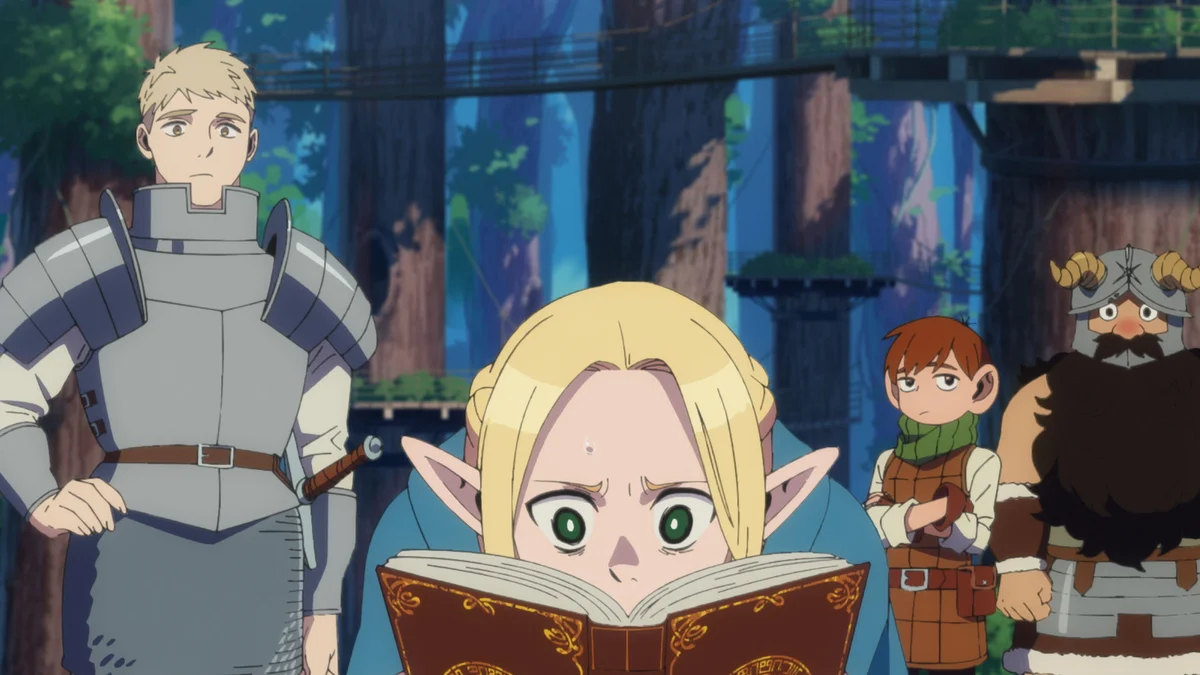
That difference is where the characters disagree. Laios is fascinated by the monsters he wants to try; Senshi, a dwarf experienced in dungeon cooking, gives the proposal practical expertise. Marcille, the party’s elven mage, does not greet monster food with the same enthusiasm. Her actor Sayaka Senbongi describes the first episode as centred on Laios and Senshi, with Marcille persistently objecting. Their interest and her refusal give the meal an argument as well as a recipe.
She is not obliged to share Laios’s appetite just because he can explain the plan. That is part of the comedy’s appeal: a reasonable need for provisions can lead to something that still sounds disgusting. Food has to become acceptable to the person expected to eat it, not only possible to obtain.

Image credits
Delicious in Dungeon
(C)九井諒子・KADOKAWA刊/「ダンジョン飯」製作委員会
Image sourceWhat does the dungeon feed on?
The rescue begins with a dragon eating an adventurer. The party’s answer is to look at the creatures around them as food in turn. Even a man-eating plant can supply the first episode’s tart. The joke belongs to a world where adventurers enter a food chain rather than standing outside it as the only creatures entitled to hunt.
This gives the descent a different practical interest from clearing one room after another. A danger may also be a food supply, but recognising it as edible is not the same as knowing how to make a meal. Laios’s curiosity and Senshi’s experience meet at that gap. The dungeon has to support the party’s bodies while they are moving towards something that has already eaten one of them.
Falin’s possible digestion keeps the cooking from becoming a leisurely tour. Stopping to eat uses time, but continuing without provisions threatens the return itself. The mundane work of sustaining the rescuers belongs inside the emergency. The party cannot live on the urgency of its mission.

Image credits
Delicious in Dungeon
(C)九井諒子・KADOKAWA刊/「ダンジョン飯」製作委員会
Image sourceWhy doesn’t everyone solve the same problem?
Laios’s interest in a creature, Marcille’s objections and Senshi’s cooking knowledge give the group different priorities at the same table. Chilchuck’s work with locks and traps adds another kind of expertise: the person who can get through a dangerous passage need not be the person deciding what goes into dinner. The descent needs those skills to coexist, even when the people using them are impatient with one another.
The useful fantasy is not that one exceptionally knowledgeable leader can do every job. It is the prospect of a party whose specialist concerns can complicate the plan and keep it alive. A monster-cooking adventure has room for somebody who does not want the meal. Letting that resistance remain makes the company more interesting than a group assembled merely to admire Laios’s idea.

Image credits
Delicious in Dungeon
(C)九井諒子・KADOKAWA刊/「ダンジョン飯」製作委員会
Image sourceHow much of the story is available?
The complete released television season has 24 episodes. The continuation is separate from this first-season commitment. Start with episode one and follow the party’s descent.
What people eat, carry and build gives the dungeon’s fantasy world much to investigate. If monster anatomy or food made from unfamiliar creatures is unpleasant for you, the central premise keeps returning to it.


