
A quiet life sounds like something that begins when the fighting stops. Red’s opening project in Banished from the Hero’s Party gives it more work than that. He wants to gather herbs, open a shop and live in the frontier town of Zoltan. The alternative to the great quest still needs to be made.
Building that quiet life gives the story something to follow. Leaving a role can end one set of expectations without immediately supplying another source of income, companionship or purpose. Red is capable, but capability has to find a use in the place where he now intends to stay.

Image credits
Banished from the Hero’s Party
©ざっぽん・やすも/KADOKAWA/真の仲間製作委員会
Image sourceWho gets to decide when somebody has stopped being useful?
Red used to be Gideon, a member of the party accompanying his sister Ruti, the Hero. His Divine Blessing, the Guide, is associated with helping the Hero begin a journey. That places another person’s destination inside his starting definition of purpose.
Being pushed out of the party makes usefulness sound like a ranking decided by other people. Can he keep up with what the quest now requires? Does his particular contribution still count? Those are consequential questions within the group, but they do not exhaust what he knows or could offer elsewhere.
The herb-shop plan changes the setting in which his knowledge can matter. It gives the story a way to ask about value without first awarding him a spectacular replacement power. A person can cease to fit one job and still possess experience that is important to somebody nearby.
That is a more interesting promise than simply waiting for the old party to regret its judgement. Vindication would still make the old role the final measure of his worth. A livelihood in Zoltan can have a purpose even before anybody from the quest has expressed an opinion about it.
Why begin the quiet life with an illness?
In the first episode, Tanta, the nephew of Red’s friend, develops a dangerous illness. The problem makes practical knowledge immediately consequential. Herbs are no longer just the comforting decoration of a future shop; knowing about remedies may matter to a particular household.
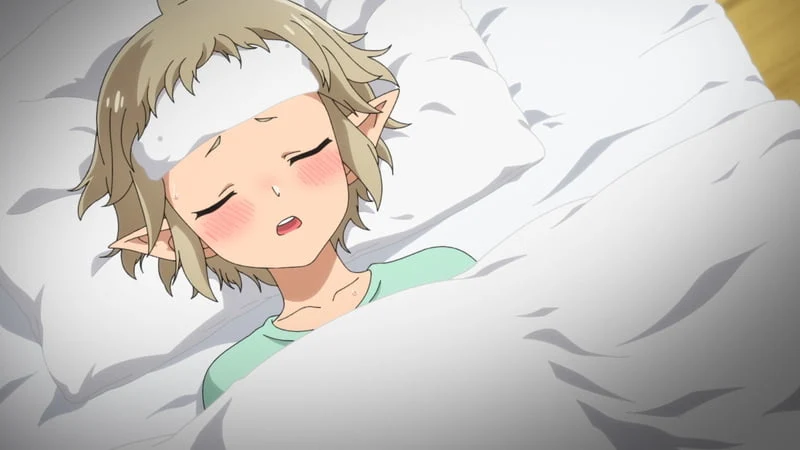
Image credits
Banished from the Hero’s Party
©ざっぽん・やすも/KADOKAWA/真の仲間製作委員会
Image sourceThe scene also prevents “ordinary” from meaning inconsequential. A town can be far from the heroic expedition and still contain urgent needs. The scale changes from the fate of a world to a person somebody knows. That makes a quieter competence visible without requiring danger to disappear.
There is no need to pretend the fantasy is a manual for running a pharmacy. Its useful dramatic choice is to let a proposed way of life encounter a need that makes sense within it. Red wants to deal in herbs; the opening shows why somebody might need that work.
What makes Rit more than a reward for retiring?
Rit arrives with an earlier connection to Red and an interest in the life he is building. Her proposal to join him brings another person’s wish into the shop. The arrangement cannot remain solely an escape plan imagined by one displaced adventurer.

Image credits
Banished from the Hero’s Party
©ざっぽん・やすも/KADOKAWA/真の仲間製作委員会
Image sourceA shared future requires choices about work and space, not only relief that the past is elsewhere. Their prior connection also makes the idea of starting again less absolute. Somebody who knew the adventurer can want to take part in the quieter household.
The town does not grant immunity from the wider world, and an assigned Blessing does not stop mattering because its bearer opens a business. Those pressures give the ordinary project something to resist. The promise is not that Red will never be needed urgently again. It is that he can try to build a life whose value is larger than the job from which he was expelled.
Sources
Linked sources contain later story details.