
The first question in Another is intimate: who is Mei Misaki, and why won’t the class talk about her? The question the series soon adds is brutally practical: which ordinary part of somebody’s day will become dangerous next?
Those are different ways to keep a viewer watching. A mystery invites us to connect information. Accident horror teaches us to distrust the environment, including objects that have no business looking sinister. The 2012 anime puts both inside the same middle-school story, and their collision helps explain why its atmosphere attracts some viewers while its logic and shocks frustrate others.
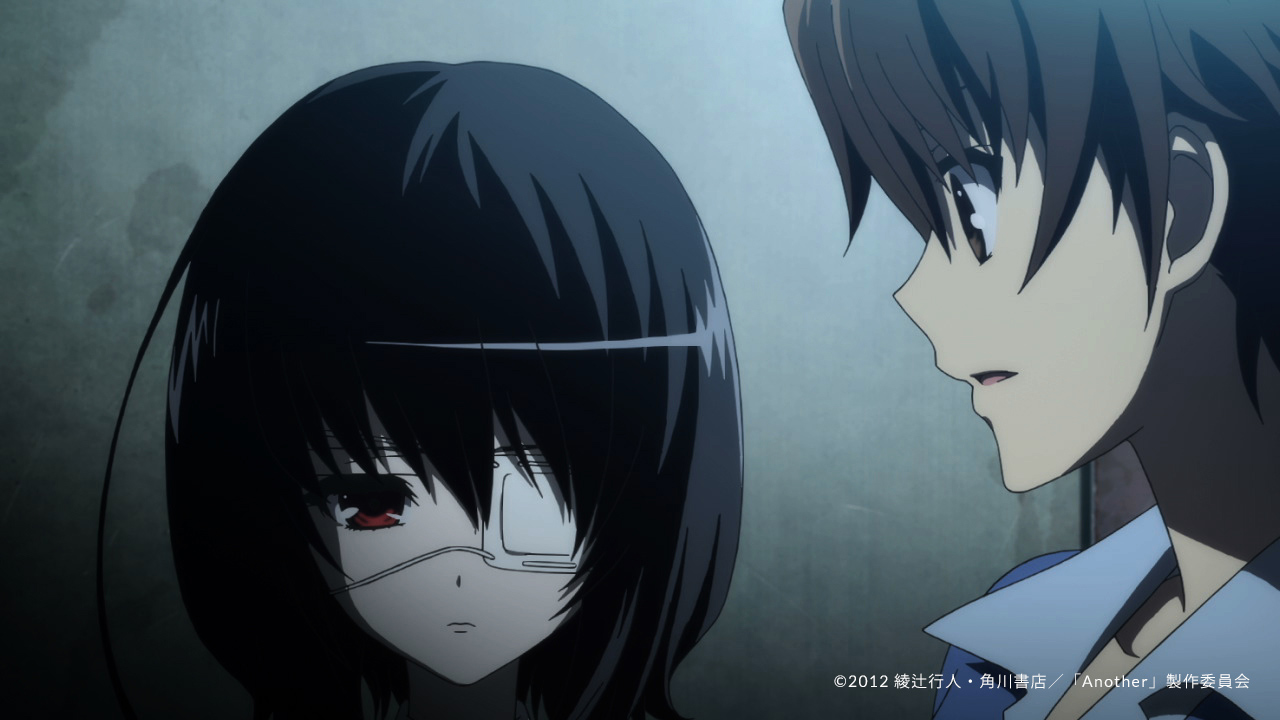
What kind of mystery does Mei promise?
Kouichi Sakakibara has already met Mei in hospital when he joins Class 3-3 a month late. His classmates are friendly, but they do not discuss her. The difference between what he has seen and what the class will acknowledge gives the early episodes a question we can follow with him.
Mei’s reserve makes her something more interesting than a convenient dispenser of answers. She attracts his curiosity while remaining difficult to read. The early doll workshop extends that uncertainty into a place: human-shaped objects surround a girl whose standing among other people is unclear. The point is not that every doll must be a clue. It is that a familiar category, a student in a class, has become difficult to trust.
In the pre-broadcast recording interview, Yukito Ayatsuji describes his source novel as horror, adolescence and mystery together, with revelations in stages and carefully placed foreshadowing. That establishes a real expectation, rather than an audience inventing a detective story the project never intended. The anime also has access to perspectives outside the novel’s first-person narrator. We can wonder what other classmates know when Kouichi is not present.
What changes when an everyday object becomes a weapon?
This section discusses the first major fatal accident, in episode 3. It does not identify the victim or reveal the mystery’s explanation.
A pupil falls on a staircase and is impaled by her umbrella. The object is ordinary enough to have entered school without explanation; the transformation into an instrument of death is what makes the incident memorable. An umbrella belongs to an everyday journey, not to a conventional murderer’s kit.
After such a shock, anticipation can attach itself to the setting. A stairway, a journey or an apparently harmless action may become something to watch anxiously. The viewer’s question changes from “what does this detail tell me?” to “what could this detail do?” One seeks understanding; the other waits for catastrophe.
That is the appeal of accident horror, but it introduces a risk for a mystery. A spectacular death can be remembered more vividly than the person who suffers it. If the construction of an accident becomes too conspicuous, the audience may start appreciating an elaborate contraption instead of feeling a character’s fear.
Why do some viewers find the same incident frightening and absurd?
In a Reddit discussion critical of Another’s plot, RascalNikov1 remembers the umbrella as one of the entertaining parts despite finding the logic weak. A reply from megatsuna instead remembers it as disturbing years later. PreludeToHell prefers the early ambiguity and finds the later escalation silly. Elsewhere, a viewer finishing the series asks for more of its horror-and-mystery mixture, and Paumas singles out its eeriness.
The distinction is more useful than deciding that the people who laugh have watched it incorrectly. A viewer can be gripped by suspense, impressed by ingenuity or pushed into disbelief by the same set piece. The important question is what the scene asks us to invest in: the person, the puzzle or the impending impact.
Criticism reflects that divide too. Ink at Ani-Gamers treats the environments and their sense of isolation as a major strength, describing how the hospital’s vacant spaces diminish the people within them. Shinmaru at The Nihon Review argues that conspicuous shocks and information withheld to prolong the mystery undermine the tension. Neither response establishes a universal verdict. Together they expose the balancing act the series attempts.
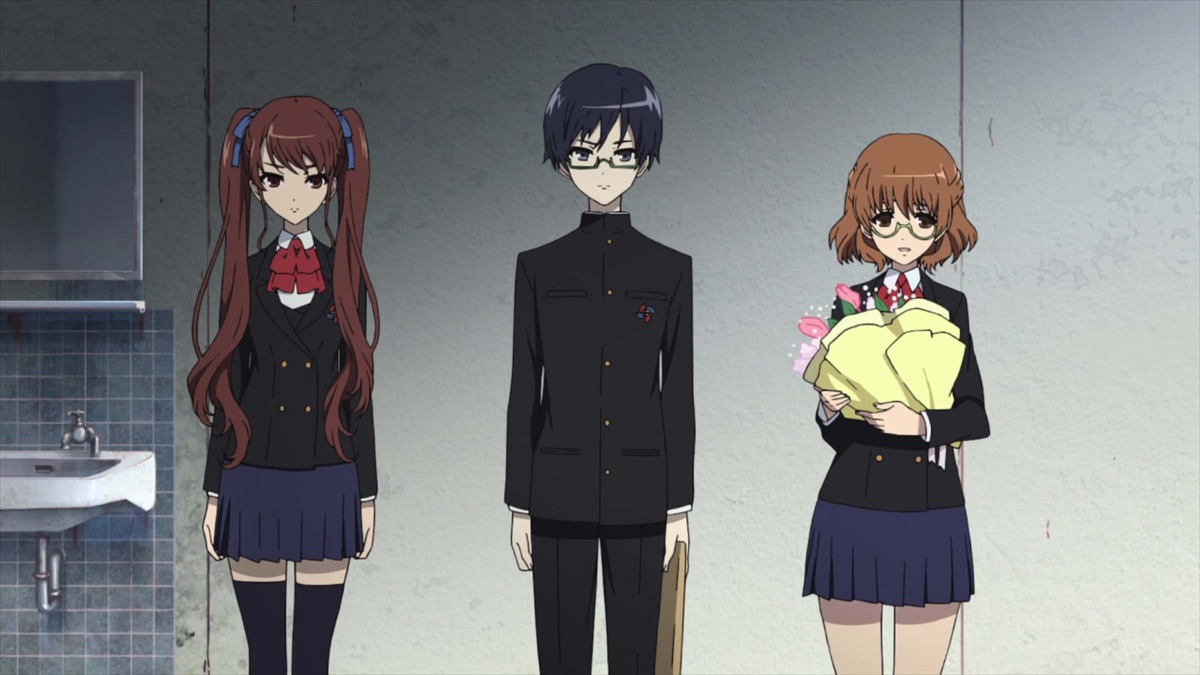
Where do the classmates fit between the clues and the shocks?
Kouichi does not enter an empty mechanism. Teshigawara’s sociability and Akazawa’s more commanding response offer different ways of handling the class’s fear. In the recording interview, their actors describe a mood-maker whose tone can turn sharply and a forceful girl trying to manage an abnormal crisis. They are recognisable adolescent positions: keep the company easy, or take charge when nobody feels safe.
Those roles make the mystery’s withholding more consequential. A frightened group can have reasons to police what its members say. But a series also has to persuade us that each interruption or omission belongs to a person in that situation. Once silence starts to feel like a device imposed solely to delay an answer, the relationship becomes less convincing, however effective the next scare may be.
Mizushima’s stated intention to make a drama of adolescence alongside horror offers a useful measure. Do the classmates remain people navigating a crisis, or become a collection of possible victims and missing clues? Another’s appeal depends partly on how much its atmosphere and escalation can carry when that balance becomes uneven.
What should you expect from that collision?
Come for a school whose habits are difficult to read, for the quiet attraction between Kouichi and Mei, and for a world in which a commonplace object can become unbearable to watch. Expect an increasing appetite for violent spectacle alongside the investigation.
The uncertainty around Mei and the fear of the next accident are not interchangeable pleasures. One may draw you further in while another strains your belief. Recognising that difference makes a more useful invitation than promising either a perfectly fair puzzle or a uniformly terrifying ride. Another has a distinctive combination of adolescent curiosity, ominous spaces and excess; its most interesting question is how long those elements can hold together.
Sources
Reviews and discussion threads contain major later revelations and endings. This feature’s specific incident is limited to episode 3; no culprit, supernatural mechanism or solution is disclosed.
- P.A.WORKS: Another and licensed opening episode: identity and newcomer/Mei premise.
- Dengeki Online: recording interview, 15 November 2011: author’s mystery structure, adaptation perspectives, actor character accounts and director’s adolescence-drama intent.
- Ink: Ani-Gamers review, 23 April 2012: original criticism of the imagery and genre shift. Shinmaru: The Nihon Review: original criticism of shock, withheld information and mystery pacing.
- M J Meier: Dread Central and Merman: Nevermore Horror: accounts of the accident-horror comparison and umbrella incident.
- RascalNikov1, megatsuna’s reply, PreludeToHell and Paumas: individual audience responses. Their threads discuss the ending.