
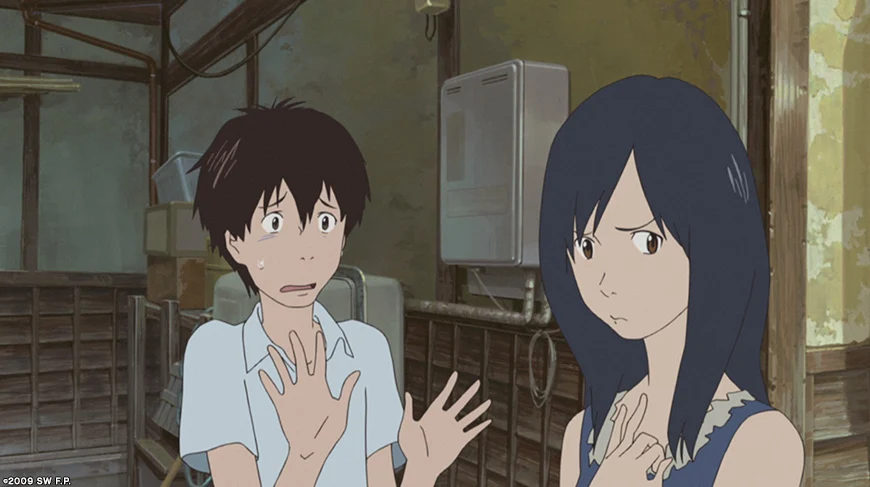
Kenji Koiso expects a summer job, not an introduction to an enormous family as somebody’s fiancé. His schoolmate Natsuki has brought him to the Jinnouchi family’s home in Nagano, where the household is gathering around its formidable elder, Sakae.
Meanwhile, much of the world’s ordinary business takes place in OZ, an online space used for communication, shopping, games and public services. Summer Wars brings those two networks, a crowded family and a digital society, into the same emergency.
Why bring a nervous student into this family?
Natsuki needs somebody to play a role in front of her relatives. Kenji’s usefulness begins with an awkward social performance rather than an ability to defeat a virtual enemy. He has to enter a house full of people who already know one another, their family history and the expectations attached to their names.
That is a different challenge from the mathematical work at which he excels. A puzzle can provide a clear problem and a correct answer. A family has overlapping conversations, old relationships and people who do not all want the same thing.
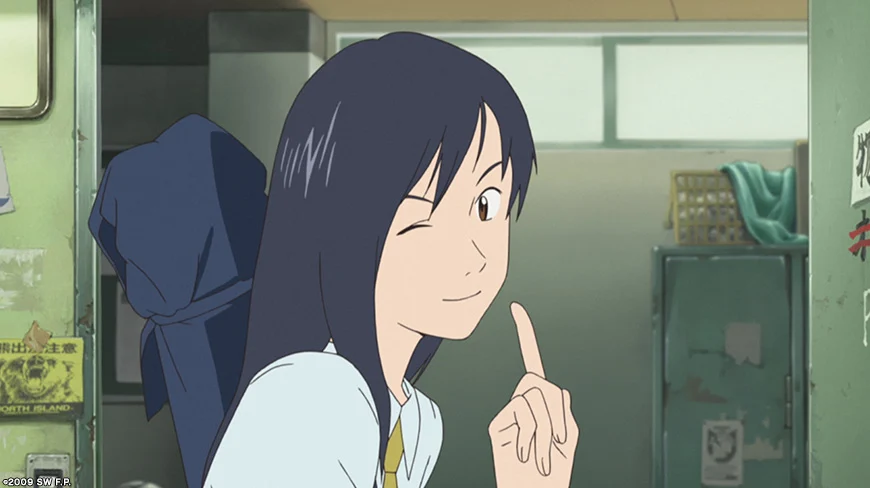
Image credits
Summer Wars
©2009 SUMMERWARS FILM PARTNERS
Image sourceSakae gives the gathering a centre. She is not simply an elderly figure waiting for the younger characters to operate the technology. Her connections and authority are another kind of resource, rooted in knowing people and knowing whom to call.
The film’s premise makes Kenji an outsider who can discover that structure along with the viewer. The task of pretending to belong arrives before any question of what he might contribute when the situation becomes serious.
What does OZ connect beyond the screen?
OZ’s users appear as avatars, with forms far removed from their ordinary bodies. The image below builds colourful structures and routes across an open white field. Tiny figures occupy a space with very different visual rules from the wooden rooms in which Kenji meets Natsuki’s family.
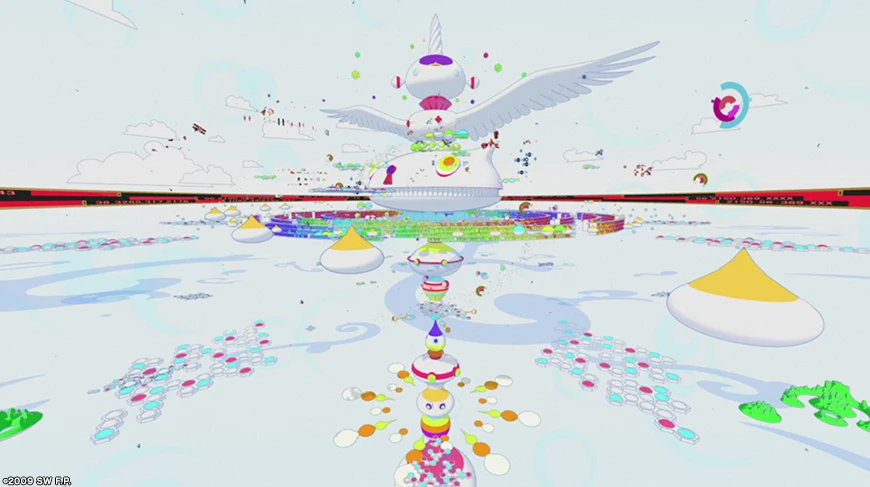
Image credits
Summer Wars
©2009 SUMMERWARS FILM PARTNERS
Image sourceAn attack on OZ matters because the system is involved in daily life. Disrupting a place used for public services and communication can create consequences outside a game. The family home cannot simply close a laptop and become independent of the network.
Kenji receives a puzzling message containing a long sequence of numbers. Working out an answer brings his mathematical ability into a much larger problem, as an artificial intelligence called Love Machine disrupts OZ. What looks like a private exercise becomes entangled with public consequences.
The virtual world’s King Kazma, a rabbit-like fighting avatar associated with Natsuki’s young relative Kazuma, gives the crisis another kind of skill. A reserved person at home and a formidable figure online can be the same family member. The contrast lets a domestic gathering contain abilities that would not be obvious from a first conversation.
How can a household respond to a network crisis?
Director Mamoru Hosoda and screenwriter Satoko Okudera join a science-fiction emergency to the practical problem of getting different people to act together. A family can have access to several kinds of knowledge without automatically knowing how to combine them.
Kenji’s mathematics, Kazuma’s familiarity with OZ and Sakae’s human connections suggest different approaches to that problem. None makes everybody else unnecessary. The story has room for the friction between them as well as the possibility that people can contribute something a single exceptionally capable person cannot supply alone.
The change of scale is part of the attraction. A family visit can involve manners, meals and the difficulty of explaining who somebody is. The same people can become participants in an event whose consequences reach far beyond the house. Neither side has to disappear for the other to matter.
Expect virtual battles, real-world peril, family arguments, grief and bereavement. The resolution and the family’s major losses are left for the film.
Is there anything to watch first?
No earlier series is required. Start with the standalone 2009 film, approximately 114 minutes. Later restorations and rereleases concern presentation of that feature, rather than a sequel needed to understand it.
It is a compact choice for a story in which an elaborate online world and the everyday work of belonging to a family can become parts of the same adventure.
What does the remaster trailer introduce?
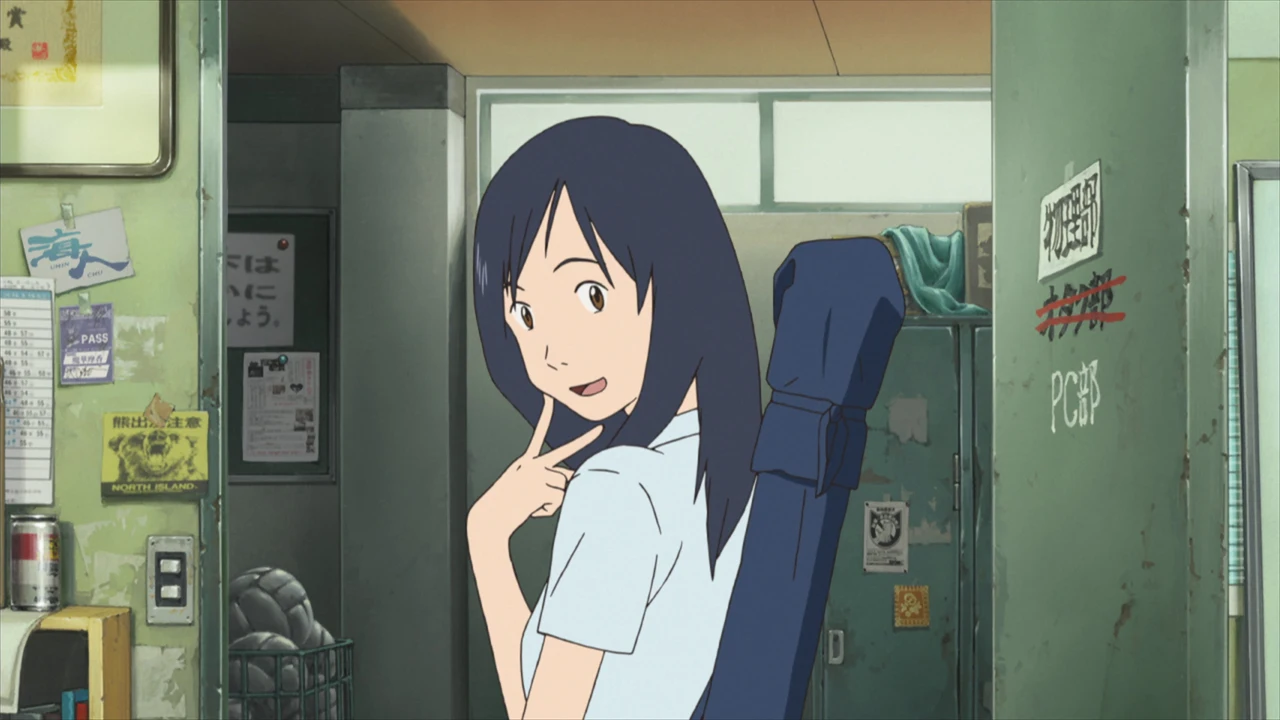
GKIDS’ trailer promotes a later 4K presentation of the original 2009 film. It includes images from the later crisis and virtual battles, rather than only Kenji’s arrival at the house.
Original 2009 film, later 4K remaster · GKIDS Films
Loading the player connects to YouTube. Playback does not start automatically.
Watch on YouTube · Poster: official film still.
Image credits
Summer Wars
©2009 SUMMERWARS FILM PARTNERS
Image source


