
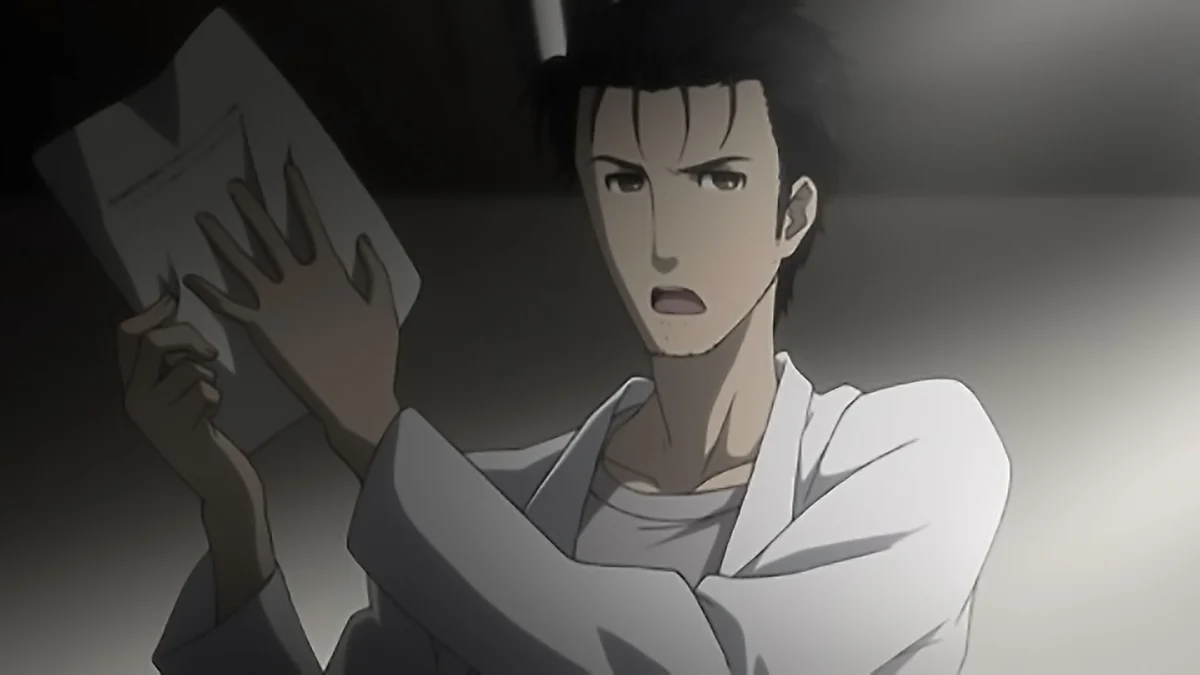
Rintaro Okabe calls himself a mad scientist and gives his circle of friends the air of a secret research group. Their Future Gadget Laboratory is a cramped Akihabara workspace where experiments and theatrical declarations often seem more ambitious than their equipment. The balance shifts when a homemade device lets them send messages to the past.
What makes the opening feel so playful?
Okabe performs a grand conspiracy for an audience that is mostly his friends. Daru, a technically capable hacker, and Mayuri, a steady and affectionate presence, respond to different parts of the performance. Their chemistry gives the lab its rhythm before the science fiction becomes a threat. The jokes are not separate from the story’s stakes: they establish the relationships that later experiments will put under pressure.
The first step towards time travel is small. The device combines a microwave and a mobile phone, and its apparent messages arrive in a context the characters do not initially understand. What sounds like one more overblown claim from Okabe may therefore be a real discovery. The other lab members need a way to distinguish his habitual performance from something that deserves a serious response.

Image credits
Steins;Gate
(C)2011 5pb./Nitroplus 未来ガジェット研究所
Image sourceHow does a message become a consequential choice?
The hook is not simply that the past can be contacted. A message changes the conditions under which people make decisions in the present. That produces a distinct kind of suspense: characters have to interpret consequences they helped create, often without knowing the full rules of the device. Curiosity becomes a moral question once other people bear the cost of an experiment.
Akihabara matters to the texture of this premise. The lab’s inventions, hobbyist culture and exaggerated nicknames make the group feel like people building a private world from whatever they have. The technology is not introduced as a polished institution’s controlled project. It is an improvised discovery shared among friends, so they become responsible for its effects before they understand how to control them.

Image credits
Steins;Gate
(C)2011 5pb./Nitroplus 未来ガジェット研究所
Image sourceWhat gives a text message weight?
Anime UK News critic Sarah singles out the summer cicadas and the sound of incoming messages in the first volume’s soundscape. The contrast is useful: one sound belongs to an ordinary season outside, while the other can announce information that changes the people inside the room. A thriller does not always need an enormous machine to make an arrival unsettling.
Kurisu Makise introduces another pressure on the group’s shared language. She has scientific expertise, so Okabe’s titles and declarations have to coexist with someone who can question an explanation. The laboratory is more interesting when its members do not all agree on what counts as knowledge. Their discovery asks them to turn a private game into a problem they can discuss clearly.

Image credits
Steins;Gate
(C)2011 5pb./Nitroplus 未来ガジェット研究所
Image sourceWhat should a new viewer include?
Start with the original 2011 television anime. This route includes its 24 broadcast episodes and the original unbroadcast bonus episode, Egoistic Poriomania, as the closing story unit. It does not include the altered episode 23β, Steins;Gate 0, the film or promotional shorts. Those are separate branches or extensions; the original broadcast order supplies the starting point.
The entry works best for someone who enjoys a slow build in which character comedy and experimental detail gradually acquire weight. The opening can feel like a circle of oddballs improvising, because that is the social shape the story establishes before it reveals what their invention can change.
For a promotional sample, see Original 2011 television PV · Nitroplus announcement. Trailers may include scenes beyond the early setup described here.


