
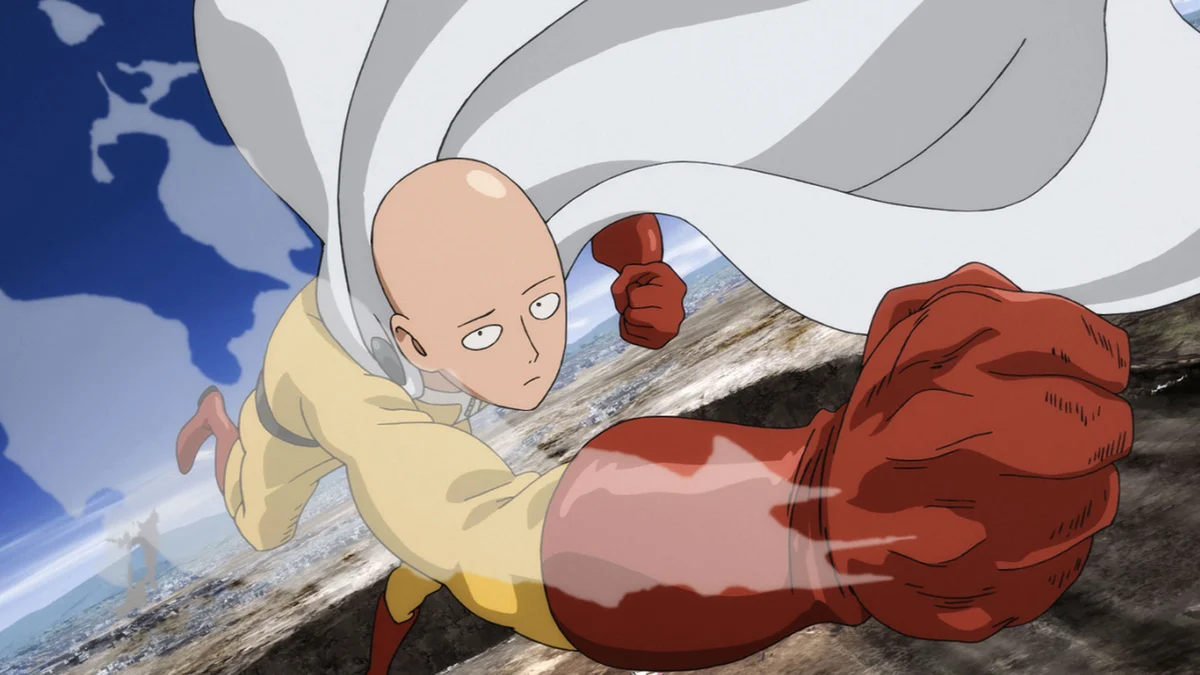
Saitama has trained until he can defeat almost any opponent with one punch. That should make him the safest hero around. Instead, it leaves him bored. One-Punch Man begins with a mismatch between the size of the threats arriving in the city and the small emotional response their defeat produces in its strongest defender.
What is left for a hero who always wins?
Saitama did not become powerful through a secret lineage or a special weapon. The first season presents his plain training routine as the unlikely source of his strength. The joke is not that effort never matters; it is that the result has arrived before the story begins. Each fight can end quickly, but the question of what Saitama wants from being a hero remains open.
The Hero Association gives this world a formal structure. Heroes register, receive rankings and are expected to respond to threats. Saitama enters the system and discovers that public recognition does not arrive automatically with useful work. His disciple Genos, a cyborg seeking revenge on the destructive enemy who ruined his life, approaches heroism with the seriousness Saitama lacks. Their partnership puts a mission-driven character beside someone whose power has outgrown his motivation.
That contrast creates room for the series to shift between absurd comedy and genuine danger. Other heroes have abilities, reputations and personal stakes that make a fight matter to them. Saitama may be able to finish an opponent, but he is not always present for the conflict that shaped it. The story can make fun of the battle formula while still caring about the people who have to survive the battle.

Image credits
One-Punch Man
(C)ONE・村田雄介/集英社・ヒーロー協会本部
Image sourceIs this only a parody of superhero fights?
The first season uses familiar hero imagery, but its subject is not simply how easy it is to defeat a monster. It asks what recognition means when ability and public status do not line up. Saitama can save a city and still be treated as an unremarkable applicant. Genos can be highly capable and remain defined by a goal that a ranking cannot satisfy.
Melissa Camacho’s Common Sense Media guide describes the show as a funny superhero series while documenting frequent graphic fantasy violence. The contrast gives a useful expectation: the joke about Saitama’s boredom sits inside a world where the fights can still be bloody.
The first season runs twelve episodes and introduces the hero rankings that later seasons develop.

Image credits
One-Punch Man
(C)ONE・村田雄介/集英社・ヒーロー協会本部
Image sourceWhy can the plain face be the funniest one?
Saitama’s smooth head and blank expression look especially spare beside Genos’s hair, mechanical arms and glowing palm. The cyborg advertises effort and intensity; the man who can end a fight may look as though he is waiting for an errand to be over. Their designs make the mismatch readable before either explains his ambitions.
The contrast does not make Genos’s seriousness meaningless. Having somebody who wants instruction gives Saitama a relationship that strength alone cannot complete. The teacher can demonstrate a result without possessing an explanation that his pupil will find useful, turning mentorship into a problem the next punch cannot solve.

Image credits
One-Punch Man
(C)ONE・村田雄介/集英社・ヒーロー協会本部
Image sourceWhere should you begin?
Start with episode one of the 2015 season, then follow season 2 and the first part of season 3. The 36 released episodes take about 14 hours at a nominal 24 minutes each. Season 3 continues with an announced second part. Bonus episodes and OVAs sit outside this route.
Its action comedy asks what happens after the power fantasy is already fulfilled. If you want a conventional rise from novice to champion, the lead begins at the other end of that journey.
For a promotional sample, see Original 2015 season PV · Bandai Namco Filmworks. Trailers may include scenes beyond the early setup described here.


