
A kingdom summons heroes to solve its problems and gets an extra office worker. While the others receive abilities that sound useful in a fight, Tsuyoshi Mukohda can order groceries from modern Japan. In a land of monsters, magic and armed adventurers, that seems an unimpressive contribution.
Campfire Cooking in Another World with My Absurd Skill finds an adventure in what he does with it. Familiar seasonings can transform unfamiliar ingredients. A pot of food can win help, earn money or persuade a terrifying creature to stop looking quite so terrifying. Mukohda would prefer a quiet life; keeping his new travelling companions fed gives him plenty to do.
What can a magical grocery order change?
Mukohda’s skill is called Online Grocery. It supplies products from his original world, so the fantasy landscape does not require him to abandon every familiar taste. He can combine imported ingredients and seasonings with whatever the journey brings him. The attraction is partly practical: what would you make if dinner’s main ingredient had just been a monster?
The food also has effects beyond filling a stomach. Ingredients from his original world can boost abilities, making the shopping skill useful to fighters as well as the person doing the cooking. Mukohda has something valuable, even if he is not especially brave about demonstrating it.
The series keeps the work around the meal visible. Someone has to obtain ingredients, prepare them and deal with the people who buy or process a successful hunt. Mukohda registers with both a merchant guild and an adventurer guild, giving him two ways to make a living. A guild is an organisation that registers members and provides work; here, paperwork can matter almost as much as a weapon.
That makes a useful distinction between having a remarkable ability and wanting a heroic career. Mukohda is happy to benefit from his skill. He is much less enthusiastic about being pushed into danger to improve his combat magic.
Who keeps asking for another helping?
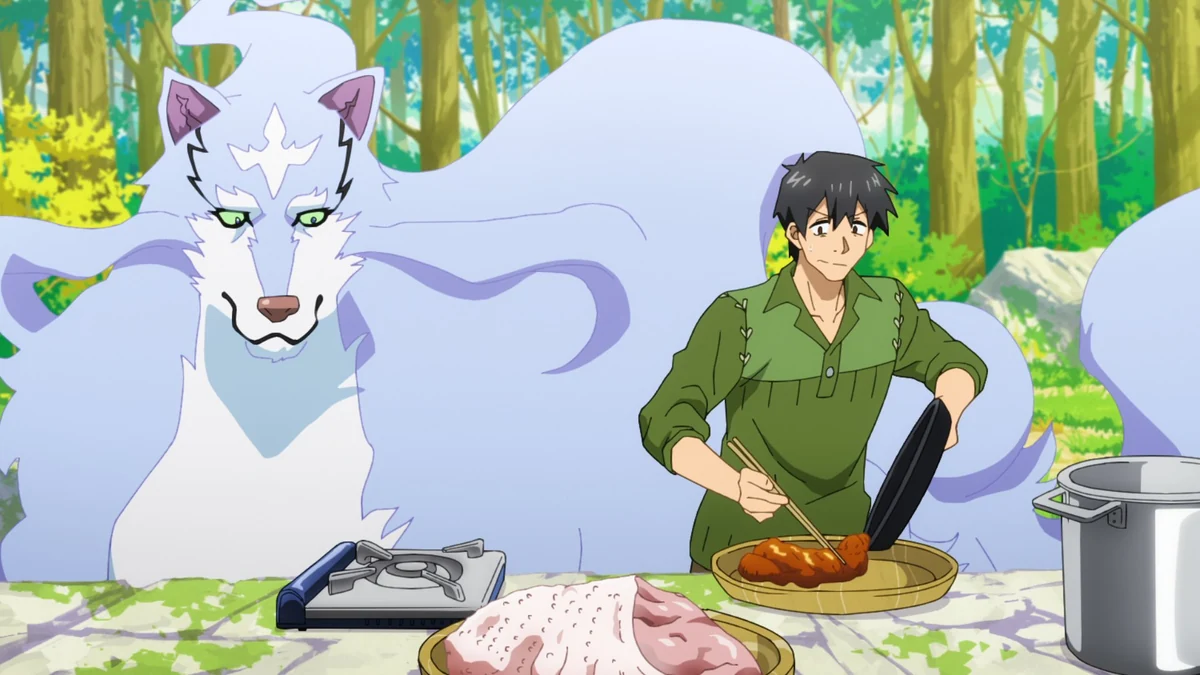
Fel is a legendary wolf-like creature, a fenrir, with the strength to make other people nervous. He becomes Mukohda’s familiar, a magically bound companion, because he wants more of his food. The arrangement gives the cook protection and the fighter a dependable kitchen.
Their unequal confidence makes a good comic partnership. Fel is willing to tackle threats that Mukohda would rather avoid. He can provide extraordinary meat, then leave the anxious human with the very ordinary problem of turning it into dinner. His official character profile adds a wonderfully domestic qualification to the legend: he dislikes vegetables.
Sui, a young slime, changes the household’s scale. Small enough to hold, Sui responds to Mukohda with affection and gives him someone to fuss over. The cook who finds a giant wolf intimidating can be tender towards a creature that initially looks much less imposing.

The wind goddess Ninrir has an appetite too, especially for sweets. Requests from above give the grocery order another customer. Divine attention becomes something Mukohda has to fit around feeding the creatures already beside him.
Why does the cooking deserve a close look?
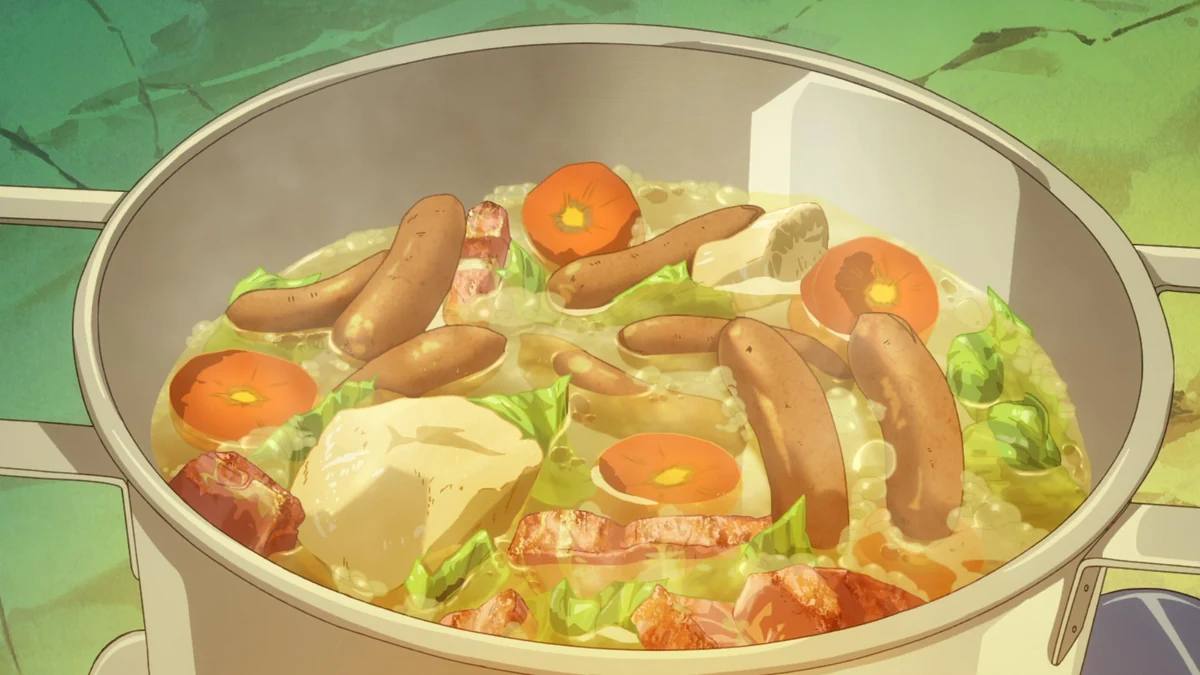
The dishes have different shapes and textures, rather than functioning as interchangeable rewards. The pot above has pale cabbage, rounded sausages and broth catching the light. Elsewhere, a huge cut of meat and a small portable stove make the scale of Mukohda’s task immediately funny. Familiar equipment sits beneath a creature large enough to dwarf the cook.
MAPPA’s adaptation, directed by Kiyoshi Matsuda, gives this domestic labour a conspicuous place in a fantasy adventure. The original production credits include a dedicated cooking-supervision role. The official site also links recipes and identifies cooperating food and household-product companies: the connection with ordinary shopping is part of the presentation.
Jose Arroyo’s first-season review for TheReviewGeek is particularly enthusiastic about the cooking animation, while finding some of the battles less impressive. That distinction is useful. The spectacle to anticipate is often something being made and eaten, rather than the biggest monster being defeated.
How does the journey develop?
New places bring hunting work, ingredients and people who need something. The second season continues that travelling meal-making life with the established companions and further additions. It is a continuation of the same adventure, so the first season is the place to begin.
The relaxed rhythm is also a meaningful limit. Arroyo finds the first season repetitive and thinks its powerful companions remove too much uncertainty. If you want a difficult battle to drive every episode, the next meal may feel like a delay. If you enjoy the routine itself, the preparation, the eating and the different appetites give the journey its character.
Relaxed does not mean free of blood. Monsters are hunted, injured and butchered, and Mukohda sometimes faces danger despite his reluctance. The warmth is in the company and the return to dinner, rather than a promise that nothing unpleasant appears.
Where should you start?
Begin with season 1, episode 1, from 2023, then continue into the 2025 second season. The official Japanese numbering carries on from episode 13 to episode 24; a service may instead label those as season 2, episodes 1–12. They are the same continuation, not a different starting point.
The two seasons contain 24 episodes. Allow about nine hours and forty minutes, using a rounded 24-minute planning allowance per episode. The BBFC lists the original season’s episodes at just under 24 minutes; this is an estimate for the viewing route, not a measured total for every edition. The novels and manga are separate versions and are not prerequisites.
What does the original-season trailer show?
The first promotional video introduces Mukohda, his food and the original travelling companions. Its release messaging belongs to the 2023 launch.
Original season · MAPPA · first promotional video. Opens YouTube.
Sources
Episode descriptions, product pages and reviews can reveal later events.
- Official first-season site, for the premise, character profiles, original production credits, episode gallery and first promotional video.
- Official second-season introduction and episode list, for continuation identity and episodes 13–24.
- Crunchyroll’s series listing, for the English series title and Online Grocery description. Catalogue access does not establish playback in a particular country.
- Apple TV’s episode 3 synopsis and episode 6 synopsis, for the guild registrations and food-related preparation for danger.
- Jose Arroyo, TheReviewGeek: season-one review, for the cooking-animation assessment and reservations about repetition and easy progress.
- BBFC episode advice and timings, for the original-season content guidance and the basis of the rounded viewing allowance.