
A detective enters a dream and finds himself inside scenes that borrow the excitement and anxiety of movies. He is usually the person expected to investigate other people. Here, Konakawa needs a guide. Paprika can move through this unstable territory with a confidence he cannot borrow simply by being a policeman.
This reversal gives Paprika something more particular than a machine for sharing dreams. Its capable adults keep encountering forms of experience that their usual skills do not master. A detective becomes a patient; a therapist adopts a playful persona; an inventor’s delight in possibility produces responsibilities his invention cannot discharge for him.
The dream chase is easier to care about when those changes remain in view. The film’s people are interesting partly because they do not enter its imaginative playground on equal terms.
Why does a detective need a guide through his own dreams?
Konakawa’s recurring dreams place him in recognisable cinematic situations, including a circus and a pursuit. The connection between dreams and movies gives him somewhere vivid to go, but being at the centre of an exciting scene does not mean knowing what it means. His unsettled experience turns the apparent privilege of starring in a movie into something closer to being trapped in a role.
Paprika’s usefulness begins with companionship inside that experience. The DC Mini allows a dream to be entered and recorded; it does not automatically make the dream legible to the person having it. Konakawa needs another participant who can travel through the images with him.
A detective’s professional task usually directs attention towards clues in the world. A patient has to bring something less easily managed into the room: an experience he cannot yet explain. That difference lets the film connect his case anxiety to vulnerability without reducing every dream object to a coded answer for the audience.
What can Paprika offer through play?
In waking life, Atsuko Chiba is a guarded researcher and therapist. In dreams she works as Paprika, whose quick, playful confidence gives help a different manner. The contrast is a practical relationship with a patient as well as a striking change in appearance and temperament. A clinical explanation and an imaginative companion do not offer quite the same kind of reassurance.
That makes play part of the work. Paprika can accept an impossible transition and keep moving. Konakawa cannot simply reason his way out of being bewildered. Watching their different degrees of ease gives the dream imagery a human scale: somebody can navigate a place that somebody else finds frightening.
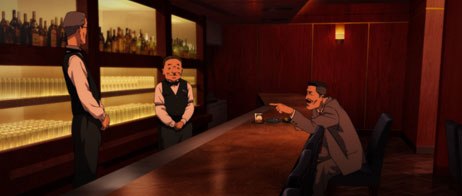
The bar image provides a quieter visual counterpart to the massed dream spectacle. One seated person gestures towards two attendants across a counter. Bottles and warm wood make a recognisable social arrangement. A dream film can make room for an exchange as well as for a chase; a pause with other people can be part of its imaginative appeal.
Chiba and Paprika also complicate any easy split between a sensible waking world and a frivolous dream world. Professional restraint is useful. So is the capacity to meet someone in a form that makes a frightening experience traversable. The question is how much of herself Chiba can allow each situation to require.
How does Tokita’s delight become a responsibility?
Kosaku Tokita’s ingenuity makes the shared dream possible. His fascination with what the machine can achieve places him at a different angle to Chiba, who must turn that possibility into work with people. Their partnership contains both dependence and frustration: she needs a capability that his invention provides, while the invention’s existence does not resolve the problems it creates.
A stolen prototype makes the mismatch urgent. A device conceived for treatment can allow someone to interfere with another person’s private imagination. The threat grows from something genuinely promising. Removing the promise would make the theft less consequential.
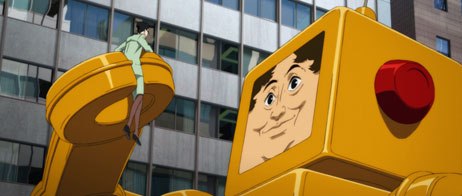
The giant toy robot is a useful image beside Tokita’s invention. Its familiar form belongs to play, but its street-filling scale makes it impossible to treat as a harmless small object. Buildings and a tiny human figure give the enlargement something to be measured against. The pleasure of making an idea enormous sits beside the difficulty of living with the result.
Do the characters have enough room inside the spectacle?
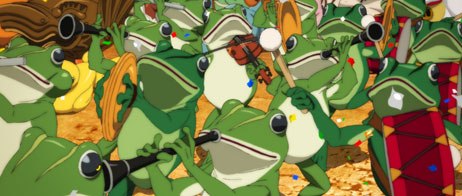
The frog band supplies another recognisable pattern for an impossible sight. Brass instruments, a drum and rows of performers organise the crowd as a parade. Absurdity has a structure that the eye can follow even when it cannot explain why these things belong together.
Kon described a long process of adapting and visualising the film in Gregory Singer’s AWN interview: about half a year on the script with Seishi Minakami, followed by a year of storyboarding. The apparent freedom of the images came through selection and construction. That production history cannot guarantee that every character receives enough space.
The distinction appears in a Paprika discussion. Its enthusiastic author praises the characters but finds an antagonist underdeveloped. In the replies, ItsMagicalSteve calls a later relationship forced; the author disagrees about how it was prepared. Another viewer finds an unconventional attraction appealing. Those responses show the difference between enjoying the visual invention and believing every emotional turn has been earned. No ending details are needed to acknowledge that reservation.
Konakawa supplies a strong way back to the individual within all that invention. He enters the film carrying a problem and needs somebody whose imagination can accompany his. Following that exchange gives the dream chase an emotional direction even when the next doorway refuses to lead where waking experience says it should.
Sources
- Sony Pictures’ official film page, for the dream-entering/recording device, theft and recovery premise.
- Gregory Singer’s interview with Satoshi Kon for Animation World Network, for the adaptation, co-writing and storyboarding process, Chiba/Paprika premise and the three published stills. Its photo credit names Madhouse and Sony Pictures Classics.
- Sony Pictures Classics press kit and Paul Jackson’s Midnight Eye account, for the character roles and early dream/movie situations; both discuss later events.
- WT discussion and replies, the specific qualified response and a contrasting personal reaction, checked 26 October 2026. These are individual readings, not proof of authorial intent.