
Sui lives in a dark storehouse because something is wrong with her eyes. Biki, a boy related to her, cares for her. Before Ginko can explain the unfamiliar life affecting her sight, the second episode of Mushishi has already established something a diagnosis alone cannot describe: two young people have a daily relationship organised around an illness.
That is how this episodic series can make a brief visit matter. Ginko arrives with knowledge, equipment and the possibility of help. The people he meets have been living with one another before his arrival. Their attachments make the encounter more than a case for a travelling expert to solve.
The original 2005–2006 series keeps changing those people. It does not need to become a continuous quest for their situations to accumulate weight. Three early encounters show how a question about mushi can also be a question about caring for somebody, trusting one’s experience or choosing where to belong.
What does Sui’s darkness mean for Biki?
The setting of Sui’s story gives care a material shape. A dark storehouse is a place set apart from ordinary daylight and activity. Biki’s attention connects Sui to someone outside that enclosure. Her condition affects what she can do, but also what he does for her.
Light behind closed eyelids becomes part of the mystery. That gives Ginko a specific disturbance to investigate. It also complicates the comfort usually attached to light: illumination need not be straightforwardly safe or helpful to someone whose sight has become unfamiliar.
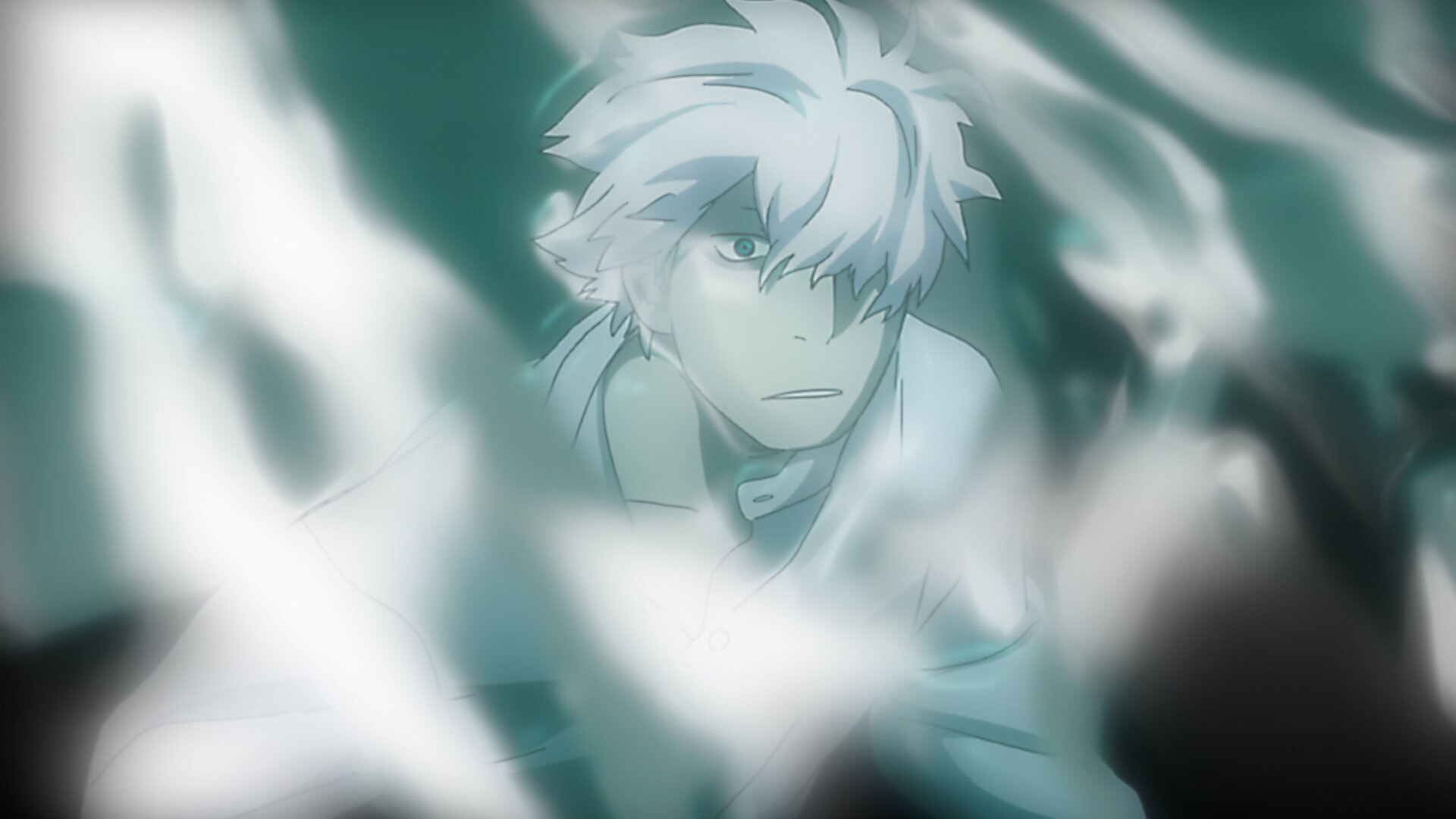
The emotional interest sits beside the strange phenomenon. Biki does not need to understand a classification of mushi to want Sui helped. Ginko’s explanation can supply knowledge that care alone cannot, while that care gives his work a purpose beyond collecting an unusual observation.
It is worth keeping both forms of attention in view. If the episode were only about a specialist knowing more than everyone else, the people waiting for his answer would become illustrations. Sui and Biki make the investigation matter because there is a relationship under pressure, not simply because the condition is rare.
Why does predicting tomorrow exhaust Jin?
In episode four, Jin, a blade sharpener, is troubled by dreams that appear to predict events. Prediction sounds like an advantage when described from outside a life. For the person having the dreams, it raises a harder question: what is he supposed to do with that knowledge?
A craft built around sharpening a blade has a tangible relationship between action and result. Prophetic dreams offer no such comfortable connection. Knowing something may happen is different from choosing it, preventing it or understanding why it has entered one’s sleep. Jin’s exhaustion places the supposed gift inside a body that still has to get through the day.
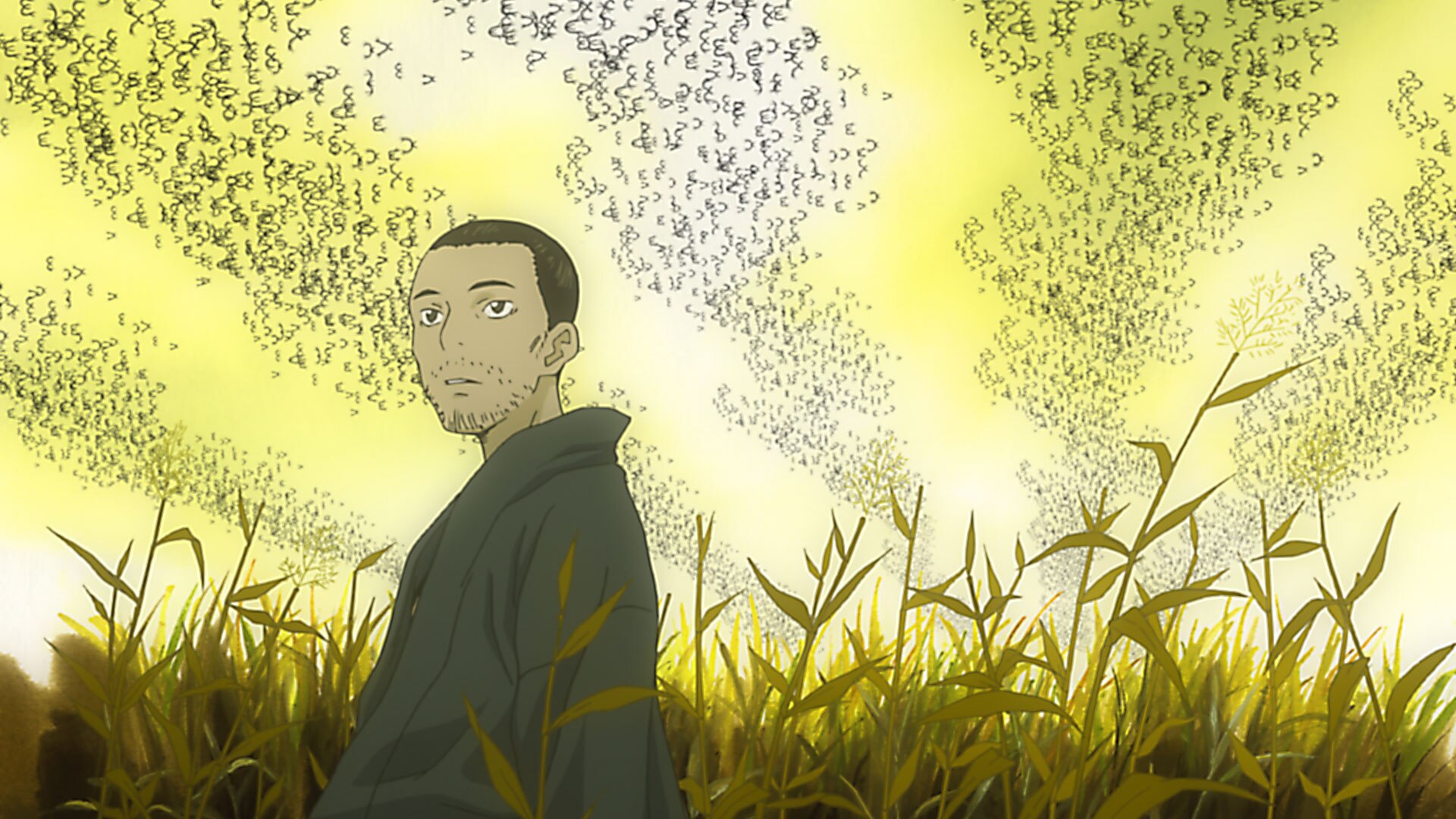
Ginko therefore meets a person already trying to interpret his own experience. Naming a phenomenon might explain its source, but cannot by itself tell Jin how to live with what he believes he knows. The pressure comes from having a future seem close enough to recognise and still beyond one’s control.
This is one of the gains of the short encounter. The series can concentrate on a particular predicament without needing it to become a new stage in Ginko’s personal advancement. For the duration of the story, the blade sharpener’s difficulty is sufficient reason to stay.
How does Io’s wish complicate Ginko’s help?
Episode five places Ginko beside Io and a moving swamp. Io wants to accompany it. The surprising part is the wish to remain with something Ginko is trying to understand. An unfamiliar form of life may be dangerous or difficult to explain and still be something a person feels attached to.
That wish changes the terms of help. Returning everybody to an ordinary village life cannot be assumed to be the answer they all want. Ginko must attend to Io’s relationship with the swamp as well as to the swamp itself. Her desire makes the encounter a negotiation with a person, rather than a problem in removing a hazard.
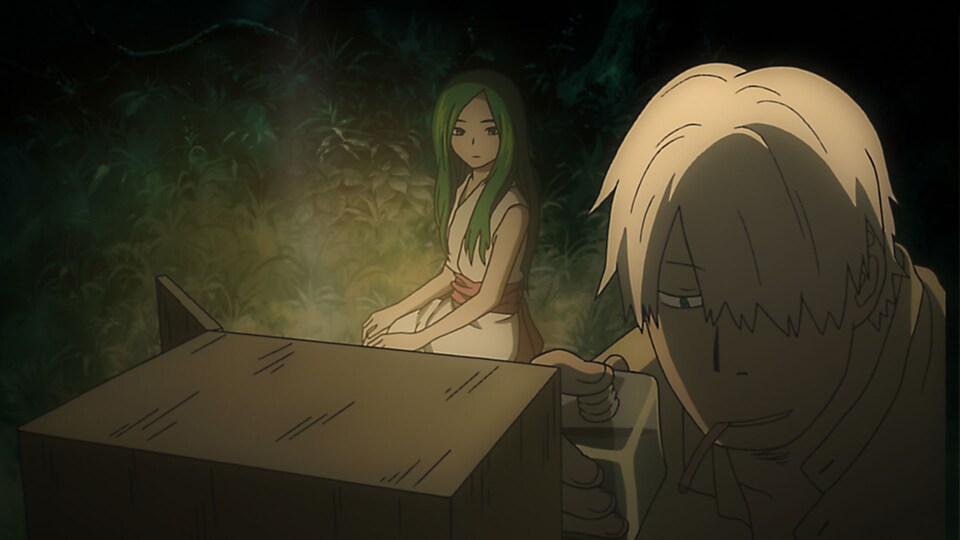
The image keeps both figures within the same dark woodland while giving them different positions. Ginko has his travelling box close at hand. Io sits behind him. The composition can hold an expert’s practical readiness and another person’s attachment without proving that they share a destination.
Io’s wish complicates the role of a wandering rescuer. A person who wants to remain with the unfamiliar may see departure as another loss. Help requires listening to that attachment, even when the specialist has reasons to be concerned.
What carries on after an episode ends?
In a discussion about whether to continue, MaridKing calls the early slow, episodic form representative while personally admiring it. Planatus666 recommends spacing episodes and describes finding a better moment to return. Those are useful expectations, rather than a rule about the correct way to watch.
The rhythm will not satisfy every reader. Someone who wants the next instalment to advance a central conflict may find the repeated arrival and departure frustrating. Promising a later transformation into a serial adventure would misrepresent the invitation.
But the encounters themselves contain continuity of another kind. Someone is living in the dark; someone is looking after her. Someone is exhausted by a future he did not ask to see. Someone wants to travel with an unfamiliar landscape. Ginko’s knowledge meets those wants, and the next village gives him another set.
Calling the series relaxing can describe a viewer’s response to its pace and atmosphere. It does not make Sui’s illness, Jin’s exhaustion or Io’s difficult attachment painless. The quiet leaves room to notice what these people are carrying. Each new arrival asks us to give somebody else that attention again.
Sources
- Marvelous’ original-series episode archive: episode 2, episode 4 and episode 5, for the distinct situations and named characters discussed here.
- Bandai Channel’s original-series listing, for the original 26-episode scope.
- MaridKing’s pacing response and Planatus666’s different viewing experience, checked 26 October 2026. Personal reactions and suggestions, not required viewing instructions.