
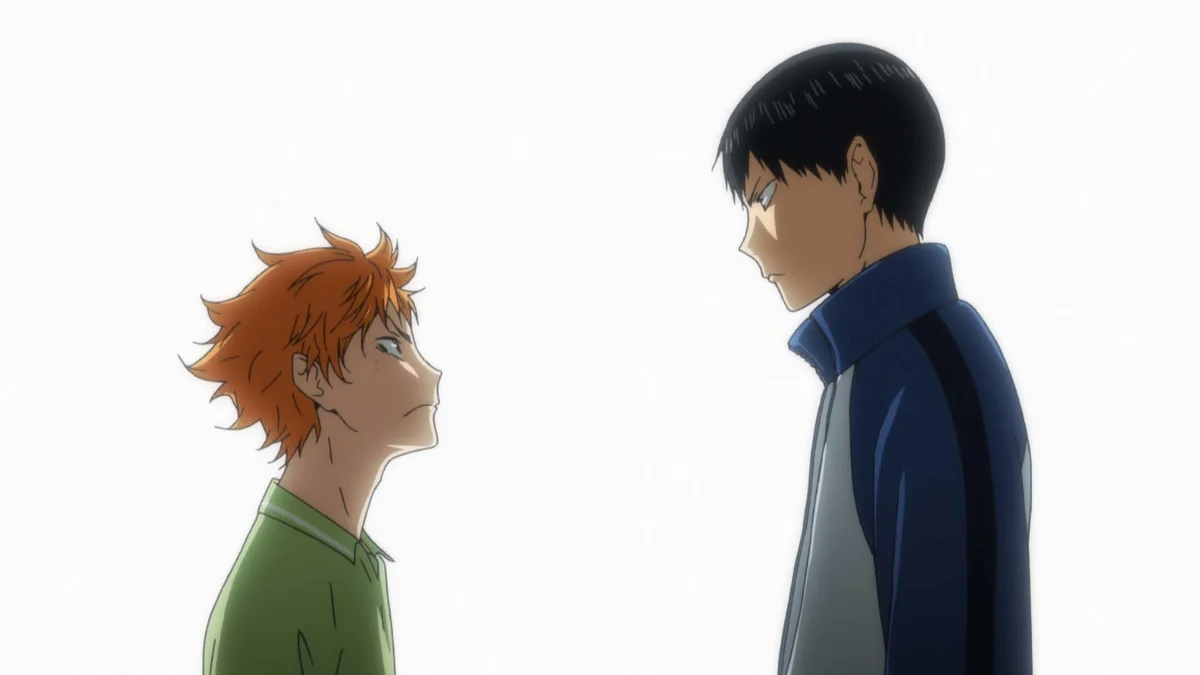
Shoyo Hinata is short for a volleyball player, but his first obstacle is not a height chart. After seeing Karasuno’s “Little Giant” play, he wants to compete at the same school. His middle-school team has too few experienced players, and its loss to Tobio Kageyama becomes the beginning of a rivalry neither boy can leave behind.
What if your rival is on your side of the net?
Hinata reaches Karasuno expecting another chance at the setter known as the King of the Court. Instead, Kageyama has enrolled there too. Their first contest is over whether they can behave like members of the same club. Captain Daichi has a team to run and an ambition beyond refereeing a personal feud.
The school can impose consequences before a tournament ever begins. A volleyball in the vice-principal’s face turns the pair’s private competition into a problem for the club. The incident is funny because the sporting obsession has collided with somebody who is not participating in it. Getting into the gym does not make the rest of the school disappear.

Image credits
Haikyu!!
(C)古舘春一/集英社・「ハイキュー!!」製作委員会・MBS
Image sourceHow can Hinata hit a ball without looking?
The early difficulty is blunt. Hinata wants Kageyama to set the ball for him to spike, but his own receiving is poor. Kageyama initially refuses. Hinata has speed and jumping reach; wanting to make the final strike has not made him a complete player. Kageyama can place the ball accurately, but that ability is not yet a working relationship.
As they struggle with a quick attack, senior setter Sugawara challenges Kageyama to pay attention to his teammate as well as the opposing blockers. The solution asks a great deal of both boys. Kageyama calculates Hinata’s approach, speed and leap, sending the ball to the place his hand will reach. Hinata commits to the jump and hits with his eyes closed. When Daichi points that out, the other players react with surprise.
That is a wonderfully particular answer to their mutual distrust. The boy who wanted to defeat Kageyama gives up watching the ball and relies on his set; the setter has to build the attack around Hinata’s movement. Their speed is exciting because it makes the dependence so exposed. The ball must arrive where a jumping person needs it, not where the setter would prefer him to be.

Image credits
Haikyu!!
(C)古舘春一/集英社・「ハイキュー!!」製作委員会・MBS
Image sourceSugawara’s intervention matters as much as the astonishing hit. The pair’s talent becomes something other players can question and help, rather than a private contest the club merely watches.
Does the story care about the other side of the net?
A match needs opponents whose choices change what Karasuno can do. Reviewing the tournament half of season one, Anime UK News critic Demelza praises the attention given to opposing players and the way matches develop their characters. Her reservation about the limited attention given to female managers belongs beside that praise: an expanding team story does not distribute its interest evenly.
The opening partnership gives a useful way into those matches. Hinata’s height is a real constraint, but it does not dictate only one possible attack. Discovering a solution creates the next interesting question: what happens when someone across the net can read it? The pleasure is in that conversation between a particular move and the people trying to stop it, rather than simply waiting for the protagonists to want victory more.

Image credits
Haikyu!!
(C)古舘春一/集英社・「ハイキュー!!」製作委員会・MBS
Image sourceHow much of Haikyu!! is included?
Start with season one, episode one, and follow the four TV seasons through To the Top, 85 episodes. OADs and OVAs, puppet shorts and recap films are extras. The 2024 film The Dumpster Battle continues the story after these television seasons.
Technique, teamwork and opposing characters all matter in this sports story. The separate film is a next step after the television route, not a substitute for the full four-season setup.


